Common questions. Straight answers.
Most of what homeowners ask before they hire us. Do not see your question? Call us at the number in the header.
Pricing and estimates
How much does a concrete driveway cost in San Diego?
Standard tear-out and replace driveways with broom finish run $8 to $15 per square foot. A typical 600 square foot two-car driveway lands at $5,000 to $9,000. Stamped concrete adds 30 to 60 percent. RV and boat-grade reinforced sections add another 20 to 30 percent.
How much does a concrete patio cost?
Patios run $10 to $20 per square foot depending on finish and access. A 400 square foot broom-finish patio lands at roughly $4,000 to $6,000. Stamped or aggregate finishes run $7,000 to $11,000 for the same footprint.
Do you charge for an estimate?
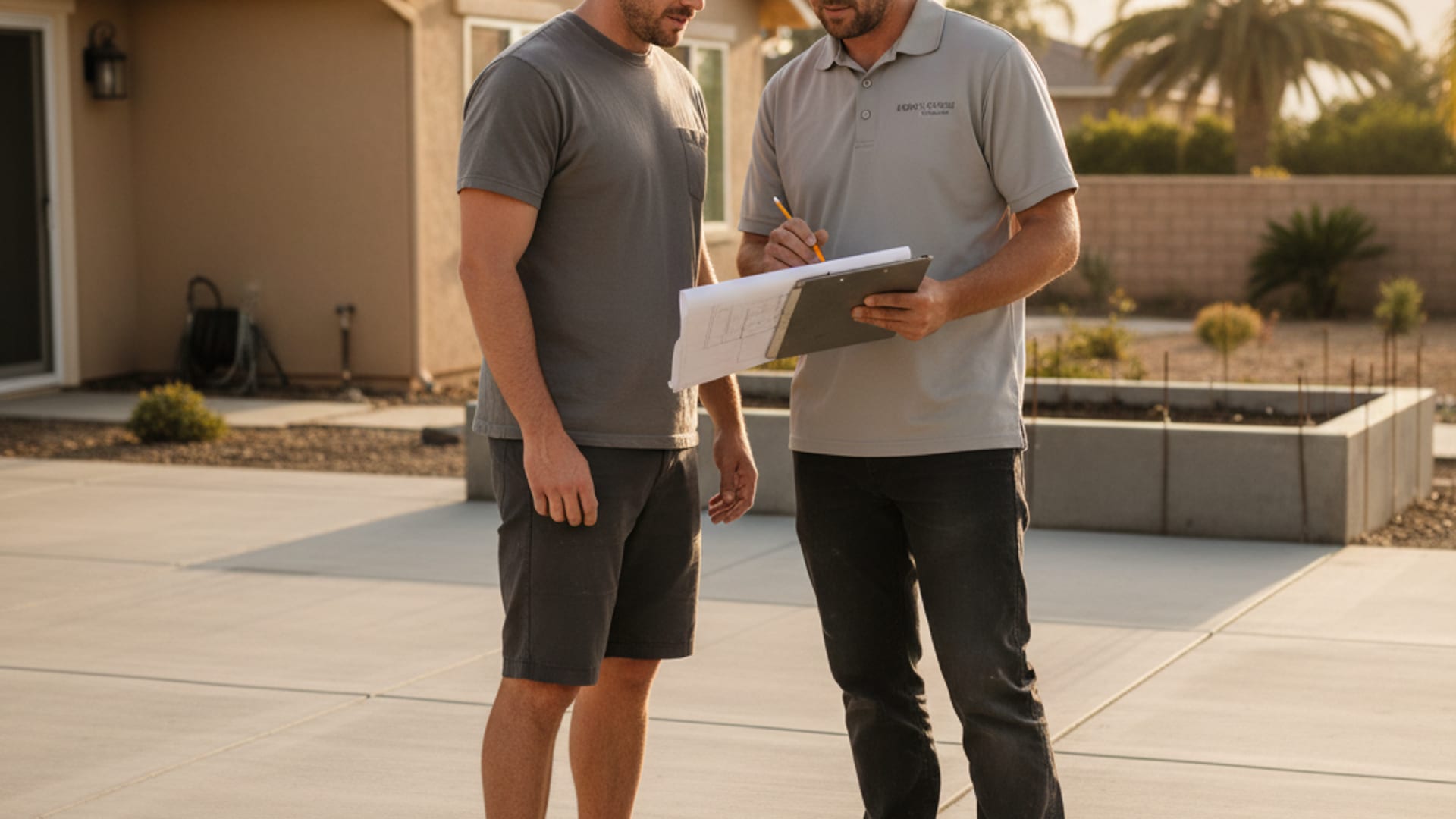
No. Onsite estimates are free across San Diego County. We walk the project, take measurements, and send a flat-rate quote within 48 hours.
Do you require a deposit?
Yes. A 25 to 33 percent deposit is standard once the contract is signed and we order materials. Final payment is due on completion. We do not collect cash up front for jobs that have not been scoped.
Project timing and scheduling
How fast can you start a project?
Most new pours start within 2 to 4 weeks of estimate. Repair and crack work is usually scheduled the same week. Foundation projects with permits and inspections take longer because of inspection lead time, typically 4 to 8 weeks total.
How long does a driveway pour take?
Demo and base prep is one day. Forming and rebar is a half to one day. The pour itself is one day. Cure time before walking is 24 hours, before driving is 7 days, full strength at 28 days. Total project window: 2 to 3 days on site, 7 to 28 days before full use.
When can I drive on new concrete?
Cars and light vehicles after 7 days. RVs, dumpsters, and full-strength loads after 28 days. Driving on fresh concrete is the fastest way to crack a slab and we will not approve early use on our pours.
Do you work in winter?
Yes. The pros we send pour year-round in San Diego. Coastal and central locations rarely see weather that stops a pour. Backcountry and mountain communities (Julian, Pine Valley) sometimes need to wait out a freeze, but we use air-entrained mixes that handle cold cure.
Permits, inspections, and licensing
Are the pros you work with insured?
Yes. The concrete pros we match you with carry general liability and workers compensation coverage. Ask them for a current certificate of insurance before work starts.
When does a project need a permit?
Foundations almost always need permits. Retaining walls over 4 feet need engineering and permits. Driveway approaches into the city right-of-way need encroachment permits. Standard private patios, walkways, and driveway replacements (without changing footprint) usually do not. We tell you up front during the estimate.
Do you handle the permit paperwork?
Yes. We file with the appropriate jurisdiction (city, county, or HOA), schedule inspections, and pour after the rebar inspection passes. Permits are part of the bid, not a surprise add-on.
Will my project pass inspection?
The pros we send pour to engineer drawings and code. We have not failed a rebar inspection in years. If something is borderline, we call the inspector before the pour, not after.
Concrete process and materials
How thick should my concrete be?
Walkways: 4 inches. Patios: 4 inches. Driveways for cars and light trucks: 4 inches. Driveways for RVs, boats, or commercial vehicles: 5 to 6 inches. Foundations: per engineer. We do not pour 3-inch concrete on residential work.
Do you use rebar or wire mesh?
Rebar on driveways, foundations, and any slab over 100 square feet. Wire mesh on narrow walkways under 3 feet wide. Mesh is not a substitute for rebar on driveways.
What PSI concrete do you use?
3,000 PSI for standard residential work. 4,000 PSI for driveways with heavier loads, RV pads, and exposed aggregate work. Foundations follow the engineer spec, typically 3,000 to 4,500 PSI.
Why do you saw-cut control joints?
All concrete cracks somewhere. Saw-cut joints (within 24 hours of pour) tell the slab where to crack. Cracks land in the joint, invisible to the eye, instead of running across the middle of your driveway.
Repair, sealing, and maintenance
Can you repair my cracked driveway?
Usually yes. Cosmetic cracks (under a quarter inch) get sealed with a flexible joint sealant. Settlement cracks need polyurethane lift to bring the slab back to grade. Structural cracks running through control joints usually need tear-out and replace. We diagnose first and recommend the cheapest fix that holds.
How often should I seal my concrete?
Penetrating silane sealers last 5 to 10 years. Topical acrylics last 2 to 3 years. Stamped concrete should be resealed every 2 to 3 years to keep color rich. Coastal driveways benefit from resealing every 5 to 7 years.
Why is my concrete spalling?
Spalling (surface flaking) is usually salt damage on coastal slabs, finishing too late in the cure window, or rebar rust pushing concrete off from below. The fix depends on cause, surface patch for finishing issues, partial pour for rebar rust, replacement for widespread salt damage.
Can sunken concrete be lifted?
Yes. Polyurethane foam lift or mudjacking can raise sunken slabs back to grade in a few hours, at 25 to 40 percent of replacement cost. Heaved slabs (going up instead of down) cannot be leveled, those need root or soil cause removal.
Ready for concrete service that actually answers the phone?
Call for a free onsite estimate. Same-week scheduling on most concrete work.