If you are building an ADU in San Diego County, the foundation question gets settled early because it shapes the whole project: cost, schedule, drainage, plumbing, and resale flexibility. Most San Diego ADUs land on one of two foundations: slab-on-grade or stem-wall. Here is how to pick.
What’s the difference?
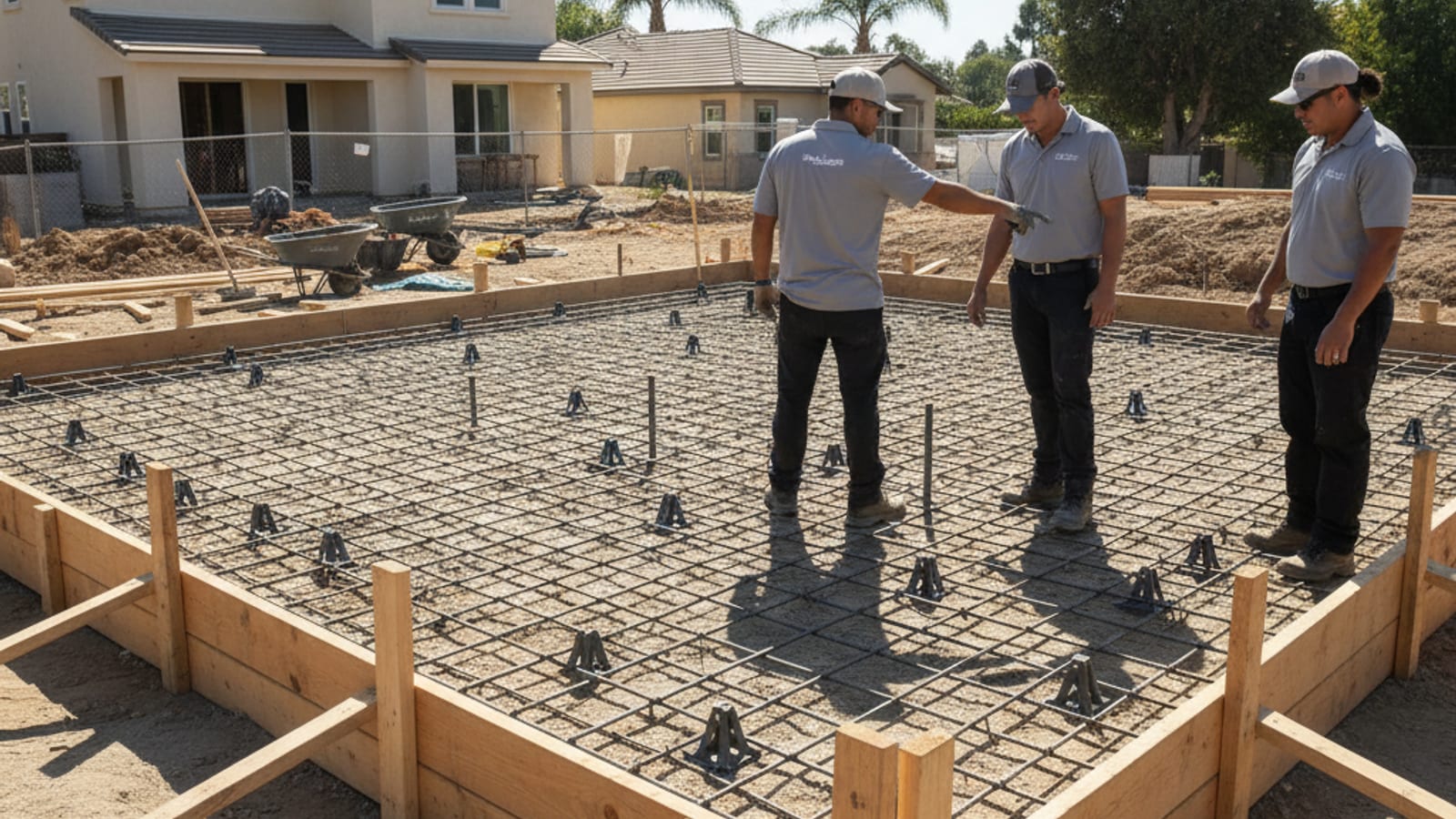
Slab-on-grade is a single concrete pour that combines the foundation, the floor, and (in stiffened-edge designs) the perimeter footing. The structure sits directly on the slab, with anchor bolts cast into the concrete and stub walls built up from there. No crawl space.
Stem-wall is a poured concrete or CMU (concrete masonry unit) wall sitting on a continuous perimeter footing, with the floor system framed inside the wall as a separate platform. There is a crawl space between the soil and the floor.
Each has trade-offs that matter for ADUs.
When slab-on-grade is the right call
Slab-on-grade is faster, cheaper, and flatter. It is the standard for most San Diego ADUs.
Pick slab-on-grade when:
- The lot is reasonably level. No more than 1 to 2 feet of grade change across the building footprint.
- The soil is suitable. A geotech report (often required by your jurisdiction) confirms the bearing capacity. Most San Diego County soils are fine for slab-on-grade with thickened-edge details and proper rebar.
- You are comfortable with no crawl space. Plumbing runs are buried in the slab or stub up through it. Once the slab is poured, those runs are committed.
- You want lower total cost. Slab-on-grade typically saves $4,000 to $8,000 on a 600 to 1,200 square foot ADU compared to stem-wall.
- You want faster construction. Slab-on-grade saves a week or two on the schedule.
Slab-on-grade ADU costs in San Diego in 2026:
- 400 to 600 square foot ADU (junior ADU): $12,000 to $20,000 for the foundation.
- 700 to 1,000 square foot detached ADU: $18,000 to $30,000.
- 1,000 to 1,200 square foot detached ADU: $24,000 to $38,000.
Costs vary with soil report findings, rebar schedule, footing depth, and any required over-excavation. Inland clay soils typically run 10 to 20 percent more than coastal sandy soils.
When stem-wall makes sense
Stem-wall is the right call when the lot or design demands it.
Pick stem-wall when:
- The lot slopes. A stem-wall can step up the slope while keeping the floor level. Trying to slab a sloped lot means significant cut-and-fill or import grading.
- You want a crawl space. Easier access for plumbing changes, utility runs, and future repairs. Some homeowners prefer this for long-term flexibility.
- The architectural style requires it. Some Craftsman and Spanish ADU designs read better elevated 12 to 24 inches above grade.
- The soil is expansive enough that a deep, isolated footing is preferable to a wide thickened-edge slab.
- You are connecting to the main house with a matched foundation type.
Stem-wall ADU costs in San Diego in 2026:
- 400 to 600 square foot ADU: $16,000 to $26,000 for the foundation system.
- 700 to 1,000 square foot ADU: $24,000 to $38,000.
- 1,000 to 1,200 square foot ADU: $32,000 to $50,000.
Stem-wall costs more because it involves more concrete (continuous footings, walls), more rebar, more form work, more excavation, and the floor system on top.
What the soil report actually changes
San Diego County requires a soil report (geotechnical investigation) for new structure foundations in most jurisdictions. The soils engineer takes core samples, measures bearing capacity and expansion index, and writes a report that specifies:
- Bearing capacity (in pounds per square foot), which sets footing width.
- Expansion index, which sets thickened-edge depth and rebar schedule for slab-on-grade, or footing depth for stem-wall.
- Moisture barrier requirements: vapor barriers, sand layers, foam board insulation.
- Over-excavation. If native soil is unsuitable (loose fill, organic material), a depth of removal and replacement with engineered fill.
The soil report typically costs $1,500 to $3,500 and is non-negotiable for permits in most San Diego cities. A foundation built without a soil report is a foundation a bank may not finance and a buyer may not accept.
The differences between a “standard” foundation and a foundation with adverse soil conditions can be significant. Highly expansive clay (expansion index over 90) might require:
- Deeper footings: 24 to 36 inches instead of standard 18.
- Heavier rebar: #5 bar instead of #4, on tighter centers.
- Over-excavation: 24 to 36 inches of unsuitable soil removed and replaced with compacted fill at $4 to $8 per square foot of footprint.
If your soil report comes back with adverse conditions, the foundation cost can jump 30 to 60 percent above standard estimates. Plan for it during budget conversations.
Permits, inspections, and the schedule
ADU foundations in San Diego County require permits. The typical sequence:
- Geotechnical investigation: 2 to 4 weeks.
- Architectural and structural drawings: 4 to 8 weeks (concurrent with geotech).
- Permit application: 2 to 6 weeks for most jurisdictions, longer in coastal zones.
- Foundation excavation and forming: 3 to 5 days.
- Rebar layout and inspection: 1 to 2 days plus inspection scheduling (2 to 5 days for inspector availability).
- Concrete pour and finishing: 1 to 2 days.
- Cure and stripping forms: 5 to 10 days before framing can start.
Total time from “I want to build an ADU” to “the foundation is cured and ready to frame” is typically 3 to 6 months.
What ADU foundation contractors should include in a bid
A complete ADU foundation bid covers:
- Excavation and over-excavation per the soil report.
- Compaction and density testing when required.
- Forming to architectural drawings.
- Rebar per structural engineer schedule.
- Anchor bolts placed per structural drawings, embedded to spec.
- Vapor barrier and sand layer per geotech.
- Concrete placement at specified PSI (typically 3,000 to 4,000).
- Inspections: foundation, rebar, post-pour as required.
- Permits, included or itemized separately.
- Cleanup and stripping of forms, removal of excess fill.
A bid missing inspections, permits, or rebar inspection scheduling is incomplete. Foundations are not the place to discover scope gaps three weeks into construction.
Common ADU foundation mistakes
Three things that cause expensive problems mid-project:
Skipping the soil report. Some contractors will pour without one to save time and money. The bank financing the construction may not approve a foundation poured without an engineered geotech report. The home you build on it may have appraisal and insurance issues at sale.
Cutting rebar to win the bid. Reducing rebar from #5 to #4 or stretching center spacing from 12 inches to 16 saves a few hundred dollars and weakens the foundation enough to fail inspection or fail in service.
Over-excavating without a plan. When unsuitable soil is found, the right answer is engineered fill compacted in lifts to the required density. The wrong answer is dumping any available dirt and pouring on top, which leads to settlement and cracking within five years.
Get an ADU foundation estimate
Onsite ADU foundation estimates are free. We coordinate with your designer or engineer, schedule the soil report if needed, file permits, and pour to spec. Call (858) 925-5546 or use the contact form to start the conversation.