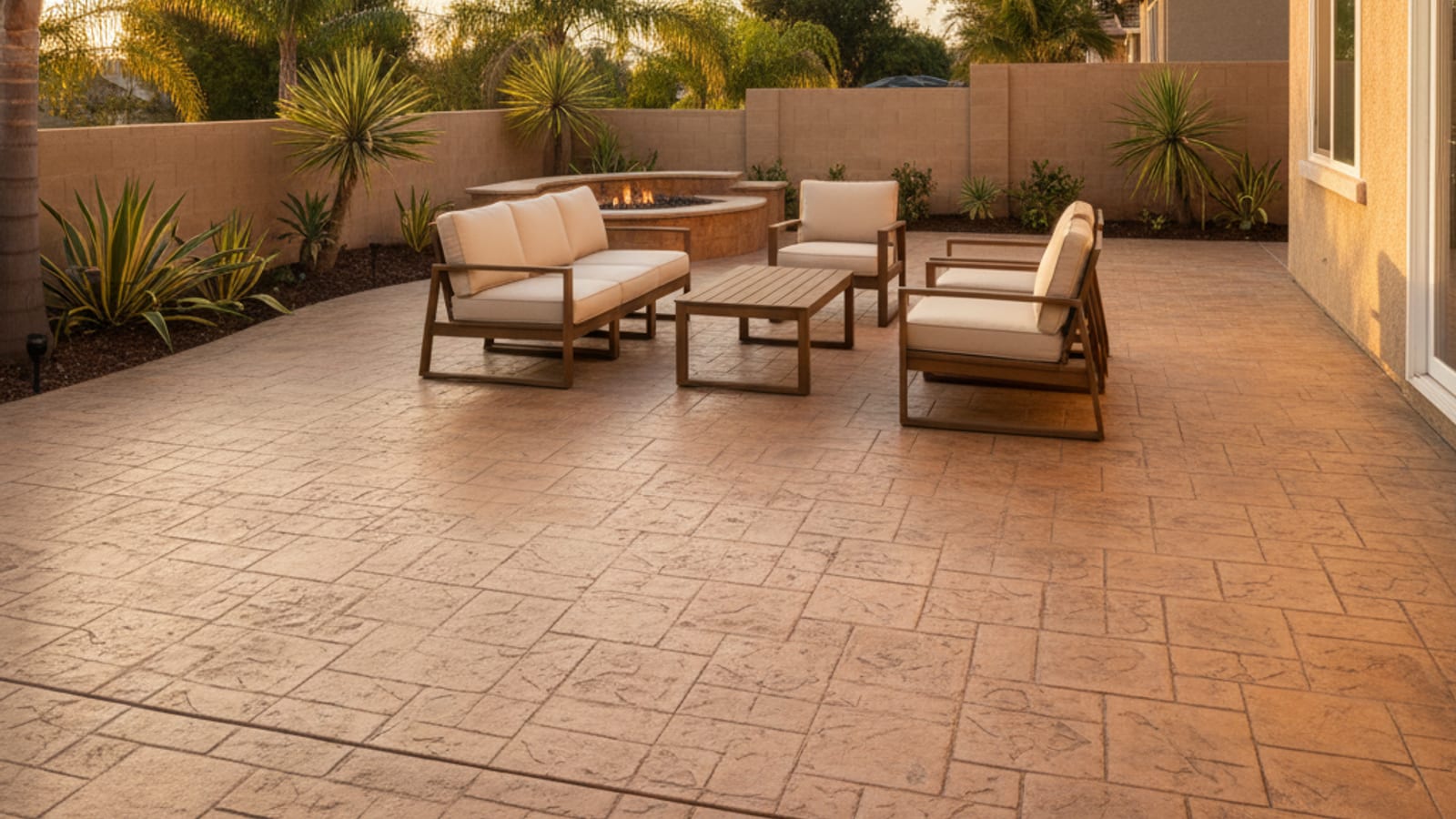
A concrete patio is the most cost-effective way to turn unused yard into usable outdoor living space. The tradeoff is finish: a broom-finish patio is the cheapest option but reads as utility concrete. A stamped or aggregate patio costs more but ages better and adds resale value. Here is how the pricing actually works in San Diego County in 2026.
What does a concrete patio cost in San Diego?
Concrete patios run $10 to $25 per square foot depending on finish, access, and footprint complexity:
- Broom finish, integral color: $10 to $16 per square foot
- Salt or wash finish: $12 to $18 per square foot
- Stamped concrete with one or two colors: $15 to $22 per square foot
- Exposed aggregate: $13 to $20 per square foot
- Polished concrete: $18 to $30 per square foot
A 400 square foot backyard patio (about 20 by 20 feet) lands at:
- Broom finish: $4,000 to $6,400
- Stamped: $6,000 to $8,800
- Aggregate: $5,200 to $8,000
Larger patios benefit from economy of scale. A 600 square foot patio costs less per square foot than a 200 square foot patio because mobilization, forms, and finishing labor scale slower than material.
What’s actually in a real concrete patio bid
A complete patio bid covers:
- Site prep. Clearing existing pavers, sod, or planter areas. Grading to drain away from the home.
- Base prep. Compacted Class II road base, 4 inches minimum, plate-compacted in lifts.
- Forms and edging. Lumber forms set to grade with proper slope. Curved edges add labor.
- Reinforcement. #3 or #4 rebar grid, or fiber-reinforced concrete for slabs under 200 square feet.
- Concrete placement and finishing. 3,000 to 4,000 PSI mix, hand-screed, bullfloated, troweled, finished to spec.
- Saw-cut control joints. Within 24 hours of pour.
- Curing and protection. Especially in summer when San Diego heat speeds the cure.
- Optional sealing. Recommended at 28 days, often quoted as a separate line.
A bid that comes in dramatically cheaper than the rest usually skips reinforcement, base prep, or both. Both are what make a patio still look right ten years from now.
Which finish is right for your home?
The finish question has two parts: visual fit and practical use.
Broom finish is grippy underfoot, ages well, and is the easiest to clean. It is the right call for casual yards, pool deck approaches, and homes where the patio is functional rather than decorative. Color it with integral pigment for a richer look, or leave it gray for a clean modern read.
Stamped concrete mimics flagstone, slate, brick, or wood at a fraction of pavers’ cost. Best for entertaining patios visible from inside the home, Spanish or Mediterranean architecture, and resale-grade properties. Tradeoff: it is slightly slick when wet (we add non-slip aggregate to the sealer to fix that), and color fades without regular sealing.
Salt or wash finish is the under-rated middle ground. Texture, character, and slip resistance without the cost of stamped. Reads coastal-California right.
Exposed aggregate is durable, slip-resistant, and rich in character. It works especially well around pools and on driveways that double as patio space. The aggregate (river rock, granite, beach pebble) sets the tone, so pick stones that match the home’s palette.
Polished concrete is high-end modern. Best for indoor-outdoor flow with adjacent polished concrete inside. Higher maintenance, higher cost, but stunning when done right.
Why patio cost varies so much across San Diego
The same 400 square foot patio can cost $4,000 in one job and $9,000 in another. The variables:
Access. A backyard with a wide gate and clear driveway gets the ready-mix truck within 50 feet. A backyard requiring a concrete pump (line of sight blocked, second-story restriction, narrow side yard) adds $400 to $1,500 to the pour. Wheelbarrow-only access through a 36-inch gate adds labor hours.
Tear-out scope. Replacing existing concrete or pavers costs more than pouring on dirt. Brick patios with dry-set joints come up easy; mortar-set tile or aggregate-bedded slabs are slower.
Slope and drainage. A flat lot is straightforward. A lot that needs significant grading, drain installation, or wall integration adds engineering time and cost.
Tie-ins. A patio that ties into an existing slab, deck, or pool coping needs careful joint isolation. A standalone patio is simpler.
Finish complexity. Single-color broom is fast. Two-color stamped with multiple patterns and a stamped border is meaningful additional labor on the same square footage.
What stamped concrete actually costs to maintain
Stamped concrete is a long-term investment that requires upkeep to age well. Plan for:
- Resealing every 2 to 3 years. $0.75 to $1.50 per square foot. A 400 square foot patio is $300 to $600 every couple of years.
- Periodic cleaning. Pressure wash before each reseal.
- One major refresh at year 10 to 15. Light grinding and recoat to refresh color, $3 to $6 per square foot.
Total cost of ownership over 25 years: roughly 30 to 40 percent more than the install price. Most homeowners recover that and more in resale value, especially in coastal North County.
Common patio mistakes we see
A few things homeowners regret six months in:
Pouring too thin. 4 inches is the residential minimum. Some contractors bid 3 inches to win on price. The slab cracks within a year.
No control joints. All concrete cracks somewhere. Saw-cut joints tell the slab where to crack so it stays invisible. A patio without joints will crack diagonally across the field.
Wrong slope. A patio must slope away from the house at minimum 1/8 inch per foot. Flat patios pond water against the foundation and rot stucco.
Skipping the foundation isolation joint. A patio butted directly against the home’s foundation with no flexible joint will crack at the wall when either side moves. The isolation joint is a 30-cent piece of foam that prevents thousands in repair.
No sealer. Especially on stamped concrete. Without sealer, color fades within 3 years and stains permanent.
Cheap stamp pattern. Generic flagstone stamps look like generic flagstone. Pick a pattern that matches the home’s architecture and a stamp set the contractor has actually used before.
When to call for an estimate
The best time to plan a patio is 8 to 12 weeks before you want it finished. That gives time for design, finalized scope, the bid process, scheduling, and the pour itself. Spring and fall are our busy seasons in San Diego. Summer and winter slots are easier to book.
Onsite estimates are free across the county. We walk the project, take measurements, identify drainage and access issues, recommend a finish that matches the home, and quote flat-rate within 48 hours. Call (858) 925-5546 or use the contact form to book.