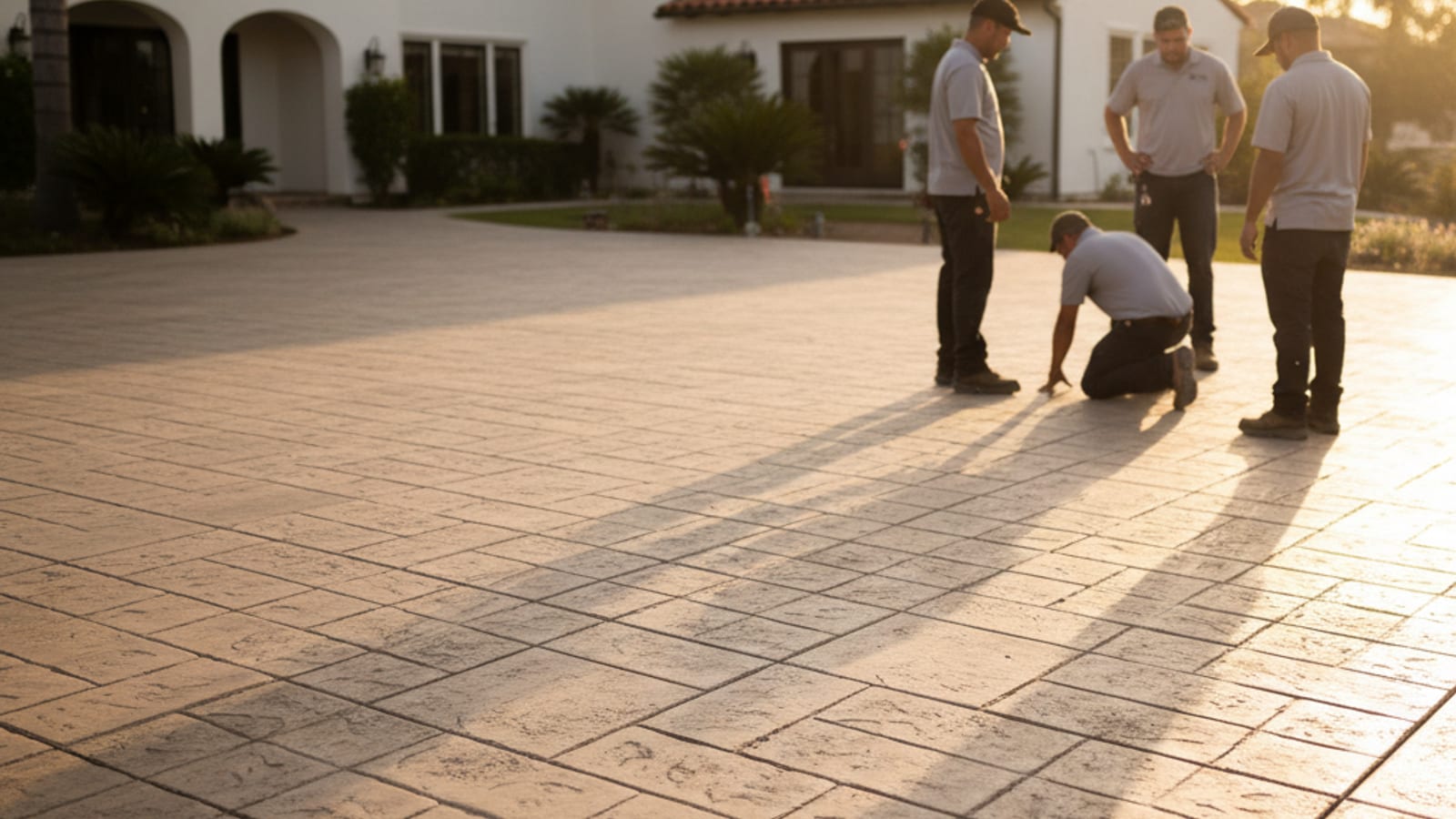
Stamped concrete gets you the look of flagstone, slate, brick, or wood at a fraction of the cost of pavers and a fraction of the maintenance. The work that makes a stamped patio look right ten years in is mostly invisible: pattern fit to the architecture, color choices that age well, and a contractor who has poured the pattern enough times to read the cure window.
Here is how to think about pattern, color, and finish for a stamped patio or driveway in San Diego.
Match the pattern to the home
The single biggest mistake we see on stamped concrete is a pattern that fights the architecture. A few combinations that work, and a few that do not.
Spanish, Mediterranean, and Hacienda homes look right with cobblestone, random flagstone, ashlar slate, or tumbled stone patterns. Warm earth tones work best: terra cotta, sand, soft browns. These homes have texture and character built in, and the patio should match.
Modern and contemporary homes want large-format patterns: oversized slate, plank wood-grain, or single-color smooth-troweled finishes with a stamped border. Cool grays, warm whites, and graphite tones.
Craftsman and bungalow styles work with brick patterns or smaller-scale flagstone. Moderate tones suit them: warm tan, rust, soft red. Avoid anything too uniform or too modern.
Coastal cottages look best in tumbled stone or salt-finish patterns. Soft, weathered, beachy. Lighter grays and warm sands.
Ranch homes are flexible, and broom finish or simple stamped slate both work. Avoid fussy patterns; ranch architecture wants clean, calm surfaces.
The wrong pattern: a fancy cobblestone stamp on a clean modern home. The pattern reads as fake on architecture that is supposed to be minimal.
How color actually works in stamped concrete
Color comes from two sources, and the difference matters a lot for how it ages.
Integral color is mixed into the concrete at the truck before the pour. The whole slab is colored from top to bottom, so as the surface wears, the color stays consistent. Integral color is the one to insist on.
Release agent is a dry powder broadcast on top of the wet concrete before stamping. It adds a secondary color, usually a darker tone settled into the low spots of the stamp pattern, leaving the high spots in the integral color. This is what gives stamped concrete its depth and character.
Acid stains and topical stains are post-pour treatments. They work, but they only color the surface. Once the surface wears, the underlying gray concrete shows through. Avoid stain-only color systems on driveways or high-traffic patios.
The color that fades fastest is cheap iron-oxide pigment in direct sun. The color that ages best is a higher-grade UV-stable pigment from a reputable supplier (Davis, Solomon, Increte). When we bid stamped work, we name the pigment supplier. If your contractor will not, the color may not last.
The stamp itself: rubber matt vs imprint roller
Two main tools press the pattern. Rubber stamp mats give the most realistic, three-dimensional look. They are weighty silicone or polyurethane molds pressed by hand or with a tamper. Imprint rollers are faster and cheaper but the pattern is shallower and reads less natural.
For any patio, driveway, or pool deck where the stamp is the visual feature, insist on rubber stamp mats. Rollers are fine for borders and accents.
Anti-slip considerations for pool decks and walkways
Stamped concrete with a smooth integral surface and a topical sealer is slick when wet. On pool decks, walkways, and any stamped surface that will see water or shoes, this is a serious safety issue.
The fix: a non-slip aggregate added to the sealer. We use either a fine silica grit or a polymer bead that brushes into the final coat. Adds about $0.50 per square foot to the sealing cost. Mandatory for pool decks. Strongly recommended for walkways, entry patios, and driveways with any slope.
How long does stamped concrete actually last?
A properly poured, properly sealed stamped concrete patio holds up for 25 to 30 years in San Diego. The variables:
- Sealing. Reseal every 2 to 3 years. Skipping sealing is the single fastest way to kill color and let stains permanent. Coastal patios benefit from a 2-year cycle; inland inland and shaded patios can stretch to 3.
- UV exposure. Patios in full afternoon sun fade faster than shaded patios. UV-stable pigments matter more in unshaded inland yards.
- Salt exposure. Coastal salt fog and chlorinated pool water both attack sealers. Use sealers rated for those conditions, not generic acrylics.
- Foot traffic. Heavy traffic patterns wear faster. Pick higher-grade integral color in high-traffic zones.
Around year 10 to 15, most stamped patios benefit from a refresh: light grinding, recolor, and reseal. Adds another decade of life and costs about $4 to $7 per square foot.
What stamped concrete costs in San Diego
In 2026, expect:
- Single-color stamped, simple pattern: $14 to $18 per square foot
- Two-color stamped with release agent: $16 to $22 per square foot
- Premium pattern with multiple colors and stamped border: $20 to $28 per square foot
A 400 square foot stamped patio lands at $5,600 to $11,200 depending on complexity. Compare that to flagstone pavers at $25 to $40 per square foot installed. Stamped wins on cost and beats pavers on weed-free, settling-free durability.
The questions to ask a stamped contractor before signing
Before you sign a bid, ask:
- What pigment supplier do you use, and which integral color number? The answer should be specific (Davis #5237, Solomon Buff, Increte Cocoa, etc.). A vague answer means you do not know what you are getting.
- Will I see your stamp pattern samples on a previous job? A real contractor has finished work in your area to walk through.
- What sealer and how often? Penetrating, acrylic, or hybrid? Recommended reseal cycle in writing?
- Anti-slip aggregate in the sealer? Mandatory near pools and on slopes.
- What if the stamp does not press cleanly? Stamping is a single-shot window. The honest answer is that minor imperfections happen and the contractor will work them in by hand. The dishonest answer is “we never have problems.”
Get a stamped concrete estimate
Onsite stamped concrete estimates are free across San Diego County. We bring sample boards, walk the project, and quote flat-rate within 48 hours. Call (858) 925-5546 or use the contact form to book.