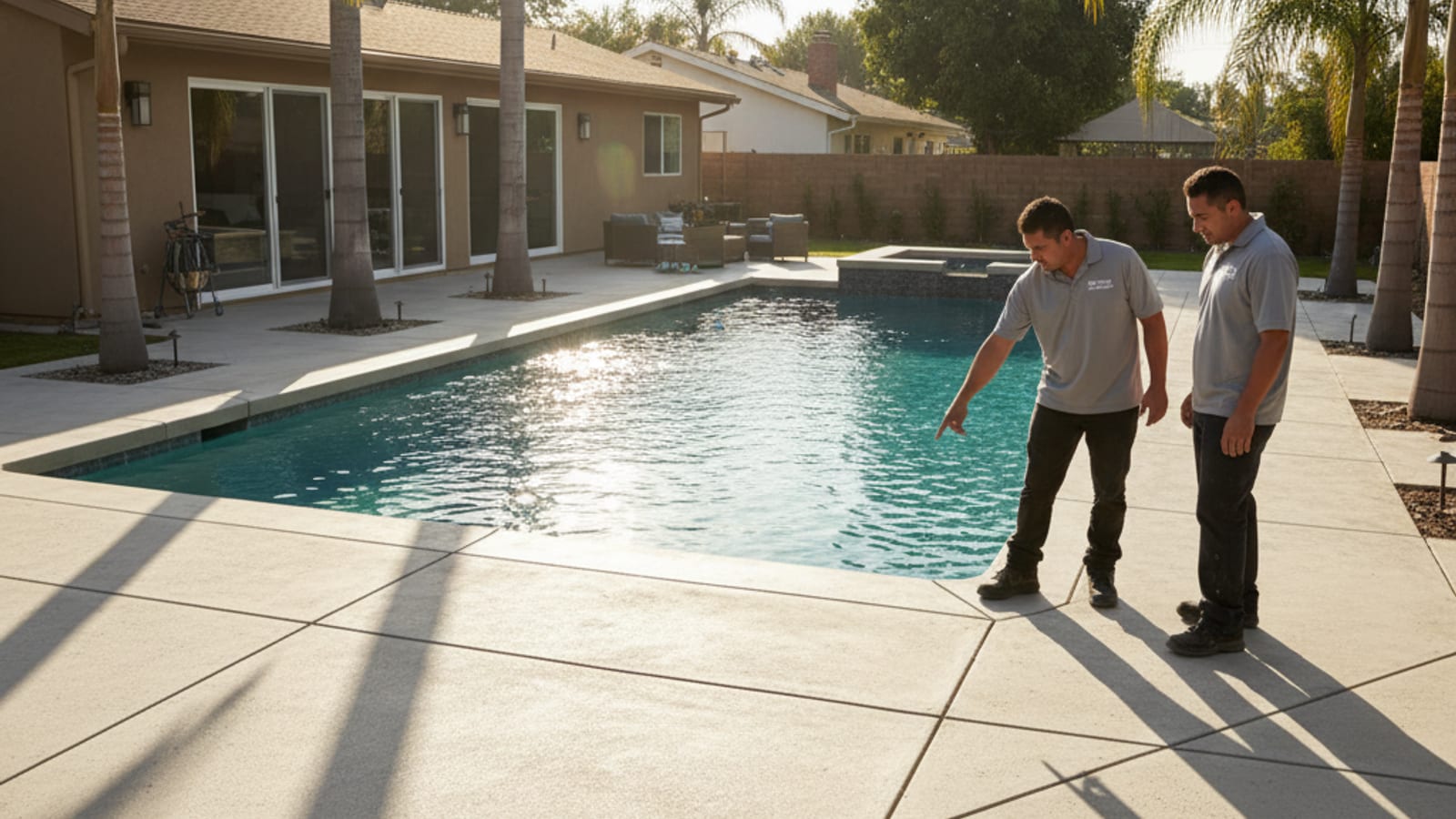
A pool deck has three jobs: stay cool enough for bare feet, stay grippy when wet, and survive years of pool chemistry without cracking, fading, or flaking. The three most common surface options in San Diego, cool-deck, stamped, and exposed aggregate, each handle those jobs differently.
Here is how to pick.
Cool-deck (acrylic textured coating)
Cool-deck is a generic term for acrylic-cement coatings applied 1/8 to 1/4 inch thick over an existing or new concrete slab. The texture is created by a knockdown finish, sprayed on, then knocked down with a trowel for a sand-like surface.
Heat performance: Excellent. Light-colored cool-deck stays 20 to 30 degrees cooler than bare concrete in direct sun. The thermal mass and color do most of the work.
Slip resistance: Excellent. The textured surface grips well when wet.
Durability: Moderate. Coatings last 7 to 15 years before needing refresh. Worn cool-deck shows underlying concrete, chips at edges, and stains permanently.
Cost: $4 to $8 per square foot for a recoat over existing concrete. $14 to $22 per square foot for new concrete plus cool-deck application.
Best for: Existing pool decks needing refresh, any pool deck in full sun, families with kids running barefoot.
Tradeoffs: Cool-deck has limited design flexibility. Most colors are off-white, sand, or muted tones. It is functional more than decorative. When it fails, it fails visibly with chips and worn spots.
Stamped concrete
Stamped concrete creates patterns mimicking flagstone, slate, or stone. Integral color goes through the whole slab, release agent adds depth.
Heat performance: Variable. Light-colored stamped concrete stays reasonable in heat. Dark stamped patterns get hot enough to burn bare feet, so avoid dark colors near pools.
Slip resistance: Poor by default. Smooth stamp patterns are slick when wet. Mandatory: add non-slip aggregate to the sealer for any stamped pool deck.
Durability: Excellent. Properly sealed stamped concrete lasts 25 to 30 years.
Cost: $15 to $25 per square foot installed. Recoating sealer every 2 to 3 years adds $0.75 to $1.50 per square foot per cycle.
Best for: Resale-grade homes, Spanish or Mediterranean architecture, pool decks where design matters as much as function.
Tradeoffs: Hot in dark colors. Slick without anti-slip aggregate. Higher maintenance than cool-deck (regular reseal). Premium upfront cost.
Exposed aggregate
Exposed aggregate exposes decorative stones (river rock, granite, beach pebble) on the surface by washing the cement paste before it fully sets.
Heat performance: Good. The textured surface and varied color absorb heat unevenly, staying cooler than smooth concrete.
Slip resistance: Excellent. The natural stone texture is the most slip-resistant surface available. No need for added aggregate.
Durability: Excellent. 25 to 30 years with proper sealing every 3 to 4 years.
Cost: $13 to $20 per square foot installed.
Best for: Coastal homes (looks beach-appropriate), pool decks where slip resistance is the top priority, homeowners who want texture and character without the maintenance of stamped.
Tradeoffs: Limited pattern flexibility (it is what it is, a stone texture). Stones can crumble at edges over decades. Some stones (sandstone) wear faster than others (granite).
Side-by-side comparison
| Feature | Cool-deck | Stamped | Exposed aggregate |
|---|---|---|---|
| Cost (new install) | $14-22/sq ft | $15-25/sq ft | $13-20/sq ft |
| Cost (refresh) | $4-8/sq ft | $4-7/sq ft | Reseal $0.75-1.50/sq ft |
| Heat (light color) | Coolest | Cool | Cool |
| Heat (dark color) | N/A | Hot | Cool (varies by stone) |
| Slip resistance | Excellent | Poor (without aggregate) | Excellent |
| Durability | 7-15 years | 25-30 years | 25-30 years |
| Maintenance | Low (until refresh) | Reseal every 2-3 years | Reseal every 3-4 years |
| Visual flexibility | Low | High | Medium |
How to pick for your pool
Existing concrete deck that is structurally sound: Cool-deck recoat or acrylic-cement overlay. Cheapest, fastest. Adds texture and cools the surface for 7 to 15 years.
New construction or full deck replacement, family priority: Cool-deck on new concrete. Best heat and slip performance for the price.
New construction, design priority: Stamped concrete in light colors with non-slip aggregate in the sealer. Beautiful, durable, well-suited to high-end homes.
Coastal homes or homes with character architecture: Exposed aggregate with river rock or granite. Looks right, performs well, ages gracefully.
Already have a damaged pool deck: Get a structural diagnosis before picking a surface. If the underlying slab is cracked or settling, no surface coating will hold long-term. Polyurethane lift, repair, or replacement may need to come first.
What kills pool decks fast
Three failure modes we see most often:
Salt-water pool systems: Salt cell pools generate chlorine from salt, leaving salt residue on the deck after every splash and evaporation cycle. Cheap topical sealers chalk and flake within 18 to 24 months. Use salt-tolerant penetrating sealers.
Cyanuric acid (CYA) buildup: Pool chemistry maintained with traditional CYA stabilizer eventually saturates and starts attacking the concrete surface near the pool. Worth replacing high-CYA pool water periodically and resealing concrete on schedule.
Sprinkler overspray: Hard water from automatic sprinklers leaves white salt deposits on pool decks. Penetrating sealers help. Adjusting sprinkler heads helps more.
What to ask a pool deck contractor
Before signing:
- What sealer and how often? Should be a salt-tolerant penetrating sealer (or a product specifically rated for pool environments).
- Anti-slip aggregate in the sealer? Mandatory for stamped or smooth surfaces.
- Tie-in to existing pool coping? Should isolate at coping with flexible joint to prevent cracking.
- Light or dark color? A real contractor steers you toward lighter colors for heat reasons.
- Warranty on coating? Cool-deck and acrylic coatings should carry product and labor warranties.
Get a pool deck estimate
Onsite estimates are free across San Diego County. We work with the existing pool, the deck condition, and your priorities to recommend the right surface. Call (858) 925-5546 or use the contact form to book.