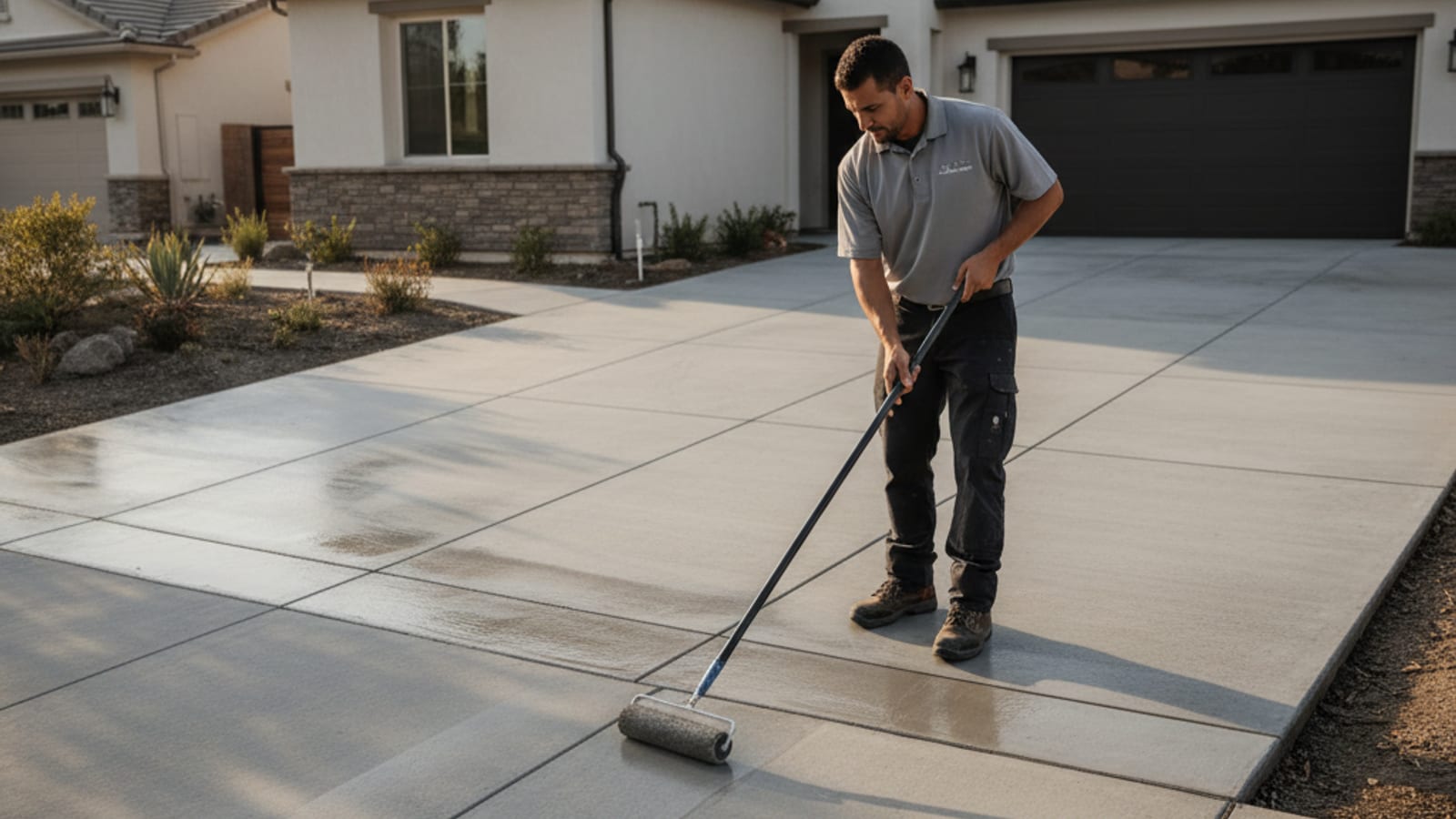
Sealing concrete is the single best thing you can do to keep a slab looking right for decades. The catch: pick the wrong sealer and it fails inside two years, sometimes inside two days. Here is which sealer fits which slab and why.
The four major sealer types
There are four product families that cover almost all residential concrete sealing in San Diego.
1. Penetrating sealers (silane and siloxane)
Penetrating sealers soak into the concrete, react chemically with the slab, and create a hydrophobic barrier within the surface, not on top of it. The slab still looks like concrete. There is no sheen, no film, no surface coating to flake or peel.
Best for: driveways, walkways, patios, and any horizontal slab that needs maximum durability with minimum maintenance.
Lifespan: 5 to 10 years depending on traffic and exposure.
Cost: $1.50 to $3 per square foot installed.
Pros: Cannot peel or flake. UV stable. Salt tolerant. Slip-neutral (no surface change). Works under cars and outdoor furniture without surface marking.
Cons: No color enhancement (existing concrete looks the same). Cannot be visually inspected to check coverage.
This is the sealer we recommend most often for plain broom-finish driveways and standard patios. It just works.
2. Acrylic sealers (water-based and solvent-based)
Acrylic sealers form a thin film on top of the concrete. They enhance color, provide slight to moderate sheen, and resist water and stains.
Best for: stamped concrete, exposed aggregate, and decorative slabs where color enhancement matters.
Lifespan: 2 to 4 years for water-based, 3 to 5 years for solvent-based.
Cost: $1.50 to $3.50 per square foot installed.
Pros: Wet look enhances color and texture. Easy to apply. Reasonable cost.
Cons: Can peel or flake if mis-applied. Yellow or chalk under direct sun. Slick when wet (need non-slip aggregate). Cannot be applied over old failed acrylic without stripping first.
This is the standard for stamped patios. Pick a quality product from a real concrete supplier (not a home center can), and reseal every 2 to 3 years.
3. Epoxy sealers
Epoxy creates a thick, hard film that resists chemicals, oil, and abrasion. It is the standard for garage floors, commercial floors, and any indoor slab seeing chemical exposure.
Best for: garage floors, workshop slabs, equipment pads.
Lifespan: 5 to 15 years indoors. Not recommended for outdoor exposure, because UV breaks epoxy down fast.
Cost: $2 to $6 per square foot installed.
Pros: Tough, chemical-resistant, easy to clean.
Cons: Yellow under UV (do not use outdoors). Slick when wet. Requires extensive surface prep. Cannot be applied to slabs with moisture problems.
For garage floor coatings, epoxy or polyaspartic systems are the standard. For driveways, never use epoxy.
4. Polyurethane and polyaspartic sealers
Polyurethane and polyaspartic are premium topcoats often applied over epoxy primers in garage floor systems. They are UV stable, chemical resistant, and faster to install than full epoxy.
Best for: garage floor topcoats, premium decorative concrete sealers.
Lifespan: 7 to 15 years.
Cost: $3 to $8 per square foot installed.
Pros: UV stable, beautiful finish, fast install (often single-day).
Cons: Cost. Slick without aggregate. Premium product price.
Which sealer fits which slab in San Diego?
A practical guide:
| Slab type | Best sealer |
|---|---|
| Standard broom-finish driveway | Penetrating silane/siloxane |
| Stamped concrete patio | Acrylic with non-slip aggregate |
| Exposed aggregate driveway | Acrylic (color enhancing) |
| Pool deck (any finish) | Penetrating salt-tolerant + non-slip aggregate |
| Garage floor | Epoxy primer + polyaspartic topcoat |
| Workshop/equipment slab | Epoxy chemical-resistant |
| Coastal driveway (within 1/4 mile) | Penetrating silane/siloxane only |
| Concrete walkway | Penetrating silane/siloxane |
What kills sealer fast in San Diego
A few local conditions that demand careful product choice:
Salt air. Coastal slabs face airborne salt that attacks acrylic films from the surface. Penetrating sealers are not affected because there is no film to attack. Anyone selling acrylic on a Coronado driveway is selling a 12-month product.
UV exposure. South-facing or west-facing patios see hours of direct California sun. Acrylic and epoxy sealers chalk or yellow under sustained UV. Penetrating sealers are unaffected.
Pool chemistry. Chlorine, salt-water systems, and CYA (cyanuric acid) all attack unsealed concrete and most cheap topical sealers. We use sealers specifically rated for pool environments.
Sprinkler salts. Hard water from sprinklers leaves salt deposits on patios and walkways. Penetrating sealers handle this well; acrylics chalk over time.
Heat during application. Applying sealer to concrete at 95+ degrees flashes the sealer (causes solvent or water to evaporate before the sealer bonds), leading to bubbling, milking, or peeling. Apply sealers at sunrise or sunset only in summer.
How often to reseal
A maintenance schedule that actually works:
- Penetrating sealers on driveways: every 5 to 7 years inland, every 5 years coastal.
- Acrylic on stamped patios: every 2 to 3 years.
- Acrylic on exposed aggregate: every 3 to 4 years.
- Pool deck sealers: every 2 to 3 years.
- Garage floor coatings: every 7 to 15 years (real failure window varies a lot with use).
Skipping reseal cycles is what shortens slab life. A driveway that is sealed every 5 years stays clean and sound for 30 years. A driveway never sealed picks up oil stains, rust stains, and surface wear that becomes permanent in five.
DIY vs hiring a pro
Sealing is the most-attempted DIY concrete job and the most-mistaken one we see. Common DIY failures:
- Applying penetrating sealer at noon in summer. Flashes off before it can soak in.
- Applying acrylic over a wet or oily slab. Bonds to the contamination, peels in a year.
- Stripping old acrylic incorrectly. Damages the underlying slab.
- Using a generic home center can on stamped concrete. Wrong product, wrong sheen, wrong UV behavior.
If you DIY, follow the manufacturer instructions exactly: surface prep, temperature window, application method, dry time. Most failures come from skipping prep or applying in wrong conditions.
If you hire it out, ask the contractor:
- What product? Specific product name, supplier, data sheet available.
- Why this sealer for my slab? Should match the slab type, exposure, and finish.
- What surface prep? Pressure wash, etch, or strip, depending on existing condition.
- What temperature window? Summer applications require careful timing.
- What warranty? Real sealing contractors warrant the product and the application.
Get an estimate
Onsite sealing estimates are free across San Diego County. We pick the right product for your slab and apply it under the right conditions. Call (858) 925-5546 or use the contact form to book.