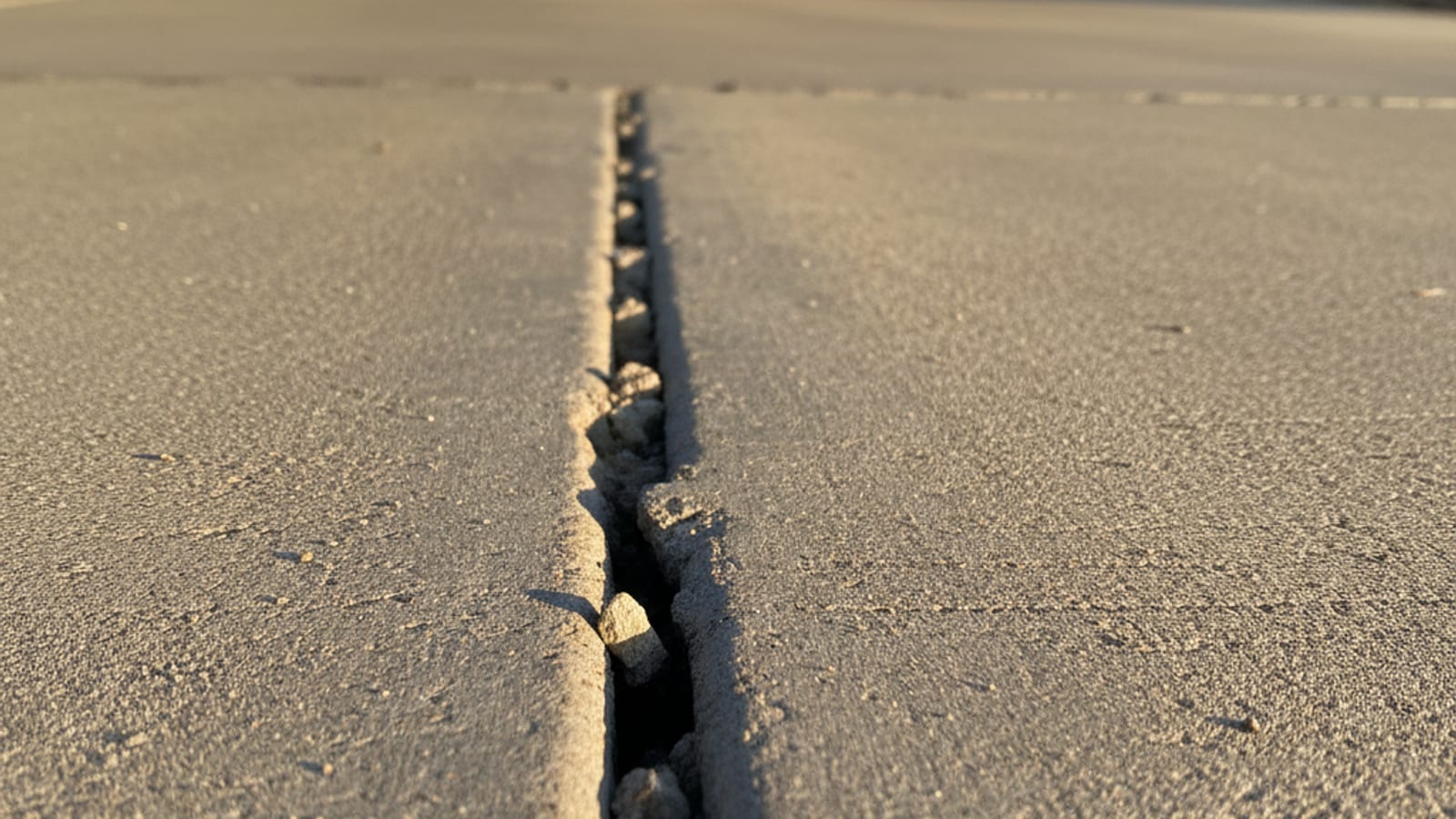
Most cracked concrete in San Diego is fixable. The trick is knowing the difference between a $300 sealant repair, a $1,500 polyurethane lift, and a $9,000 tear-out. Here is how we diagnose it onsite and what the right call usually is.
Step 1: How wide is the crack?
Width is the first signal.
- Hairline (under 1/16 inch). Cosmetic. These show up as concrete cures. They do not need repair unless they are letting water through to the base. A penetrating sealer applied at the next reseal will hide most of them.
- Quarter-inch or wider. Worth investigating. Width alone is not the issue. What matters is whether it is growing, whether one side has dropped, and whether water is making it worse.
- Half-inch and growing. Almost always a structural problem. The base under the slab has shifted, the rebar has corroded, or both.
Width that has grown over the past year is the bigger concern than current width. A static half-inch crack from a concrete cure issue 30 years ago is fine. A quarter-inch crack that was hairline last year is failing.
Step 2: Has the slab moved?
Run your hand across the crack. If one side is higher than the other (we call it stepping), the slab has settled. The base under one side dropped while the other side stayed put. That is a settlement crack and it does not heal itself.
Also look for:
- Rocking sections when you walk on them.
- Sections that pump water during rain.
- Slabs lifting above neighboring sections (heaving, the opposite of settling).
Stepping under a quarter inch is often fixable with polyurethane lift. Stepping over an inch usually means the slab is structurally compromised and needs replacement.
Step 3: Where is the crack?
Location tells you the cause.
Cracks at the foundation. Drainage problem. The slab is not sloped away from the house, water is pooling at the joint, soil is saturating, and the slab edge is dropping. Fix the drainage first or the new slab will fail too.
Cracks running through control joints. This means the joint did its job. The crack landed in the joint instead of randomly. If the crack is hairline and the slab is otherwise stable, leave it alone and reseal.
Cracks across the middle of the slab. Either the joint pattern was missed, the slab was poured too thick to relieve, or the base under the middle of the slab has weakened. Worth a closer look.
Cracks at corners and edges. Usually base failure or impact damage. Easy to repair if the damage is contained.
Spider-web cracks (crazing). Cosmetic. Caused by surface finishing while the underlying concrete was still bleeding. A topical resurfacer can hide them, or live with them.
Step 4: What about the rebar?
If the slab has rust stains pushing through the surface, especially within a half-mile of the coast, the rebar is corroding. Salt air infiltrates concrete through cracks, reaches the rebar, and the rust expands, pushing concrete off from below as spalling.
Spalling fixes:
- Light surface spalling, no exposed rebar. Grind and overlay. Buys 5 to 10 years.
- Spalling with exposed but sound rebar. Patch with polymer-modified mortar. Bonds well, holds up.
- Spalling with rusted, deteriorated rebar. Cut out the section, splice in new epoxy-coated rebar, repour the patch. More work but it lasts.
Painting over rust always comes back. We see it on every coastal driveway built by a previous “fix it cheap” contractor.
The four real options for cracked concrete
Once we have diagnosed the crack, the conversation is which of four options makes sense for your slab.
Option 1: Flexible joint sealant, $200 to $800
For working cracks (cracks that move with temperature or weight) that are wider than 1/8 inch but not stepped, a polyurethane self-leveling sealant fills the crack and stays flexible. This is not paint or caulk. It is a structural sealant rated for concrete movement.
Best for: cosmetic cracks in patios and walkways. Cracks at expansion joints. Surface cracks that just need to stay sealed against water.
Lifespan: 10 to 15 years if the crack does not grow significantly.
Option 2: Epoxy or polyurethane injection, $300 to $1,500
For non-moving cracks in structural concrete (foundation walls, retaining walls, structural slabs), epoxy injection bonds the two sides back together. The slab regains close to its original strength.
Best for: foundation cracks, retaining wall cracks, structural slab cracks that have stabilized.
Lifespan: lifetime if the cause is fixed. The crack will not reopen as long as the underlying movement is addressed.
Option 3: Polyurethane lift, $400 to $3,000
For settled slabs (driveways, walkways, garage floors, AC pads), polyurethane foam injected through small drill holes lifts the slab back to grade. Drives or walks within 15 minutes. Costs about 25 to 40 percent of replacement.
Best for: settlement cracks where the slab itself is sound. Trip hazards. Sunken AC pads. Garage floors that slope wrong.
Lifespan: 10 to 30 years depending on what caused the settling. If the underlying cause (drainage, soil erosion) is also fixed, the lift lasts as long as the slab.
Option 4: Tear-out and replace, $5,000 to $25,000+
When the slab is structurally compromised, the rebar has failed, multiple major cracks have grown, or the underlying base has eroded beyond repair, replacement is the honest answer.
Best for: 50+ year old original slabs with no rebar. Slabs with multiple major settlement cracks. Slabs with widespread spalling and rebar failure. Driveways that have heaved or shifted enough that lift cannot recover them.
Lifespan: 25 to 30 years on a properly built replacement.
How we decide on your slab
When we walk a job, the question is which option costs the least and lasts long enough to be worth doing.
A $300 crack repair on a 50-year-old failing driveway is throwing money away, and we will tell you to plan for replacement. A $9,000 tear-out on a 5-year-old driveway with a single settlement crack near the foundation is overkill. Fix the drainage and lift the slab for $1,500.
We tell you the cheapest fix that holds, even when it is not the bid we would profit most from. That is the only way the business works long-term.
Red flags from other contractors
A few things that should make you call a second contractor:
- “We need to tear it out” without diagnosing the cause. If the drainage is bad, tearing out and pouring a new slab in the same conditions just gives you a new slab that fails the same way.
- “We can paint over the cracks.” Paint and concrete-color resurfacers hide problems for 6 to 18 months. They do not fix anything.
- “We use a foundation patch product from the home center.” The cheap patch products are filler. Real concrete repair uses polymer-modified mortar or polyurethane sealants.
- A bid for replacement without a bid for repair option. Every honest contractor lays out the options. If yours only quotes the most expensive scenario, get another opinion.
Get a real diagnosis
Onsite concrete repair estimates are free across San Diego County. We walk the slab, identify the cause, and quote the cheapest fix that holds. Call (858) 925-5546 or use the contact form to schedule.