A settled driveway is annoying. It is uneven, ugly, and a trip hazard. The good news: most settled slabs are fixable without tearing them out. The catch is that the right fix depends entirely on why the slab settled. Five causes show up over and over in San Diego.
Cause 1: Drainage problems against the foundation
By far the most common cause we see. Water pools at the joint between the driveway and the house, saturates the soil under the slab edge, and the slab drops at the foundation.
How to spot it: The settled section is at the house wall. The slab tilts toward the house instead of away. Visible water staining on the foundation. Wet soil or efflorescence at the joint.
The fix: Polyurethane lift to bring the slab back to level plus drainage correction. A French drain, surface drain, or regrading at the joint solves the underlying cause. Lift without drainage fix = slab settles again in 2 to 5 years.
Cost: $1,500 to $4,000 for lift plus drainage correction.
Cause 2: Soil erosion under the slab
Water finds a way under the slab, sometimes from a leaking sprinkler, broken irrigation line, or downspout dumping at the edge, and slowly washes the base material out from under the concrete. The slab drops as the void grows.
How to spot it: Settling is concentrated near a downspout, sprinkler head, or hose bib. Sometimes you hear hollow sounds when tapping the slab. Voids may be visible at the slab edges.
The fix: Identify the water source first. Repair sprinkler, redirect downspout, fix any leaks. Then polyurethane fill (foam fills the void as it expands) to support and lift the slab back to grade.
Cost: $1,000 to $3,500 for void fill and lift, plus whatever the water source repair costs.
Cause 3: Expansive clay soil cycling
Inland San Diego County, including Escondido, Poway, El Cajon, San Marcos, and Vista, sits on expansive clay soils that swell in winter when wet and shrink in summer when dry. The slab rides that cycle. After enough cycles, the slab edge that faced the most moisture variation drops.
How to spot it: Slab is on inland clay soil. Settling is gradual over years rather than sudden. Hairline cracks parallel to the long dimension. Sometimes the slab heaves in some seasons and settles in others.
The fix: Polyurethane lift restores grade. Long-term, drainage management to reduce moisture variation around the slab. Heavy rebar at the original pour helps a lot here. Slabs without rebar suffer this much more than reinforced slabs.
Cost: $1,500 to $4,000 for lift and drainage adjustments.
Cause 4: Original poor base prep
Some driveways settle because the base was never properly prepped. Loose fill dirt, undersized base material, missed compaction lifts, or just dumping concrete on graded native soil all show up later as settlement.
How to spot it: Settling appears within 5 to 10 years of pour. Affects multiple sections, sometimes the whole slab. The original construction was visibly cheap (thin slab, no rebar, irregular thickness, exposed bare dirt at edges).
The fix: Depends on severity. Small settled sections can be lifted. Slabs that are settling in multiple places with poor base usually need replacement. Lifting buys 5 to 10 years, but the next failure comes faster.
Cost: Lift $1,500 to $4,000. Replacement $5,000 to $15,000 depending on size.
Cause 5: Underground utility or root damage
A water line, sewer line, or root growing under the slab can shift the base. Tree roots can lift the slab; collapsed pipes can drop it.
How to spot it: Settling concentrates over a known utility line or near a large tree. Sometimes a sinkhole or void appears at the edge. Plumbing issues elsewhere on the property may be related.
The fix: Address the underlying issue first. Repair the line, remove or root-prune the tree. Then lift or replace the slab depending on damage.
Cost: Highly variable. Utility repair can run $1,500 to $20,000. Slab repair on top is $1,500 to $9,000.
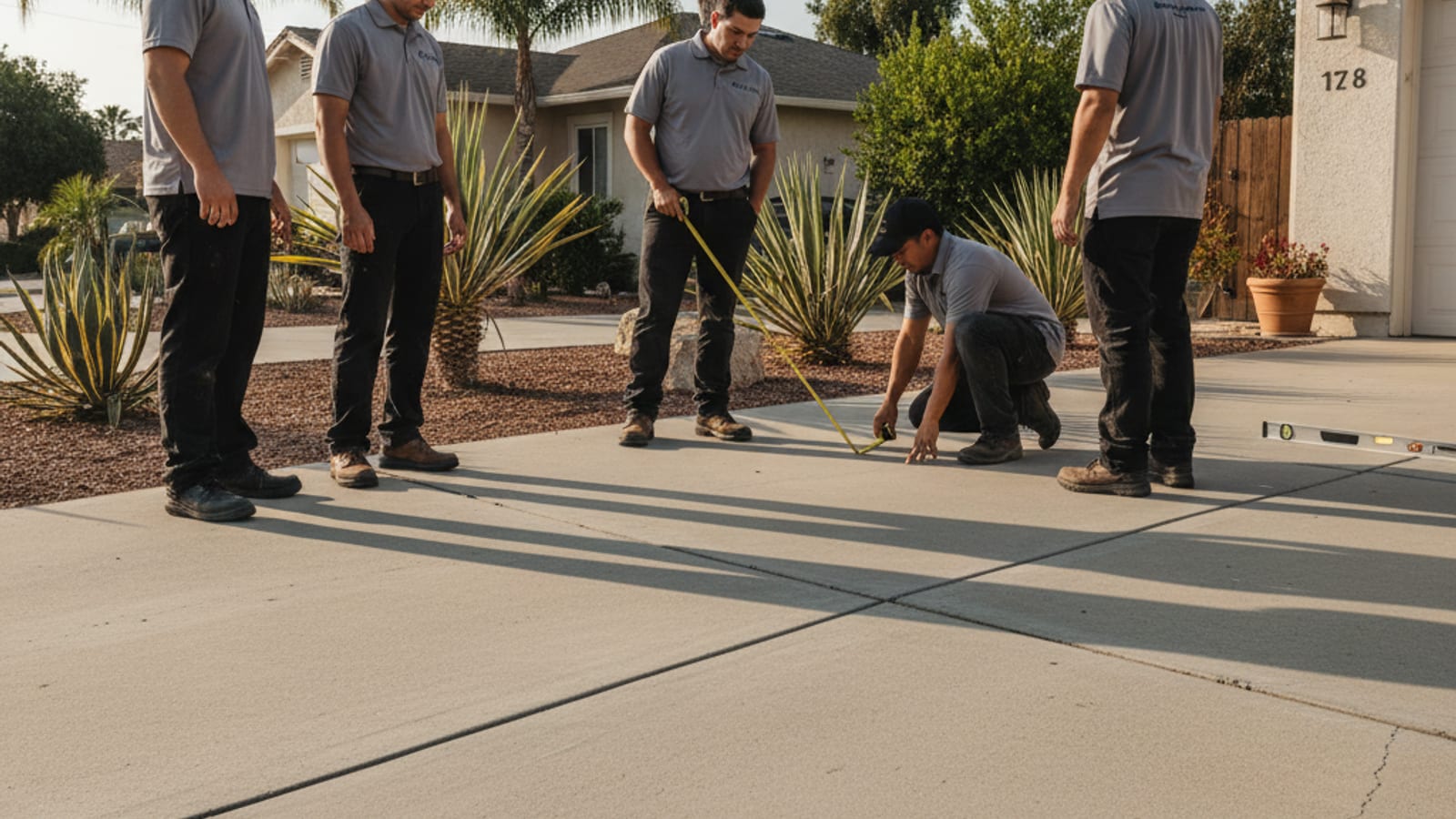
How we diagnose settlement onsite
When we walk a settled slab:
- Measure the drop at the edge or joint. A quarter-inch is cosmetic; an inch matters; over two inches is significant.
- Check drainage: slope, downspouts, sprinklers, foundation conditions.
- Look for cracks and crack patterns to understand how the slab is moving.
- Sound test: tap or stomp to find hollow areas or voids.
- Inspect the surrounding soil for erosion, vegetation, or recent excavation.
- Ask the homeowner when settling started, what changed (landscaping, plumbing, weather), and what other symptoms they see.
The right fix follows from the diagnosis. We do not lift slabs without identifying the cause first. That just resets the clock.
When polyurethane lift is the right call
Polyurethane foam injection works for most San Diego driveway settlement when:
- The slab itself is structurally sound (no major cracks, no broken pieces).
- The settlement is uniform or concentrated rather than chaotic.
- The cause has been or can be addressed (drainage, irrigation, etc.).
- The drop is between 1/4 inch and 4 inches.
The work itself is fast: small drill holes, foam injection, slab rises within 15 minutes. Most jobs done in half a day. Drivable immediately. Costs about 25 to 40 percent of replacement.
When replacement is the honest answer
We recommend tear-out and replace when:
- The slab has multiple major cracks running through control joints.
- The original base was so poor that lifting would just set up the next failure.
- The slab is over 50 years old and has no rebar.
- Settlement exceeds 4 inches and the slab has likely cracked from the lift forces.
- The slab has spalling, rebar failure, or surface deterioration alongside the settling.
Replacement costs more upfront but lasts 25 to 30 years on a properly built new slab. Lifting a slab that should be replaced costs less today but stacks up to more cost over a decade.
What it costs to ignore it
Unfixed settlement gets worse. The patterns we see when homeowners wait too long:
- Cracks widen as the slab continues to flex.
- Drainage problems compound. Water continues to undermine the base.
- Trip hazards become liability issues.
- Resale value drops. Buyers see settled concrete as deferred maintenance.
A $2,000 lift today often prevents a $7,000 problem in five years.
Get a real diagnosis
Onsite settlement diagnosis is free across San Diego County. We identify the cause, recommend the cheapest fix that holds, and tell you straight when replacement is the right answer instead of a quick lift. Call (858) 925-5546 or use the contact form to book.