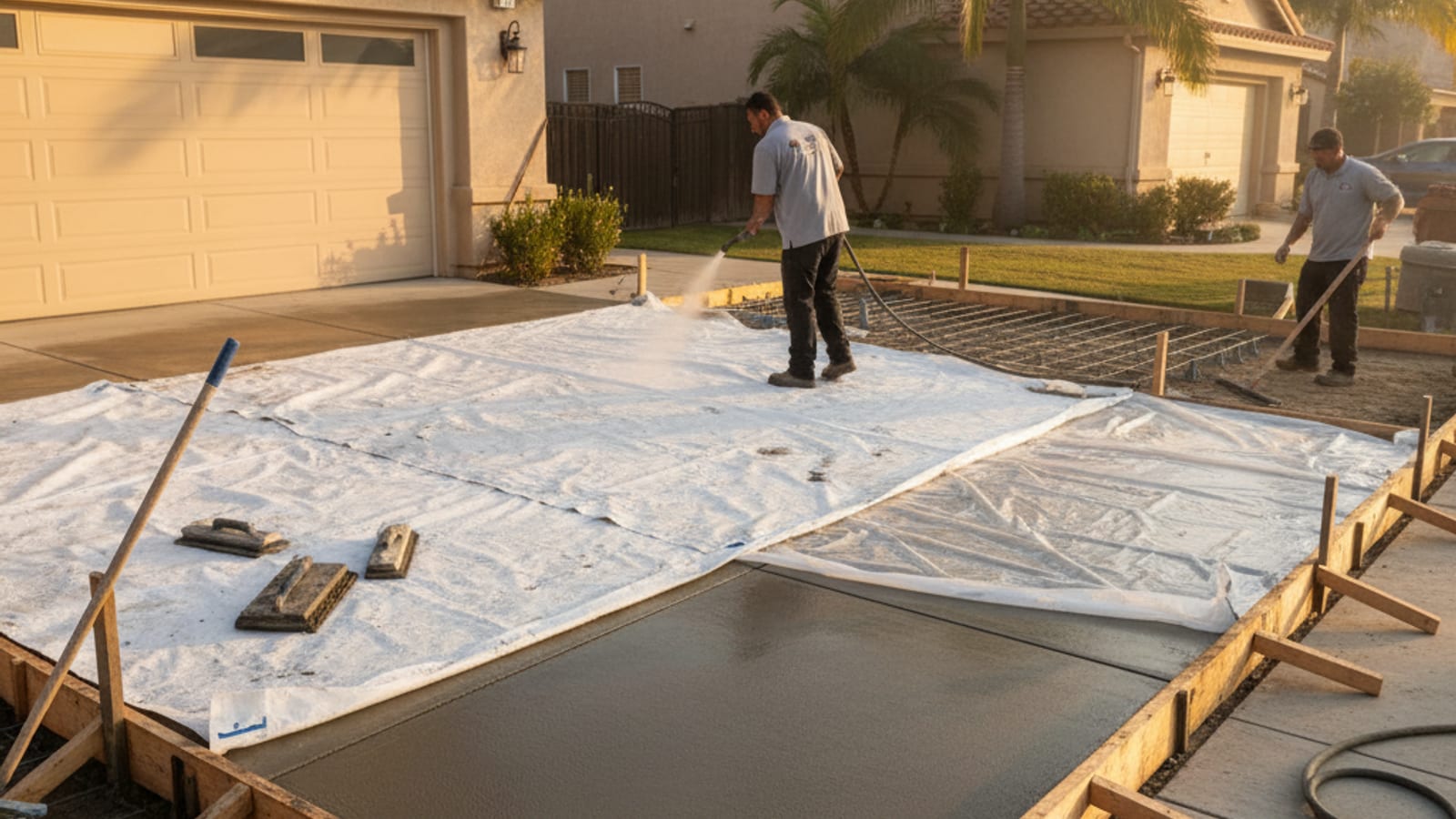
Concrete is not “set” when it stops being wet on top. It is set when the chemical hydration has built up enough strength to handle load, and that schedule has rules. Here are the real cure times for residential concrete in San Diego, and why following them matters more than people think.
The 24/7/28 rule
Three milestones on every concrete pour:
- 24 hours: walk-on strength. Concrete has set firmly enough that foot traffic does not damage the surface. You can walk across a driveway, patio, or walkway 24 hours after the pour. Pets too.
- 7 days: light vehicle strength. The slab has reached roughly 70 percent of design strength. You can drive a passenger car, light truck, or SUV onto the slab.
- 28 days: full design strength. The slab is at 100 percent of design PSI (typically 3,000 to 4,000 PSI for residential). Heavy vehicles, RVs, dumpsters, jack stands, and full-load applications are now safe.
These are minimums. Cooler temperatures, higher humidity, larger slabs, and certain admixtures can stretch them.
Why driving early cracks slabs
Concrete builds strength through a chemical reaction between cement and water called hydration. The reaction continues for weeks or even months after pouring, but the bulk of the strength gain happens in the first 28 days. At 7 days, concrete has roughly 70 percent of its 28-day strength. At 24 hours, it has roughly 15 to 20 percent.
When a vehicle drives on a slab at 70 percent strength, the slab can usually handle it, barely. When a vehicle drives on a slab at 30 to 40 percent strength (3 to 5 days after pour), the slab cracks. The cracks may be hairline at first, but they widen as the slab continues to flex under repeated loads.
The pros we send have replaced driveways where homeowners drove on the new slab at day 4 because they were told “concrete sets in 3 days.” It does not. Setting and curing are different things, and the contractor who told them that was wrong.
What “set” actually means
Concrete passes through several stages:
- Plastic state (first 1 to 4 hours): Wet, workable, can be finished.
- Initial set (4 to 8 hours): No longer workable, surface starts to firm up. Saw-cutting begins.
- Final set (24 hours): Firm enough to walk on. Hardened in appearance.
- Early cure (7 days): Most of the rapid strength gain happens here.
- Continued cure (28+ days): Strength continues to develop slowly for months.
A slab that is “set” is at stage 3 or 4. It is not at full strength. The slab continues to gain strength every day for at least 28 days.
Saw-cut control joints: within 24 hours, no exceptions
One time-sensitive task happens on the same day as the pour: saw-cutting control joints. The joints have to be cut while the concrete is firm enough to cut cleanly but soft enough to cut without ripping.
For most residential pours, the cut window is 4 to 12 hours after final finish. Cut too early and the saw blade tears the surface. Cut too late and the slab has already cracked uncontrolled.
Joints are cut roughly 1 inch deep on a 4-inch slab, about 25 percent of the slab depth. Spacing depends on slab thickness:
- 4-inch slab: joints every 8 to 12 feet.
- 5-inch slab: joints every 10 to 15 feet.
- 6-inch slab: joints every 12 to 18 feet.
A driveway without saw-cut control joints will crack across the field of the slab, diagonally, randomly, and visibly. A driveway with joints cracks invisibly, in the joint, where you do not see it.
Why cure protection matters in San Diego
San Diego summer heat is the enemy of new concrete. When the surface dries faster than the underlying slab can hydrate, you get crazing (spider-web surface cracks), low surface strength, and color blotching on integral-color pours.
Real cure protection on a hot day:
- Curing compound sprayed on immediately after final finish.
- Plastic sheeting to slow evaporation, especially overnight.
- Wet curing (mist or wet burlap) for premium pours.
- Curing blankets on cold or windy nights.
The cheapest contractors skip cure protection entirely. Their slabs craze, the color is uneven, and the surface strength is 20 to 30 percent below spec. You see it within the first year.
What homeowners can do to help the cure
If you have a new pour:
- Stay off it for 24 hours. Period.
- No cars for 7 days. Park on the street if needed.
- No heavy stuff for 28 days. Hot tubs, dumpsters, jack stands, and RV parking all wait the full window.
- Keep it wet (or covered) for the first 3 days if the contractor leaves curing instructions. Wet curing builds stronger concrete.
- Do not seal until 28 days. Sealer applied to a curing slab traps moisture and damages the surface.
- Do not pressure wash for 60 days. Surface is still hardening.
If your contractor leaves the slab uncovered in 95-degree heat with no cure protection, ask. The right answer is curing compound, plastic, or burlap. The wrong answer is “concrete cures itself.”
What you should expect from your contractor
Before signing a bid, confirm:
- PSI of concrete. Not “regular concrete,” but a number, like 3,500 PSI.
- Cure protection plan. Especially if the pour is in summer.
- Saw-cut joint timing. Same-day, 4 to 12 hours after finishing, not “the next day.”
- Walk-on, drive-on, and full-strength dates in writing.
- Sealing recommendation at 28 days.
A contractor who knows the answer to all five is taking the work seriously. A contractor who waves these off is going to deliver a slab that fails the cure cycle.
When the cure goes wrong
Signs your slab did not cure properly:
- Crazing. Fine spider-web surface cracks within a few weeks. Caused by surface drying faster than the slab cured. Cosmetic but ages poorly.
- Color blotching on integral-color pours. Uneven color caused by inconsistent moisture during cure.
- Low surface strength. Surface dusts or scales easily, never feels fully hard.
- Premature cracking. Major cracks within the first 3 to 6 months.
If you see these, contact the contractor while the work is still under warranty. Properly cured concrete does not have these issues for years.
Get a real estimate
Onsite estimates include cure protection plans tailored to the season and the slab. Free across San Diego County. Call (858) 925-5546 or use the contact form to book.