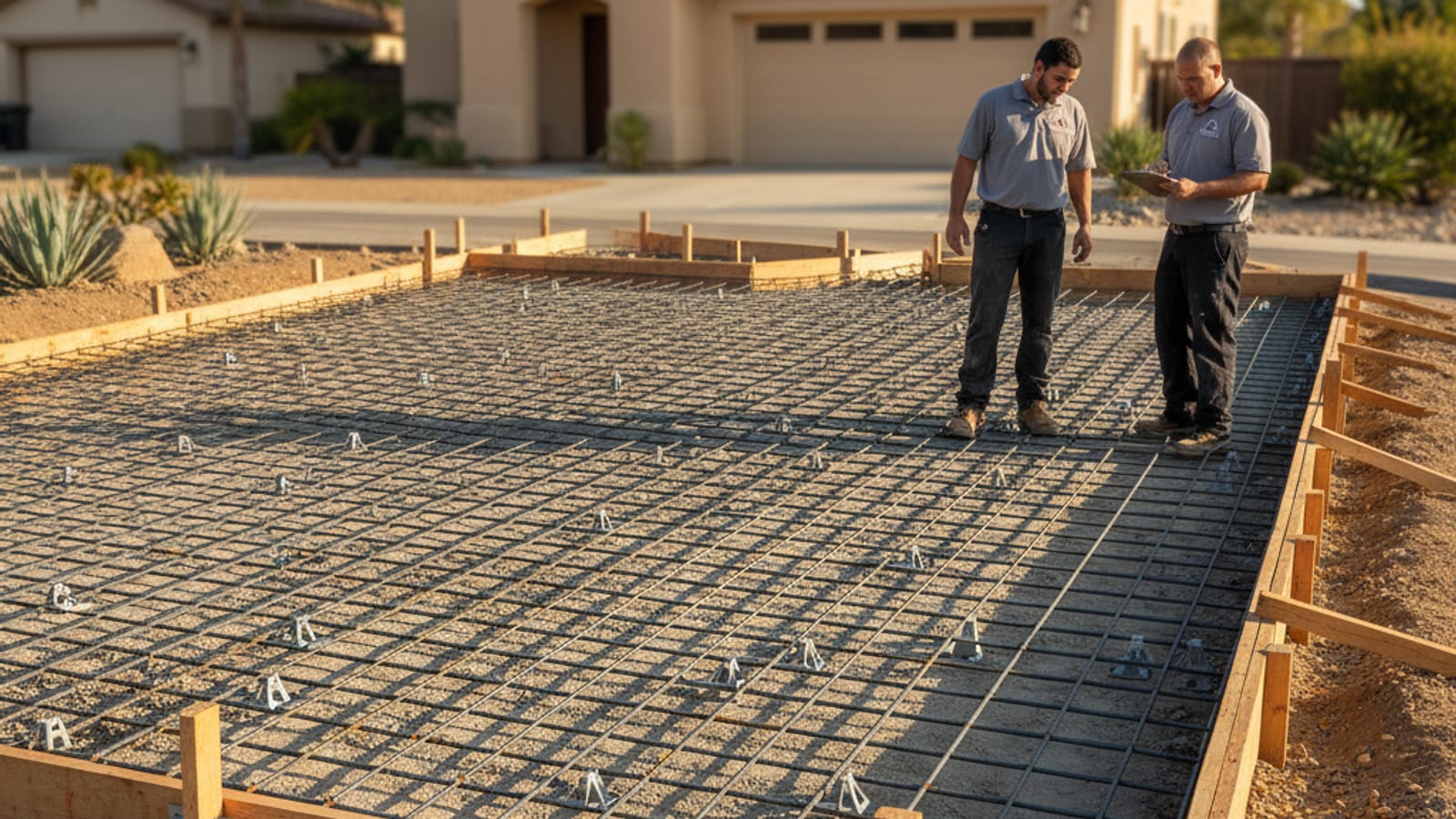
Yes, you need rebar in your San Diego concrete driveway. The longer answer explains why, and why a contractor offering to skip it on price is selling you a slab that will fail in five to ten years.
What rebar actually does
Concrete is incredibly strong in compression. Push down on it and it holds up. Concrete is weak in tension. Pull or bend it, and it cracks. A driveway under a car experiences both forces: compression directly under the wheel, tension on the underside of the slab as the load tries to bend it down between supports.
Rebar handles the tension. Embedded steel inside the slab takes the bending forces that would otherwise tear the concrete apart. Without rebar, even the heaviest concrete cracks under bending loads.
Rebar also handles soil movement. San Diego soils, especially inland clay, swell in winter when wet and shrink in summer when dry. The seasonal cycle bends the slab. Rebar holds the slab together as it flexes.
The minimum spec for a residential driveway
The standard residential driveway in San Diego County:
- 4 inches thick for cars and light trucks; 5 to 6 inches for RVs and commercial vehicles.
- #4 rebar (1/2 inch diameter) on 18-inch centers in a grid pattern, both directions.
- Concrete coverage of at least 1.5 inches above and 1.5 inches below the rebar.
- Tied with snap ties at every intersection.
- Supported off the base with chairs (small plastic or concrete spacers) so the rebar sits in the middle of the slab during the pour.
Heavier loads bump the spec: #5 rebar (5/8 inch) on 12-inch centers for RV pads, commercial driveways, and slabs that will see point loads.
What happens if a driveway has no rebar
The pros we send replace plenty of unreinforced 1950s and 1960s San Diego driveways. The failure pattern is consistent:
- Year 1 to 3: Hairline crack appears, usually parallel to the longest dimension or at a quarter point.
- Year 3 to 7: Crack widens. Drainage starts to find it. Frost or seasonal moisture cycles widen it further.
- Year 7 to 12: Crack grows into multiple cracks. Sections start to settle independently. Trip hazards develop.
- Year 12 to 20: Slab is structurally compromised. Polyurethane lift can buy time but the underlying problem is solved by replacement.
Compare that to a properly reinforced driveway: 25 to 30 years of clean service before any meaningful repair, often longer.
What about wire mesh?
Wire mesh (also called welded wire fabric or WWF) is a 6x6 inch grid of thinner steel wire welded at intersections. It is cheaper than rebar and faster to install. It also does less work.
Wire mesh is appropriate for:
- Walkways under 3 feet wide with only foot traffic.
- Garden paths and decorative slabs.
- Sidewalks in low-load applications.
- Slabs poured over existing reinforced subgrades as a secondary reinforcement.
Wire mesh is not appropriate for:
- Driveways. The steel is too thin and the spacing too wide to handle vehicle loads.
- Garage floors. Same reason.
- Patios over 200 square feet with any expected load (BBQ islands, fire pits, hot tubs).
- RV pads, equipment pads, or any heavy-duty application.
We see wire mesh in driveways from 1970s and 1980s tract construction. Most of those driveways are now cracking or being replaced.
Why fiber-reinforced concrete is not a substitute
Fiber-reinforced concrete (FRC) mixes synthetic or steel fibers into the wet mix. The fibers reduce surface cracking from concrete shrinkage during cure. They do not replace rebar.
FRC is good for:
- Reducing surface crazing on broom-finish slabs.
- Helping slabs stay together during the cure window before saw-cutting.
- Adding tensile strength to small slabs and walkways as a supplement to rebar.
FRC is not good for:
- Replacing rebar in any driveway, foundation, or structural slab. Marketing claims that fibers eliminate the need for rebar are wrong on residential concrete.
When a contractor pitches “fiber-reinforced concrete instead of rebar” on your driveway, get another bid.
The right way to tie rebar
The work that makes rebar effective happens before any concrete shows up. A few details:
Tie every intersection. Not every other one. The grid only acts as one unit if every joint is tied tight. We use snap ties or hand-twisted tie wire at every crossing.
Use chairs to support the bar. Plastic or concrete spacers hold the rebar 1.5 to 2 inches off the compacted base. Without chairs, the rebar settles to the bottom during the pour and ends up uselessly outside the structural neutral axis.
Lap splices at minimum 24 bar diameters. When you splice two pieces of #4 rebar end-to-end, you overlap them at least 12 inches and tie them at each end and the middle. Skipping this turns a continuous grid into disconnected pieces.
Bend rebar at corners and edges. Continuous bar around perimeters helps the slab edges stay together. Cut bar pieces stopping short of the edge create weak zones.
The pros we send pour to engineer specs and inspector standards every time. When the rebar inspection happens before the pour (required on most foundations and on driveway approaches into city right-of-way), the inspector verifies bar size, spacing, ties, chairs, and laps. We have not failed an inspection in years.
What a real driveway pour costs
Properly reinforcing a residential driveway adds $1.50 to $3 per square foot to the bid compared to no reinforcement. On a 600 square foot driveway, that is $900 to $1,800 of rebar, ties, chairs, and labor.
Compare to the cost of failing without it: a slab replacement at year 8 because the driveway cracked apart costs $5,000 to $9,000. The math always works out for rebar.
When you compare two driveway bids and one is dramatically cheaper, the first thing to check is reinforcement. If the cheaper bid uses wire mesh or no reinforcement, you are not comparing the same product.
Get a real driveway estimate
Onsite estimates are free across San Diego County. We bid every driveway with proper rebar, base prep, and saw-cut joints, the work that makes a slab last 25 years instead of 8. Call (858) 925-5546 or use the contact form for a free estimate.