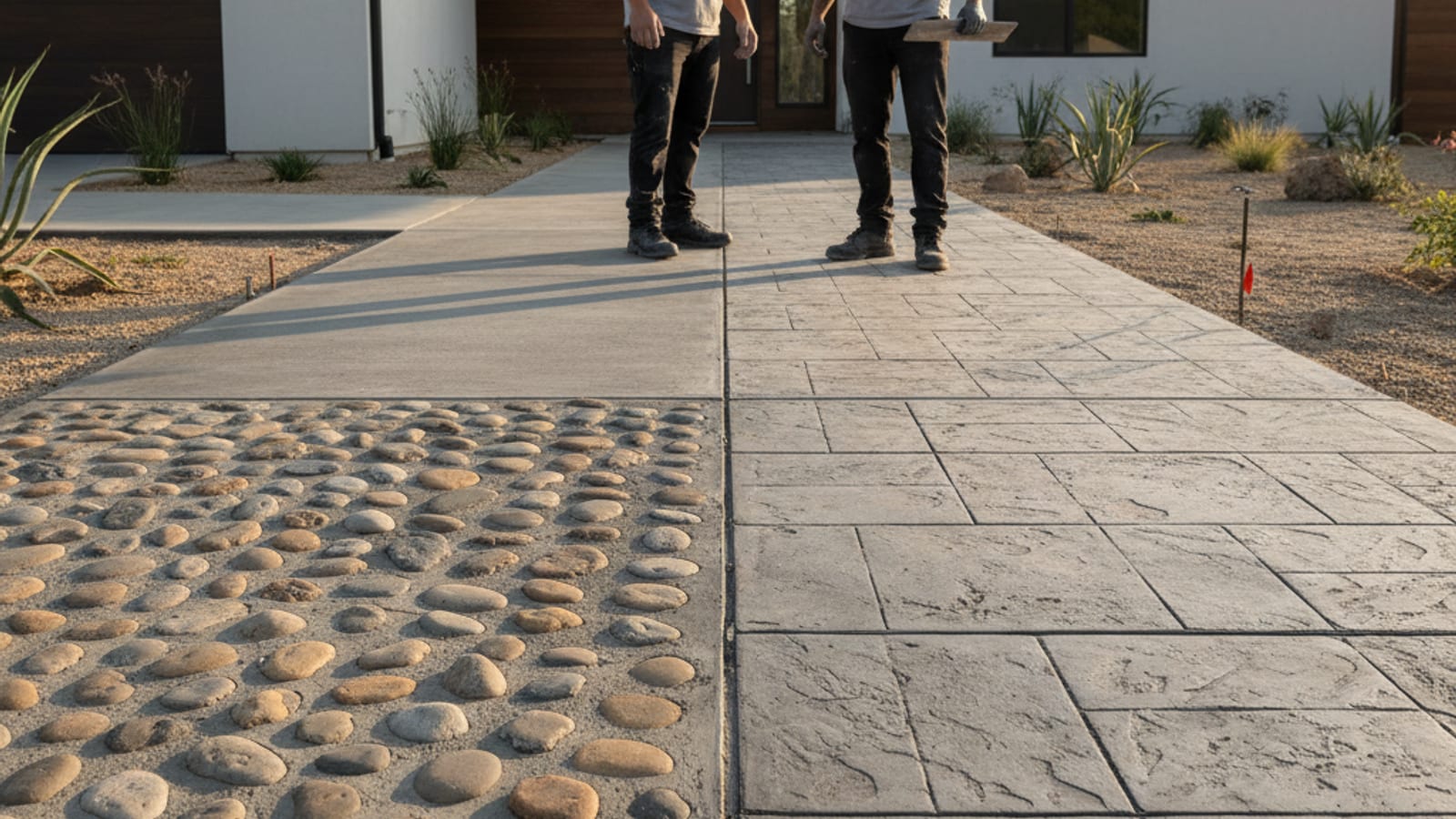
The two most-asked-about decorative concrete finishes in San Diego are exposed aggregate and stamped. Both add character and value over plain broom-finish concrete. The question is which one fits your home, budget, and long-term plan. Here is the honest comparison.
Quick summary
- Exposed aggregate has natural texture from real stones. Slip-resistant by default. Limited pattern flexibility. Ages gracefully with regular sealing.
- Stamped concrete mimics flagstone, slate, or stone with imprinted patterns and integral color. High visual flexibility. Slick when wet without anti-slip aggregate. Premium look with regular maintenance.
Both last 25 to 30 years properly sealed. Both cost similar, within $2 per square foot of each other. The choice is mostly aesthetic and use-case.
Cost comparison in San Diego
In 2026:
| Finish | Price per sq ft (installed) | 600 sq ft driveway |
|---|---|---|
| Broom finish (baseline) | $8 to $15 | $5,000 to $9,000 |
| Exposed aggregate | $13 to $20 | $7,800 to $12,000 |
| Stamped (single color) | $14 to $18 | $8,400 to $10,800 |
| Stamped (premium, multi-color) | $16 to $25 | $9,600 to $15,000 |
Stamped tends to run slightly more for premium multi-color jobs. Aggregate runs slightly less for equivalent quality, mostly because the labor is faster.
Maintenance over 25 years runs roughly even. Both need resealing every 2 to 4 years to keep their look.
Where each one wins
Exposed aggregate wins on:
Slip resistance. The natural stone texture grips when wet without any added aggregate or topcoat. Best for pool decks, walkways, and any surface that will see water.
Coastal aesthetics. Beach-town homes look right with aggregate finishes. It reads coastal-California, weathered, character-rich. Stamped patterns can feel forced in coastal architecture.
Low-maintenance design. Aggregate is more forgiving than stamped if you skip a reseal cycle. The texture hides minor wear better than the high-and-low contrast of a stamp pattern.
Driveway performance. The natural texture handles tire loads, oil drips, and seasonal use better than stamped patterns where the integral color can wear in tire tracks.
Stamped concrete wins on:
Visual flexibility. Want it to look like flagstone? Slate? Wood plank? Brick? Stamped does all of it convincingly. Aggregate looks like aggregate.
Architecture matching. Spanish, Mediterranean, Craftsman, and Tudor homes look better with stamped patterns matched to the architectural style. Aggregate is too busy or too natural for these.
Resale grade in coastal North County. Carlsbad and Encinitas resale buyers expect upgraded finishes. Stamped reads as quality work. Aggregate is more divisive. Some buyers love it, some find it dated.
Color customization. Stamped concrete can be colored to match siding, roofing, or landscape stone. Aggregate is what the stones are.
Heat and slip considerations
For pool decks specifically:
- Aggregate: excellent slip resistance even when wet. Heat depends on stone color, and light stones stay cooler.
- Stamped: slick when wet without added aggregate; we always add non-slip silica or polymer aggregate for pool deck applications. Heat depends on color, and dark stamped patterns get hot.
For driveways:
- Aggregate: great traction in winter rain, no slip concerns.
- Stamped: wet stamped surfaces are slick on slopes; consider aggregate-added sealer for sloped driveways.
Maintenance reality
Both finishes need sealing on a regular cycle. The differences:
Exposed aggregate maintenance:
- Reseal every 3 to 4 years.
- Pressure wash before each reseal.
- Pebble loss is rare but possible at edges over 15 to 20 years.
- Stains generally clean up with hot water and concrete-safe cleaner.
Stamped concrete maintenance:
- Reseal every 2 to 3 years to keep color rich.
- Pressure wash annually.
- Color fades faster on south or west-facing surfaces.
- Refresh project at year 10 to 15 (light grinding plus full reseal) costs $4 to $7 per square foot.
If you skip maintenance:
- Skipped aggregate: loses a little color depth, picks up some dirt.
- Skipped stamped: loses noticeable color, risks permanent stains, develops chalky surface.
Stamped is less forgiving. If you know yourself well enough to know reseal cycles will get skipped, aggregate is the safer choice.
What we recommend by use case
- Pool deck: Exposed aggregate or stamped with non-slip aggregate. Both work.
- Front walk in coastal home: Exposed aggregate or salt finish. Reads coastal.
- Front walk in Spanish or Mediterranean home: Stamped flagstone or cobblestone.
- Backyard patio for entertaining: Stamped if architecture supports it; aggregate otherwise.
- Standard residential driveway: Either works. Pick by what matches the home better.
- High-end coastal driveway: Aggregate or stamped, both fine. Aggregate if you want lower maintenance.
- Inland tract home with HOA: Check HOA approval, since many limit stamped and aggregate options.
What kills both finishes fastest
Three things to watch:
- Skipped reseal cycles. Both finishes degrade visibly if you go 5+ years without reseal.
- Pressure washing too aggressively. Excessive pressure can chip aggregate stones or wear stamped texture.
- De-icing salts. Common on cold-climate concrete but irrelevant in San Diego. Coastal salt fog is the equivalent here, and penetrating sealers handle it on both finishes.
Get a sample comparison
Onsite estimates include sample boards of both finishes so you can see them next to your home. Free across San Diego County. Call (858) 925-5546 or use the contact form to book.