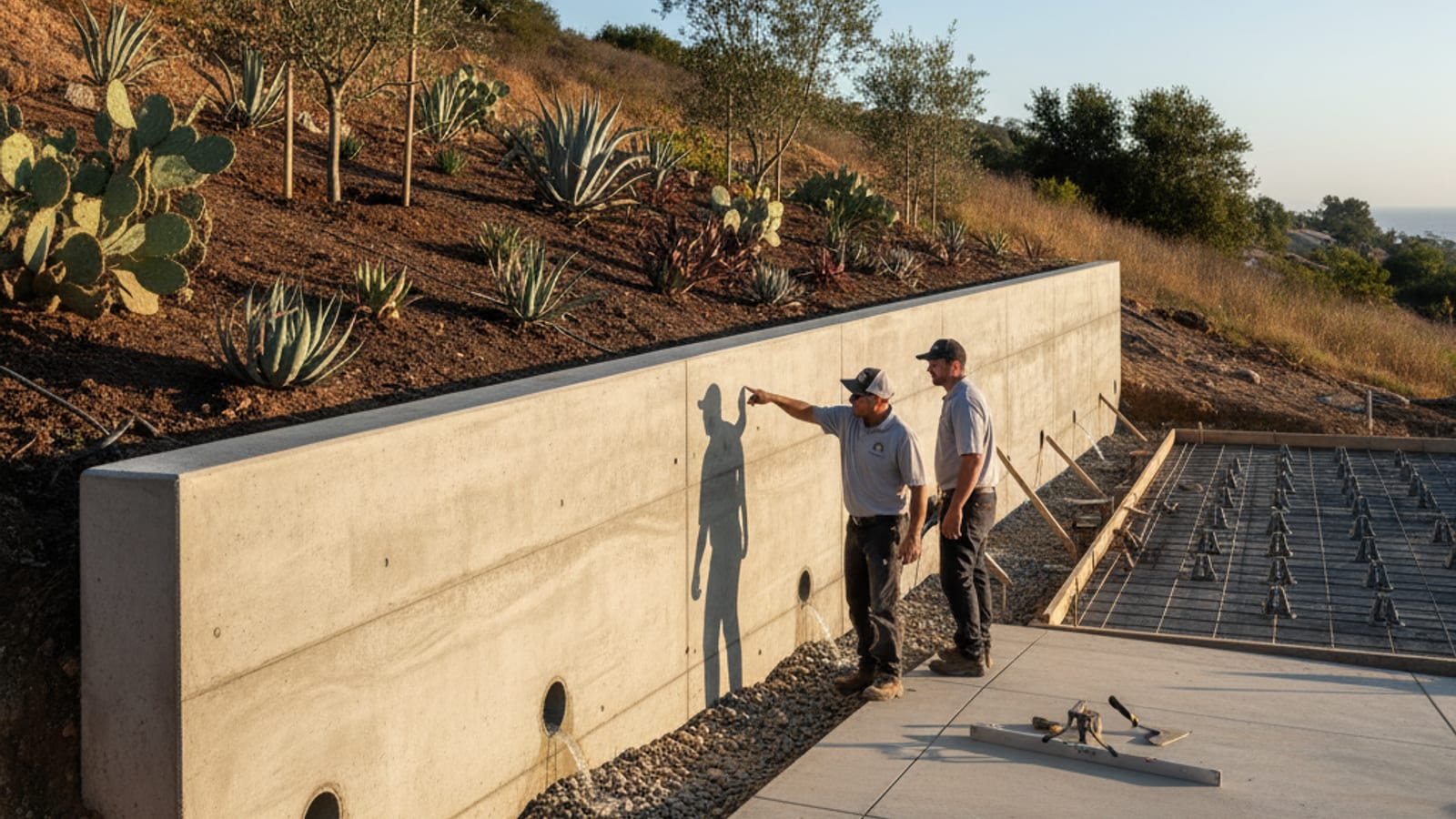
A retaining wall is a structural element. Building one without checking permit and engineering requirements is how homeowners end up with stop-work orders, failed inspections at sale, or worse: wall failures during heavy rain. Here is what you actually need to know about San Diego County retaining wall permits in 2026.
The 4-foot rule (most jurisdictions)
In most San Diego County jurisdictions, including the City of San Diego, Carlsbad, Oceanside, Escondido, Chula Vista, Vista, San Marcos, and Poway, retaining walls 4 feet or less in total height (measured from the bottom of the footing to the top of the wall) generally do not require a building permit if:
- The wall has no surcharge load (nothing structural above it).
- The wall is not retaining a slope steeper than 1:1.
- The wall is not retaining a swimming pool, structure, or driveway above it.
- Local zoning, HOA, or coastal commission rules do not add additional requirements.
Walls over 4 feet require a permit and engineered drawings. No exceptions in any San Diego County jurisdiction we work in.
The surcharge rule (any height)
If the wall retains anything that adds load, such as a structure, a driveway, a pool, or even a heavily landscaped slope, it is considered “surcharged” and needs engineering and a permit at any height. A 3-foot-tall wall holding back the dirt under a driveway is structurally working harder than a 5-foot wall with no surcharge.
Common surcharge scenarios in San Diego:
- Wall under a driveway approach.
- Wall holding back a slope with a structure above.
- Wall around a pool deck.
- Wall under a deck or other elevated structure.
- Wall on a hillside with significant slope above.
If you are not sure whether your wall is surcharged, the answer is “probably.” Engineered drawings on a $300 to $1,500 fee solve the question and protect you at sale.
What permit walls require
A permitted concrete retaining wall in San Diego County typically requires:
- Engineered drawings by a licensed civil or structural engineer. Specifies wall height, footing dimensions, rebar size and spacing, drainage details.
- Soil report in many jurisdictions, especially for walls over 6 feet or in high-expansion soil zones.
- Building permit filed with the city or county, including drainage and grading plans.
- Footing inspection before pouring the footing.
- Rebar inspection before pouring the wall stem.
- Final inspection after the wall is complete.
The full process from engineering to final inspection takes 8 to 16 weeks for most residential walls.
Cost for engineered walls vs unengineered walls
A 4-foot unengineered wall (no permit, no surcharge):
- 4-foot wall, 30 feet long: $7,000 to $11,000
A 6-foot engineered wall, no surcharge:
- 6-foot wall, 30 feet long: $13,000 to $20,000 (plus engineering and permit fees of $2,000 to $5,000)
An 8-foot engineered wall with surcharge (retaining a driveway above):
- 8-foot wall, 30 feet long: $22,000 to $35,000 (plus engineering and permit fees of $3,000 to $7,000)
Engineering, permits, and inspections add 15 to 25 percent to a wall project. The alternative, building unpermitted and paying for it at resale or after a failure, costs much more.
Why drainage matters more than wall thickness
The thing that fails on most concrete retaining walls is not the wall itself. It is drainage. Water trapped behind the wall builds hydrostatic pressure, which forces walls to lean, crack, or fail entirely.
A properly built wall has:
- Gravel backfill behind the wall (typically 12 to 24 inches of clean drain rock).
- Filter fabric between native soil and gravel to keep fines out.
- Perforated drain pipe at the base of the gravel, daylighting downhill.
- Weep holes through the wall at 6 to 8 foot intervals as a backup drainage path.
A wall built without proper drainage can fail at any height. We have rebuilt 3-foot walls that toppled in heavy rain because the original contractor skipped the drain pipe.
Common retaining wall mistakes
Three patterns we see when we are called for a wall replacement:
Wall built without a footing. A retaining wall’s footing is what keeps it from tipping. A wall built directly on graded dirt, with no footing and no rebar projecting up, falls within 5 to 10 years.
Wood walls that should have been concrete. Pressure-treated wood walls are fine for short, non-surcharged retaining where a homeowner accepts a 10 to 15 year replacement cycle. They are not appropriate for walls over 4 feet, surcharged walls, or walls in high-moisture conditions.
Block walls without grout-filled cells and rebar. A CMU (concrete block) wall needs vertical rebar in grouted cells at 24 to 48 inch spacing depending on height. Walls built with hollow blocks and no grout are decorative, not structural.
What about block walls vs poured walls?
Both work for retaining. The choice depends on the project:
CMU block walls:
- Faster for short, straight walls.
- Better for tight access where forms cannot be set easily.
- Lower cost per linear foot for walls under 6 feet.
- Limited curve and architectural finish options.
Poured-in-place concrete walls:
- Better for tall walls over 8 feet.
- Better for curves and architectural finishes.
- Cleaner appearance with smooth or board-formed face.
- Slightly higher cost but stronger continuous structure.
Both require footing, rebar, and drainage to spec.
When to call before designing the wall
Call a contractor and ideally an engineer before you finalize the wall design if:
- The wall will be over 4 feet tall.
- The wall will retain a driveway, pool, or structure.
- The wall is on a steep slope (1:1 or steeper).
- The lot has known geotechnical issues (active slide, unstable soil, high water table).
- Your jurisdiction has coastal, hillside, or environmental overlays.
The walls that fail are almost always the ones built without engineering. The walls that pass inspection and last 50 to 100 years are the ones that started with proper design.
Get an estimate
Onsite estimates include height measurements, surcharge assessment, drainage requirements, and a clear breakdown of permit and engineering needs. Free across San Diego County. Call (858) 925-5546 or use the contact form to book.