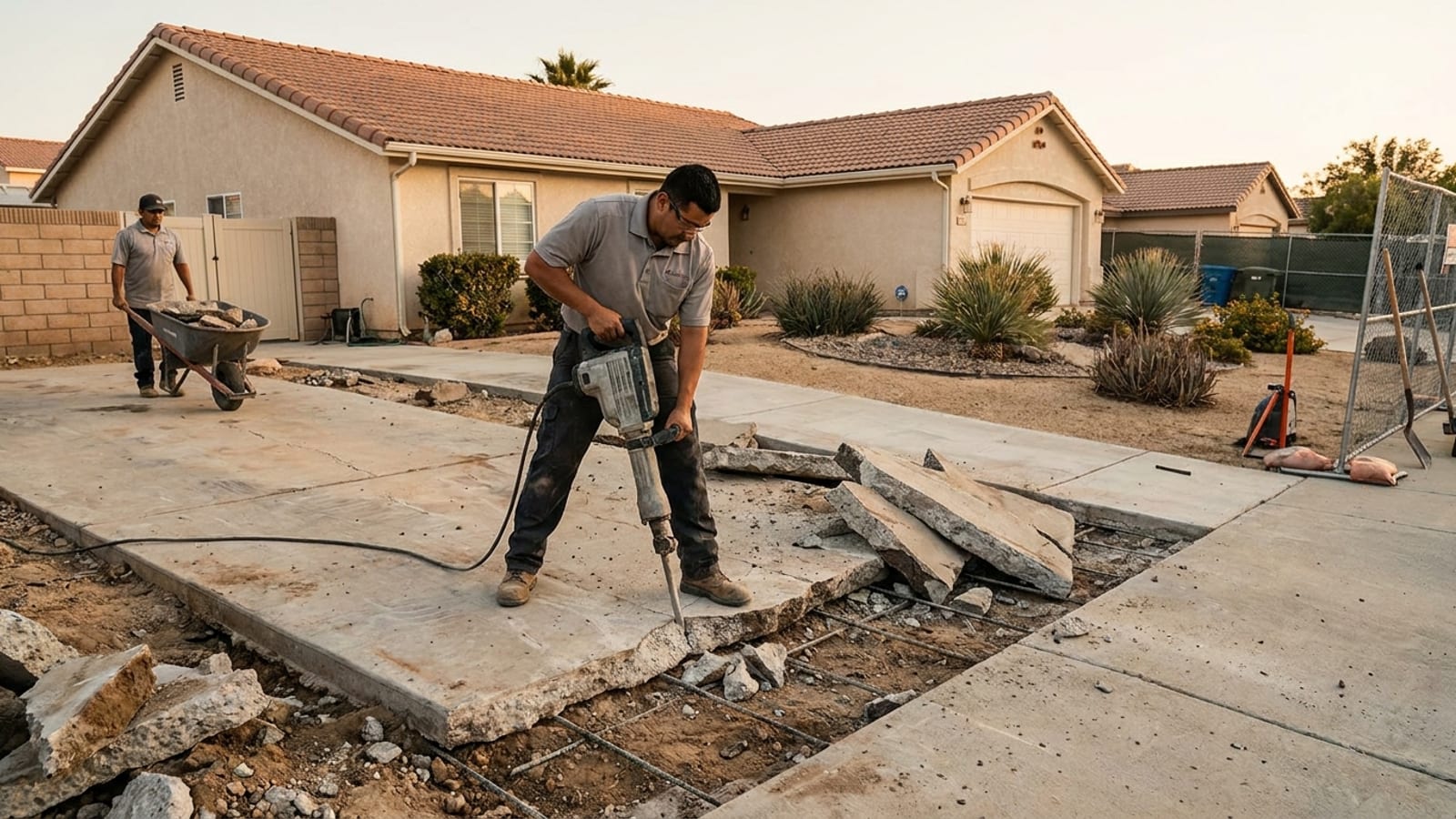
Most people call us asking about a new pour. The conversation usually starts with the slab that’s already there: “Can we save it, or does it have to come out?” When the answer is removal, the next question is what that costs. Concrete removal cost in San Diego runs $2 to $7 per square foot depending on thickness, reinforcement, access, and haul-off distance. On a typical residential driveway or patio, the total lands somewhere between $600 and $4,500. Here’s how those numbers break down.
What does concrete removal cost per square foot in San Diego?
The per-square-foot range reflects real variation in the work, not contractor markup games. Three factors set the number before you even pick up the phone:
Thickness. A standard 4-inch residential slab breaks faster and weighs less than a 6-inch RV pad or commercial floor. More weight per square foot means more labor and more haul tonnage.
Reinforcement. Unreinforced slabs from the 1960s and 70s crack into manageable chunks. Rebar or wire-mesh slabs have to be broken apart and then the steel cut out or bent free before the debris is stackable. That adds labor time and slows everything down.
Access. A slab at street level with a clear path to the curb is the easiest removal scenario. A backyard patio behind a gate, or a slab surrounded by landscaping, means wheelbarrow runs or a concrete pump instead of a direct machine load.
| Slab type | Typical cost per sq ft (San Diego) |
|---|---|
| Unreinforced, 4 inches, good access | $2.00 to $3.50 |
| Unreinforced, 4 to 6 inches, limited access | $3.00 to $5.00 |
| Rebar-reinforced, standard access | $4.00 to $6.00 |
| Rebar-reinforced, limited access or thick slab | $5.00 to $7.00 |
| Wire-mesh reinforced | $3.50 to $5.50 |
These figures include breaking, loading, and haul-off. They do not include disposal if the hauler charges a separate dump fee, which some do.
What drives concrete removal cost in San Diego specifically
Concrete removal cost in San Diego tracks with the rest of Southern California on labor, but a couple of local factors push the number on specific jobs.
Haul-off distance. San Diego has several concrete recycling yards that accept clean concrete at lower tipping fees than a general landfill. Contractors who use recyclers pass some of that savings on. Contractors who haul to the Otay or Miramar landfill pay higher tonnage fees, and that shows up in the bid. Ask your contractor where the concrete goes. It matters to your price and to the county’s waste stream.
Soil access for equipment. Inland San Diego neighborhoods in Santee, El Cajon, Lakeside, and Spring Valley often have tight lots with narrow side yards. Getting a skid-steer in requires removing a fence panel or working around sloped grade. Coastal neighborhoods like Oceanside or Encinitas tend to have wider lots but more landscaping to protect. Either way, access restrictions are San Diego’s biggest price variable after reinforcement.
Slope and drainage grade. A flat backyard patio is one job. A sloped driveway in Mission Hills or a tiered patio in Rancho Bernardo is a different job. Breaking concrete on a grade requires different footing for equipment and generates debris that has to be moved uphill or managed carefully to avoid rolling.
Haul-off and disposal fees: what’s included and what’s not
Most local concrete removal bids bundle breaking, loading, and haul-off into a single price. Some contractors quote the demo separately and add a per-ton disposal fee on top. Know which you’re getting.
Disposal fees in San Diego County run roughly $90 to $160 per ton at public facilities. A typical residential driveway, about 600 square feet at 4 inches thick, generates around 9 to 11 tons of concrete debris. That’s $810 to $1,760 in disposal alone if the bid doesn’t include it. Recycling yards often charge less, closer to $40 to $80 per ton, because clean concrete aggregate has resale value as road base.
Rebar-reinforced slabs cost more to dispose of because the steel has to be separated. Some contractors pull the rebar out on-site and haul it separately for scrap value, which can offset some of the disposal cost. Others just haul the whole mass and pay the mixed-material rate.
If you’re getting bids and one is significantly cheaper, ask directly: “Is haul-off and disposal included in this price?” A bid that doesn’t include disposal is not a fair apples-to-apples comparison.
Removal-only versus removal bundled with a new pour
This is where the math gets interesting. Concrete removal cost in San Diego drops significantly when it’s part of a larger replacement project.
When you hire us to tear out and repour a driveway or patio, the removal cost is absorbed into the overall project pricing. We’re already mobilizing equipment, already on-site for two to three days, already coordinating a ready-mix truck. The marginal cost of demolition within a replacement project is lower than standalone demo because we’re not making a separate trip just for tear-out.
Standalone removal, where you’re just getting rid of a slab with no repour planned, requires a dedicated mobilization. Equipment, crew, haul-off trailer, disposal fees. All of that overhead applies to a single line item.
For context: a standalone removal on a 400-square-foot patio might run $1,200 to $2,000 separately. Bundled into a full tear-out and repour, the same work might add $600 to $1,000 to the overall project cost. If you know you’re replacing the concrete eventually, there’s a real financial reason to do it in one job.
See our concrete driveway cost guide for what a full replacement runs, and our repair vs. replace breakdown if you’re not sure whether removal is even necessary.
DIY concrete removal: honest take
Breaking up a concrete slab yourself is possible. It’s also a day of hard labor that most homeowners underestimate before they start swinging.
You’ll need a 60 to 80 lb electric demolition hammer (rental is about $80 to $120 per day), protective gear, and a plan for the debris. Concrete is heavy. A 4-by-4-foot section of 4-inch slab weighs about 250 pounds. You can’t wheelbarrow that in one load. You’re breaking it into manageable chunks, which takes time, and then you’re still stuck with a pile of concrete you have to dispose of.
Rebar makes it significantly harder. Cutting rebar with an angle grinder on a broken slab, at ground level, is slow and physically demanding.
Disposal is the part most DIYers don’t account for. You can rent a dumpster rated for concrete (not all are), which runs $300 to $500 for a short haul in San Diego County. Or you can rent a trailer and make multiple runs to a transfer station. Either way, disposal is a real cost on top of the rental and your time.
If the slab is small (under 100 square feet), unreinforced, and you have easy dumpster access, DIY can make sense. For anything larger, getting a professional bid is usually worth a call. The labor savings often don’t cover the equipment rental, disposal, and the physical reality of the work.
What to look for in a concrete removal bid
The cheapest demo bid in San Diego is not always the best deal. A few things to check before you sign:
Disposal included or extra. As covered above, always confirm haul-off and dump fees are in the price. The bid that looks $400 cheaper may have disposal excluded.
Equipment appropriate for the job. A skid-steer or mini-excavator is the right tool for most residential slab removal. A crew doing it by hand with sledgehammers is slower, costlier in labor hours, and harder on your yard. Ask what equipment they’re bringing.
Insurance and licensing. Concrete removal is classified as a demolition subcontract in California. The contractor should carry general liability and workers’ comp. If something goes wrong with an unlicensed crew on your property, you’re exposed.
Clear scope. What’s being removed, down to what depth, including or excluding any base material beneath the slab. If the base rock is contaminated or if there’s a buried utility conflict, you want that surfaced in writing before work starts.
Recycling versus landfill. As noted, this affects price. It also matters for environmental reasons. San Diego County has built good concrete recycling infrastructure. A contractor who uses it is giving you a cleaner bid and keeping debris out of landfill.
If you’re also weighing whether removal is even the right call, our concrete repair services are worth reviewing. Cracks, settled sections, and surface spalling don’t always require full removal. But when the slab is structurally compromised or the grade has shifted, removal is the only path to a lasting fix.
Get a concrete removal quote in San Diego County
We do free onsite estimates across San Diego County. We’ll look at the slab, identify the reinforcement type, assess access, and give you a flat-rate number for removal or a bundled price for removal and replacement. No satellite photo guesses. No mystery disposal fees added later.
Call (858) 925-5546 or use the contact form to schedule your free estimate. We typically turn quotes around within 48 hours.