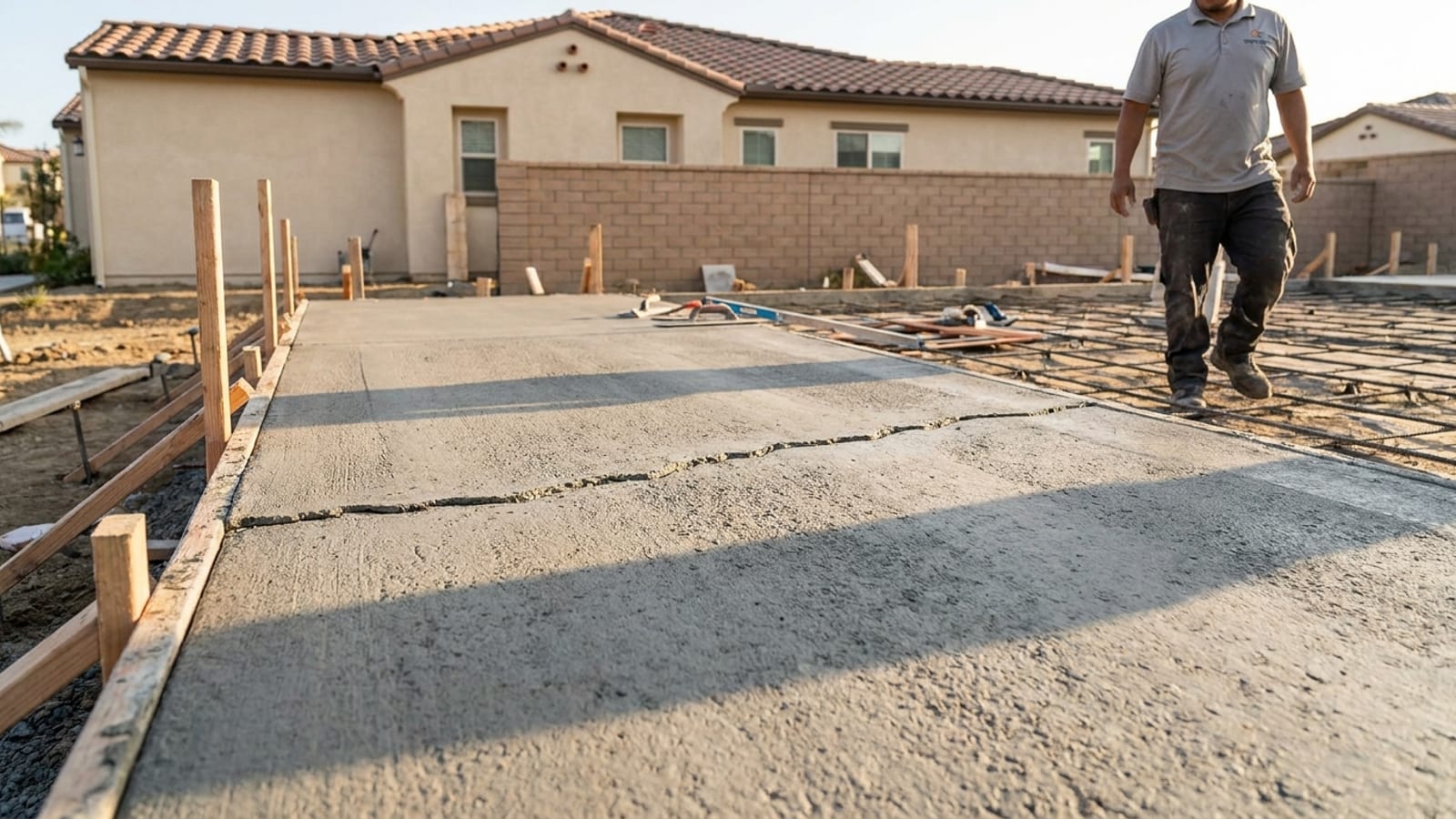
Concrete cracks. That is not a defect, it is a material property. The question isn’t whether your slab will crack, but why does concrete crack on your particular project, where it will crack, and whether you had any say in the matter. Most cracks we see across San Diego County fall into two buckets: cracks that were preventable and cracks that were coming no matter what. Knowing which is which determines whether you need to call a contractor or just keep an eye on it.
Here is the honest breakdown of what causes concrete to crack, what you can control, and how to read a crack before deciding what to do with it.
Why does concrete crack? The short version first
Concrete is strong in compression and weak in tension. When any force (shrinkage, settlement, load, thermal expansion, tree roots) pulls the slab in two directions at once, the concrete fails at its weakest point. That failure is a crack. Every cause on this list traces back to some version of tension the concrete could not handle.
Plastic shrinkage and fast drying
This is the most common cause of surface cracking on new slabs, and it happens before the concrete even sets.
When wet concrete is exposed to hot, dry, or windy conditions, moisture evaporates from the surface faster than the mix can release bleed water from below. The surface tries to shrink while the base stays wet. That difference in shrinkage creates tension in the top layer, and the result is a map-crack pattern, shallow, irregular lines that show up within hours of the pour.
San Diego’s dry heat and coastal wind make this a real risk from late spring through September. A good contractor manages it with sun shades, fog mist, evaporation retarder, and scheduling pours early morning when temperatures are lower. Plastic shrinkage cracks are almost entirely preventable with proper pour-day management.
Drying shrinkage over time
Even without fast surface evaporation, concrete shrinks as it cures. A typical slab loses volume as the water in the mix evaporates and the chemical hydration process completes. Over the first 30 days, a 100-foot-long slab can shrink roughly 3/8 of an inch.
That shrinkage has to go somewhere. If the slab is unreinforced and has no control joints to guide it, the shrinkage creates a crack wherever the concrete is weakest, usually near a corner, at a utility penetration, or at a change in thickness.
Missing or late control joints
This is the single most preventable cause of cracking, and it is also the one we see skipped most often on cheap jobs.
Control joints are saw cuts or tooled grooves placed in the slab at regular intervals, typically every 8 to 10 feet on a driveway or patio. They create a planned weak point where the slab can crack along a straight, controlled line below the surface instead of randomly across the top.
The timing matters as much as the placement. Saw-cut joints need to happen within 4 to 24 hours of the pour, before the concrete fully sets. Joints cut too late (or not cut at all) leave the slab to crack wherever it wants. We see driveways that have a perfect grid of control joints with zero visible surface cracking, and driveways that have no joints with cracks running diagonally across the middle. The difference is almost entirely the joints.
For more on how we plan joint patterns on driveway projects, see our post on whether you need rebar in a driveway.
Poor base prep and settlement
Concrete is only as stable as what is under it. If the sub-base settles unevenly after the pour (one corner drops a half-inch, one section compresses over a buried void) the slab bends to follow. Concrete does not bend. It cracks.
The most common base failures we see in San Diego:
- Uncompacted fill. Someone poured over disturbed soil without compacting it in lifts. The fill keeps settling for years.
- Washed-out base. Irrigation, drainage issues, or a broken line erodes the base material from underneath. The slab is left spanning a void.
- Tree root extraction. A large root is removed, leaving a void that collapses slowly.
- Poor drainage design. Water pools under the slab, softens the base, and causes differential settlement.
Settlement cracks tend to run diagonally or erratically and are often accompanied by one side of the crack sitting higher than the other, what contractors call displacement. That offset is a structural indicator that the base, not the concrete itself, is the problem.
Thin slab and no rebar
A 3-inch slab with no rebar has almost no resistance to bending forces. Once the base shifts even slightly, there is nothing to distribute the load and the slab snaps. The minimum for a residential driveway is 4 inches with a #4 rebar grid. RV pads need 5 to 6 inches.
Rebar does not prevent cracking entirely, but it holds the cracked pieces together and prevents displacement. A reinforced slab with a crack is still functional. An unreinforced slab with a crack often develops into a trip hazard quickly.
Thermal expansion and contraction
Concrete expands when it heats up and contracts when it cools. San Diego’s climate is mild enough that thermal cracking is less of a driver here than in extreme-climate states, but it still matters on large slabs, dark-colored concrete under direct sun, and anywhere with significant temperature swings between day and night, inland Escondido and El Cajon especially.
Expansion joints in long runs allow the slab to move without building internal stress. Skipping them on a 40-foot-plus pour is asking for a mid-slab crack somewhere around year three.
Overload
Concrete slabs are designed for a specific load range. Residential driveways handle passenger vehicles without issue. Problems start when heavy equipment (a concrete truck, a moving van, a loaded dump truck) parks or drives on a slab built to residential spec.
Point loads are worse than distributed loads. A jack stand under an RV, a dumpster on steel feet, or a heavy planter with no pad can punch through a standard slab. If you regularly park heavy equipment, the solution is a thicker slab with heavier reinforcement from the start, not a patch after the fact.
Tree roots
Mature trees near a concrete slab are a long-term cracking risk. As roots grow outward, they push up on the underside of the slab and create localized heave. The crack usually appears near the tree and runs perpendicular to the direction of root growth.
Tree-root cracking is common in older San Diego neighborhoods (Normal Heights, North Park, Kensington) where established street trees and mature landscaping are part of the character. The fix usually involves root barriers, root pruning, and section replacement rather than the whole slab.
San Diego’s expansive clay soils
This deserves its own section because it affects so much of inland San Diego County. The clay-rich soils in Escondido, Poway, El Cajon, Santee, and parts of Vista shrink when dry and swell when wet. A soil that changes volume seasonally is working against every concrete slab sitting on top of it.
On a typical year, these soils can move vertically by half an inch to an inch or more across the winter-to-summer cycle. That movement, multiplied across a large slab footprint, creates significant stress, especially at slab edges and corners where the movement is greatest.
The mitigation is heavier base prep: deeper compaction, over-compacted Class II road base, and more aggressive joint patterns. A slab poured on coastal sandy soil in Carlsbad does not need the same base treatment as a slab in Escondido. We adjust our approach based on where the project is.
How to read a crack: cosmetic vs. structural
Not every crack is a problem. Here is a practical guide to reading what you are looking at.
| Crack type | Likely cause | Cosmetic or structural | Action |
|---|---|---|---|
| Hairline surface crack, under 1/16” wide, no displacement | Drying shrinkage, fast curing | Cosmetic | Monitor; seal if near water source |
| Map cracking on surface only | Plastic shrinkage during pour | Cosmetic | Monitor; no structural risk |
| Straight crack along a control joint | Working as designed | Not a crack, it’s a joint | No action needed |
| Diagonal crack, no displacement, stable width | Shrinkage, minor settlement | Usually cosmetic | Monitor for growth or displacement |
| Crack wider than 1/8”, especially if growing | Settlement, overload, root heave | Potentially structural | Get it evaluated |
| Crack with displacement (one side higher than other) | Differential settlement | Structural | Repair or replace the section |
| Horizontal crack in a retaining wall or stem wall | Lateral soil pressure | Structural | Engineer review immediately |
| Crack with active water intrusion | Settlement or foundation movement | Structural | Evaluate and repair |
The two key indicators that move a crack from cosmetic to structural are width over 1/8 inch and displacement, any offset between the two sides of the crack. A hairline crack that has been the same width for three years is cosmetic. A crack that was 1/16 inch last spring and is now 1/4 inch is active and needs attention.
For a full breakdown of when to patch versus when to replace a slab section, read our guide on repair vs. replace concrete.
What you can prevent and what you cannot
Some cracking is unavoidable. A hairline crack or two on a large slab is normal and does not mean anything was done wrong. The industry standard tolerance for residential flatwork accepts hairline cracking as part of the material.
What is preventable: plastic shrinkage cracks (pour management), random shrinkage cracks (control joints), settlement cracks (base prep and compaction), and rebar failure cracks (proper reinforcement spec).
What is harder to prevent entirely: thermal movement on large slabs, tree root pressure over 20 years, and soil movement on expansive clay sites. Good design and base prep minimize these risks but do not eliminate them.
The difference between a slab that holds up for 30 years and one that looks bad in five is almost always base prep, control joints, and rebar, not the brand of concrete or who delivered it.
When to get a repair vs. when to keep watching
If the crack is hairline, stable, and dry: watch it. Mark the ends with a pencil and check the length every six months. If it is not growing, it is cosmetic.
If the crack is wider than 1/8 inch, has displacement, or is actively growing: get it looked at. Filling a structural crack with polyurethane caulk does not fix the underlying problem. It just hides it until it comes back wider.
If there is water intrusion through a slab or foundation crack: treat it as structural until proven otherwise.
Our concrete repair services include slab evaluation, crack mapping, and honest recommendations on whether a section can be repaired or needs to come out. We do not upsell replacement on cracks that can be filled, and we do not patch cracks that are going to fail again in two years. For more on our repair process, see our post on concrete crack repair in San Diego.
Talk to someone who works with San Diego slabs
If you have a crack you are not sure about, we are happy to take a look. We work across San Diego County (coastal and inland) and we know how the soils and climate here affect concrete over time. A five-minute look at a crack tells us a lot. Call (858) 925-5546 to schedule a free evaluation or use the contact form on our site.