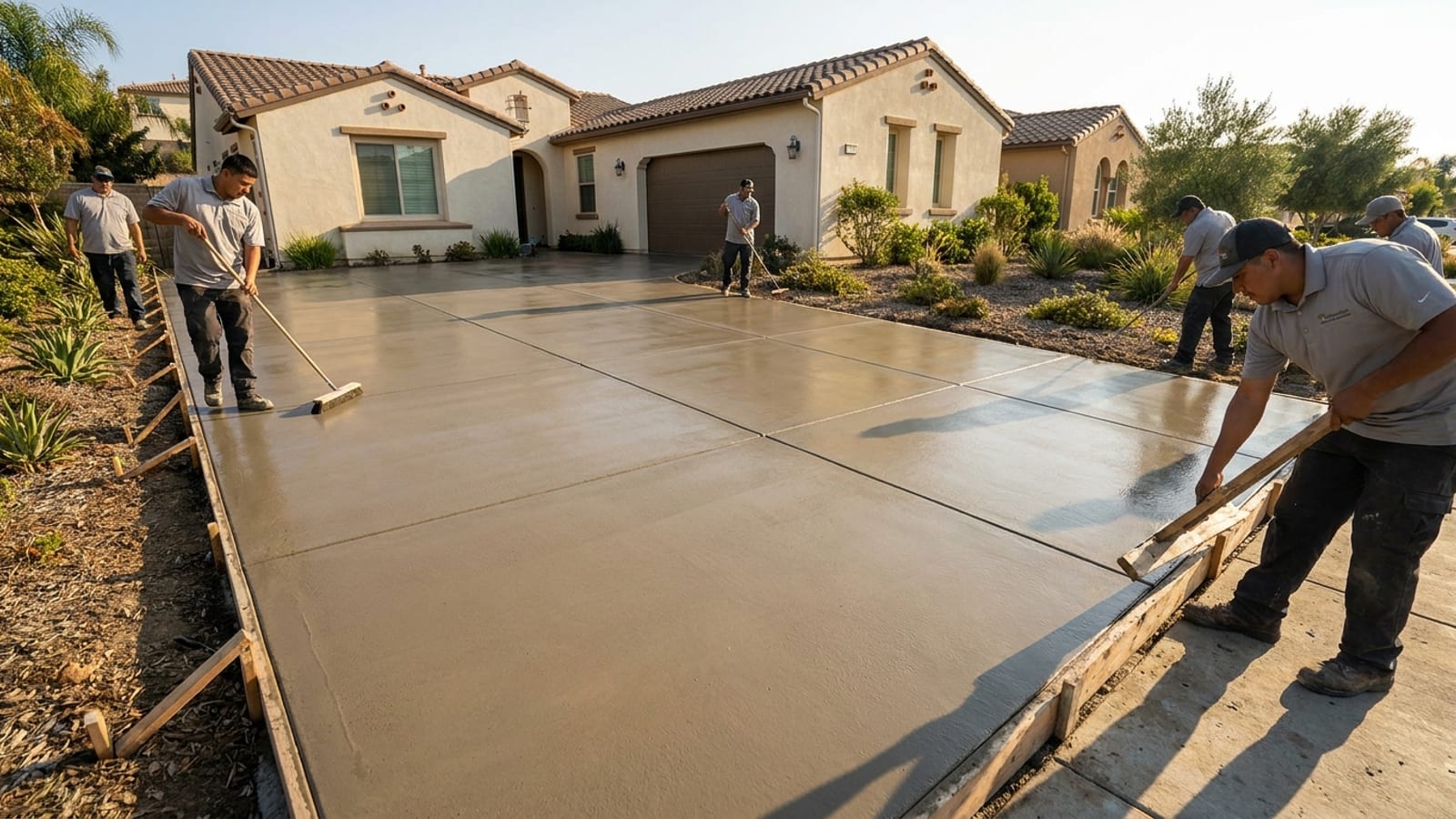
Concrete sealing cost in San Diego runs $1 to $5 per square foot for professional work, depending almost entirely on which sealer goes down and how much prep the surface needs. That’s a wide range, and the spread is real. A penetrating silane-siloxane sealer on a clean driveway lands at the low end. A two-coat decorative urethane on a stamped patio that needs cleaning and crack repair lands near the top. This post breaks down exactly where on that range your project likely falls, what the money actually pays for, and how San Diego’s UV and coastal salt load changes the resealing math compared to other markets.
What does concrete sealing cost per square foot in San Diego?
The short answer: $1 to $1.50 per square foot for a penetrating sealer, $1.50 to $2.50 per square foot for acrylic, and $3 to $5 per square foot for decorative epoxy or urethane systems. These are installed prices, labor and materials together.
Here’s the full breakdown by sealer type:
| Sealer type | Installed cost/sq ft | Reapply interval (SD) | Best use |
|---|---|---|---|
| Penetrating (silane-siloxane) | $1.00 to $1.50 | 5 to 10 years | Plain driveways, patios, walkways |
| Acrylic (solvent or water-based) | $1.50 to $2.50 | 2 to 3 years | General use, light sheen, some color enhancement |
| Decorative epoxy / urethane | $3.00 to $5.00 | 3 to 5 years (topcoat) | Stamped, colored, polished surfaces |
Those intervals are San Diego-calibrated. UV intensity here is among the highest in the continental US, and coastal zip codes from La Jolla down to Chula Vista get meaningful salt-air exposure year-round. Both factors degrade acrylic and epoxy topcoats faster than the national averages you’ll see cited in manufacturer literature.
What does a typical San Diego sealing project cost in total?
Most residential sealing projects fall into three buckets:
Standard driveway (500 to 700 sq ft, penetrating or acrylic sealer): $600 to $1,400. This assumes the surface is in reasonable shape, needs a wash, no crack chase or patching.
Patio or pool deck (300 to 500 sq ft, acrylic sealer): $400 to $1,000. Pool decks near the ocean often need a non-slip aggregate added to the sealer coat, that adds $0.25 to $0.50 per square foot.
Stamped or colored decorative surface (any size, urethane or epoxy system): $3 to $5 per square foot all-in. On a 600 square foot stamped driveway, that’s $1,800 to $3,000. This is where the cost difference between sealers matters most, because the surface you’re protecting cost $8,000 to $13,000 to install. (See our full breakdown of stamped concrete cost in San Diego.)
How often do you need to reseal concrete in San Diego?
The honest answer depends on the sealer type and where your property sits.
Penetrating sealers work by bonding chemically below the surface, they don’t form a film, so UV and traffic don’t wear them away the same way. A good silane-siloxane penetrating sealer properly applied to a clean surface holds for 5 to 10 years before the concrete stops beading water. Some last longer on covered patios. These are the low-maintenance choice.
Acrylic sealers form a thin topcoat that protects against stains and moisture and adds sheen. That film wears under traffic and UV. In San Diego’s coastal neighborhoods (Encinitas, Pacific Beach, Coronado, National City) we recommend recoating every 2 years. Inland, Escondido, El Cajon, Santee, you might stretch to 3. You can see the sealer is due when it starts to look chalky, loses its sheen, or water no longer beads on the surface.
Epoxy and urethane systems on decorative concrete are the most durable topcoats, but they still require periodic re-coating of the topcoat layer (not the full system) every 3 to 5 years. The base coat and color layer underneath stay intact much longer when the topcoat is maintained.
The consistent theme across all three: San Diego’s UV is real, and skipping a recoat cycle is the most common reason decorative finishes look washed out at year 5 when they should still look good at year 15. For more on choosing between sealer systems, see our guide on which concrete sealer is right for your project.
What prep is included in a professional sealing quote?
This is where bids vary most. The sealer itself is often 20 to 30 percent of the project cost. The rest is prep, and prep is what separates a sealing job that lasts from one that peels in 18 months.
A complete professional sealing job should include:
- Pressure washing. Concrete holds oil, algae, mineral deposits, and residual old sealer. A proper wash before any new sealer goes down is not optional.
- Degreasing. Garage aprons and driveway surfaces near vehicles need a chemical degreaser pass. Oil contamination under a new sealer coat bubbles and peels.
- Crack inspection and routing. Active cracks need to be chased and filled with a flexible polyurea filler before sealing. Sealing over open cracks locks moisture in, not out.
- Old sealer removal (if applicable). If the previous sealer is peeling, a stripper application and pressure wash are required before the new coat goes down. This is the most time-consuming prep step and adds $0.25 to $0.75 per square foot to the bid.
- Application in the right conditions. Concrete surface temperature matters. Solvent-based acrylics applied in direct sun above 90°F flash too fast and leave lap marks. Good contractors schedule early morning starts in summer.
If a bid is notably cheap, prep is almost always the shortcut. A light rinse and a spray-and-go is fast, but the sealer won’t bond properly and you’ll see peeling within a year.
DIY vs. professional sealing: where the cost and risk land
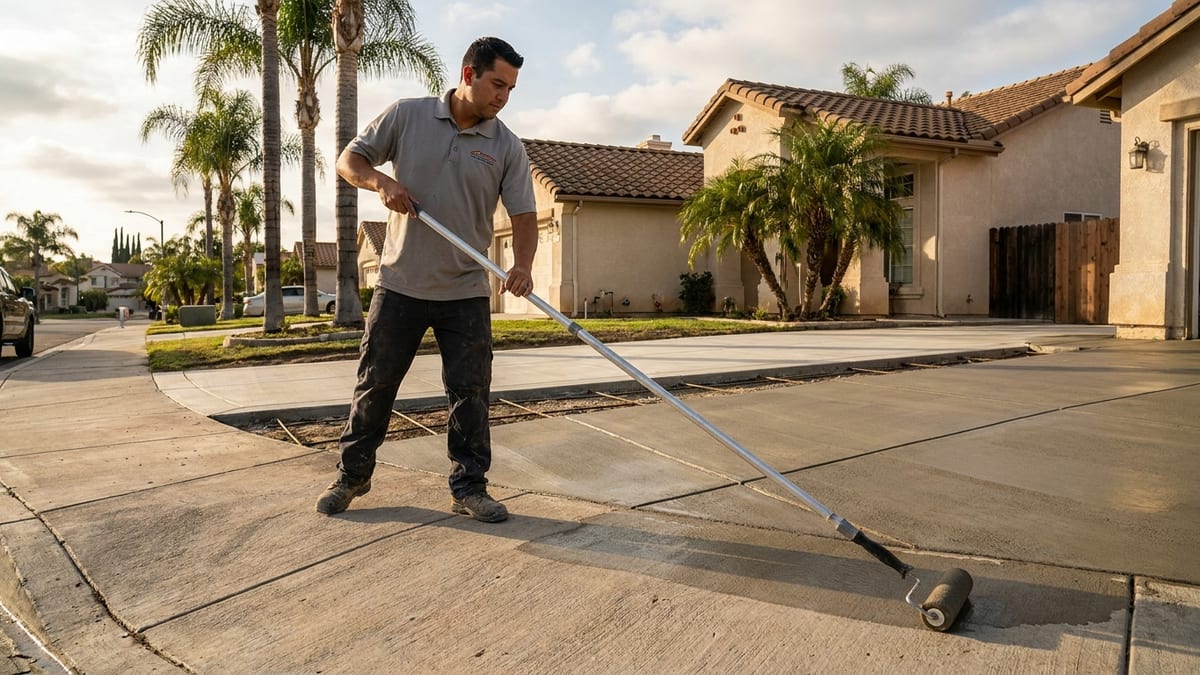 Most sealing cost is prep and labor. The right product for the surface matters more than the gallon price.
DIY sealing is realistic for plain concrete, a flat driveway or basic patio where you’re applying a penetrating or water-based acrylic sealer. The sealer itself runs $40 to $75 per gallon for penetrating and $30 to $60 per gallon for acrylic. A 500 square foot driveway uses 2 to 4 gallons depending on porosity, so material cost is $80 to $250. Add a pressure washer rental and you’re around $200 to $350 total.
Where DIY goes wrong:
Wrong product choice. Solvent-based sealers on a porous surface without proper prep blush white on high-humidity days. That’s a visible and difficult-to-fix failure mode.
Over-application. Two thin coats is always correct. One thick coat traps moisture under the film and creates bubbles. This is the most common DIY mistake.
Decorative and stamped surfaces. Don’t DIY these. The color, texture, and integral finish represent a significant investment. Applying the wrong sealer (a high-gloss acrylic over a surface that needs a penetrating base) can lock in moisture, cause the color to cloud, or cause the topcoat to delaminate. The cost to strip and redo a bad sealing job on a stamped surface can exceed the original sealing cost.
Our concrete sealing service covers cleaning, prep, product selection, and application. We use the correct sealer for the surface type, climate zone, and traffic level. No guessing on product.
What sealing actually buys you, and what it doesn’t
Sealing is maintenance, not repair. It slows deterioration. It does not fix it. There are a few things worth being clear about before you spend money on a sealing job:
Sealing extends the life of good concrete. A properly built slab that’s sealed on a reasonable cycle lasts 25 to 30 years in San Diego’s climate. One that never gets sealed is fighting UV, moisture, stain, and freeze-thaw cycles (yes, even here, elevation matters, and Ramona, Alpine, and Julian get real cold) without any protection.
Sealing protects decorative finishes specifically. Stamped and colored concrete without periodic resealing fades. The pigment in integral color concrete is UV-stable, but the sealer is what keeps the depth and richness of the color visible. A faded, chalky stamped surface is almost always a sealing failure, not a concrete failure.
Sealing does not repair structural cracks. If your concrete has active cracks from settlement or failed control joints, sealing fills the surface but doesn’t address the underlying issue. Structural work comes before sealing, not after.
Sealing does not make bad concrete good. Surface spalling, scaling, or pop-outs from a poor original pour or freeze damage need evaluation before you pour sealer on top of them. Sometimes the answer is resurfacing, not sealing.
Get a sealing estimate for your San Diego property
Onsite estimates across San Diego County are free. We walk the surface, assess what prep it needs, recommend the right sealer for the surface type and location, and quote a flat rate before any work starts. Call (858) 925-5546 or use the contact form and we’ll get you scheduled.