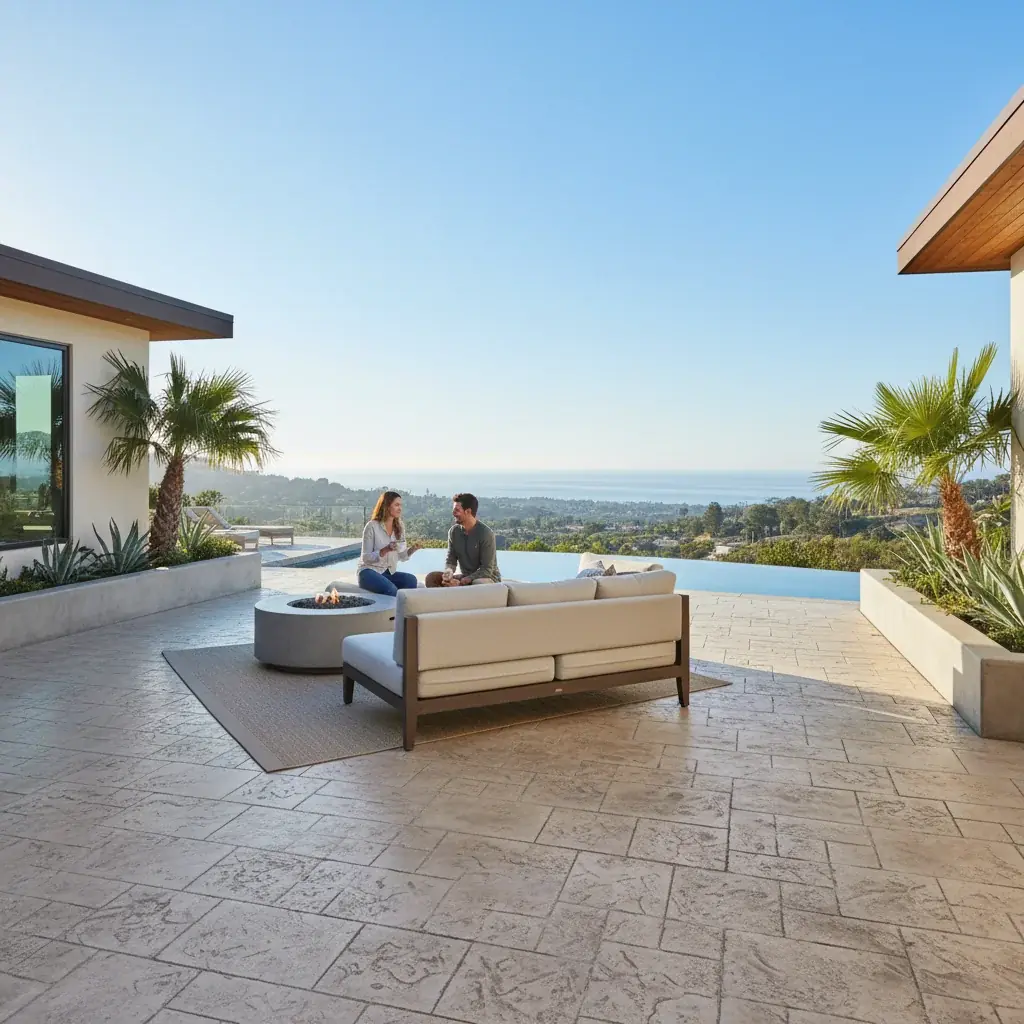
Stamped concrete in San Diego County runs $15 to $25 per square foot installed, depending on color count, pattern, access, and how much soil and drainage prep your lot needs. A 400-square-foot patio lands between $6,000 and $9,500. National calculators quote $12 to $20 because they assume flat, stable ground. Most of San Diego does not have that, and the difference shows up in the bid. Here is what stamped concrete actually costs here, and why.
What does stamped concrete cost in San Diego?
Pricing tracks the complexity of the finish and the condition of the site:
| Finish tier | Cost per sq ft | What it includes |
|---|---|---|
| Single color, one pattern | $15 to $18 | Integral or broadcast color, basic flagstone or slate stamp |
| Two color, one pattern | $17 to $21 | Base color plus antiquing release, one stamp set |
| Two color with stamped border | $19 to $23 | Field pattern plus a contrasting running-bond or brick border |
| Premium multi-color, custom | $22 to $28 | Multiple releases, hand-detailed grout lines, custom color match |
Translated to whole projects at typical San Diego sizes:
- 300 sq ft side yard or entry: $4,500 to $7,500
- 400 sq ft backyard patio: $6,000 to $9,500
- 600 sq ft patio plus walkway: $9,000 to $14,000
- 800 sq ft driveway: $12,000 to $20,000
These are real installed numbers, not material-only. A bid far below this range is usually skipping base prep, reinforcement, or both, and those are the two things that keep stamped concrete from cracking on our soil.
Why San Diego costs more than the national calculators
HomeGuide, Angi, and Fixr quote a national average. They cannot price your dirt. Four local realities push San Diego stamped concrete above those numbers.
Expansive clay soil. Much of the county sits on clay that swells when wet and shrinks when dry. That movement, called heave and settlement, cracks slabs that were poured on raw ground. A proper job adds compacted Class II base and sometimes a deeper section or thicker rebar grid. That prep is $1 to $3 per square foot the calculators never count. Skip it and you pay later in repairs. We cover the failure side in repair vs. replace concrete.
Drainage and drought swings. San Diego goes from bone dry to atmospheric-river wet. Clay reacts hard to that cycle. A stamped slab has to slope away from the house at least 1/8 inch per foot and tie into real drainage. On a flat lot that means added grading or a drain line, which adds cost but prevents water ponding against your foundation.
Coastal salt air. From Coronado to Carlsbad, salt air is tougher on sealer. Stamped concrete near the coast needs a quality solvent-based or hybrid sealer and a tighter reseal schedule, which raises the long-term number. More on that in picking the right sealer.
Permits and access. A standalone patio usually needs no permit. But work in the public right-of-way, a driveway approach, or anything tied to drainage or a retaining wall can trigger a city or county permit, and Title 24 can apply when a project touches the home envelope. Tight side-yard access that forces a concrete pump instead of a chute adds $400 to $1,500 to the pour.
What actually drives your stamped concrete price
Two patios of the same size can quote thousands apart. The variables:
- Color count. One integral color is cheapest. A second antiquing color in the release doubles the visual depth and adds a few dollars per foot. Premium custom matching costs the most.
- Pattern and border. A simple ashlar slate field is fast. Add a contrasting stamped border, a medallion, or hand-cut grout lines and labor climbs.
- Site prep. Pouring over dirt is cheaper than tearing out an old slab or pavers. Clay that needs over-excavation and import base costs more than sandy coastal soil.
- Access. Wide gate and a clear path for the ready-mix truck keeps it cheap. Pump-only access, narrow gates, or wheelbarrow runs add hours.
- Slope and drainage. A flat, draining lot is simple. Significant grading, a drain line, or tie-in to a retaining wall adds engineering and cost.
- Thickness and rebar. Four inches with a rebar grid is the residential minimum here. On reactive clay or under vehicles, a thicker section or tighter steel is worth it. See whether you need rebar.
Stamped concrete vs. the alternatives
Cost only makes sense next to the options:
| Material | Cost per sq ft | Notes |
|---|---|---|
| Broom-finish concrete | $10 to $16 | Cheapest, reads as utility concrete |
| Stamped concrete | $15 to $25 | Look of stone or brick, one continuous slab |
| Exposed aggregate | $13 to $20 | Slip-resistant, durable, different look |
| Paver patio | $20 to $35 | Higher cost, joints can shift and weed |
| Natural flagstone | $25 to $45 | Premium, highest material and labor |
Stamped sits in the sweet spot: the look of stone for roughly half the cost of real flagstone, with no shifting joints to weed. The honest tradeoff is that one slab cracks where pavers flex, which is exactly why soil prep matters so much here. If you are weighing finishes, exposed aggregate vs. stamped breaks down the look-and-durability call.
What stamped concrete costs to maintain
The install price is not the whole number. Plan for upkeep:
- Reseal every 2 to 3 years, closer to every 2 near the coast: $0.75 to $1.50 per square foot. A 400-square-foot patio is $300 to $600 each cycle.
- Pressure wash before each reseal.
- One color refresh around year 10 to 15: light grind and recoat, $3 to $6 per square foot.
Over 25 years, total cost of ownership runs roughly 30 to 40 percent above the install price. Most homeowners recover that in resale value, and stamped concrete that was sealed on schedule still looks right a decade in.
How to read a stamped concrete bid
A complete bid lists the work, not just a square-foot number. Look for:
- Base prep: compacted Class II road base, 4 inches minimum, in lifts
- Reinforcement: #3 or #4 rebar grid, sized for your soil and load
- Thickness: 4 inches residential minimum, more under vehicles
- Concrete spec: 3,000 to 4,000 PSI mix
- Control joints: saw-cut within 24 hours so cracks stay hidden
- Isolation joint: flexible joint where the slab meets the house
- Color and pattern: named colors, stamp set, border detail
- Sealing: included or quoted as a separate line, and which sealer
If two bids are thousands apart, the cheap one is almost always thinner, lighter on steel, or short on base. On clay, that is where the savings turns into a crack.
Frequently asked questions
Is stamped concrete cheaper than pavers in San Diego? Usually, yes. Stamped runs $15 to $25 per square foot installed; pavers run $20 to $35. Stamped is one continuous slab, so there are no joints to shift or weed. Pavers can be repaired piece by piece, which is their advantage.
Does stamped concrete crack on San Diego clay soil? All concrete cracks somewhere. The job is to control where. Proper base prep, rebar sized for the soil, and saw-cut control joints keep cracks at the joints where you do not see them. Skipping that prep on reactive clay is the main reason stamped slabs fail here.
Do I need a permit for stamped concrete in San Diego? A standalone backyard patio usually does not. A driveway approach, work in the public right-of-way, or anything tied to drainage or a retaining wall can require a city or county permit. We flag permit needs during the estimate so nothing stalls mid-job.
How long does stamped concrete last in San Diego? With on-schedule sealing, 25 years or more. Coastal salt air shortens the reseal interval to about every two years. Inland, every three is fine. The slab outlives the sealer, so resealing is what protects your investment.
Why is my stamped concrete quote higher than online calculators? National calculators assume flat, stable ground. San Diego’s expansive clay, drainage swings, and coastal sealing needs add real prep cost. That prep is what keeps the slab from cracking, so the higher number is usually the honest one.
Can stamped concrete go over an existing slab? Sometimes, with an overlay, if the base slab is sound. If the existing slab is cracked or heaved from soil movement, an overlay just hides the problem. We assess the base slab before recommending an overlay versus a tear-out and repour.
Get a real number for your project
Online calculators give you a national average. Your yard is not average. The only way to a real number is someone walking your lot, reading the soil and access, and quoting the actual scope.
Onsite estimates are free across San Diego County. We measure the space, check drainage and access, recommend a color and pattern that fits your home, and quote a flat rate, with the base prep and reinforcement spelled out. See the full stamped concrete service for what is included, or call (858) 925-5546 to book a walkthrough.