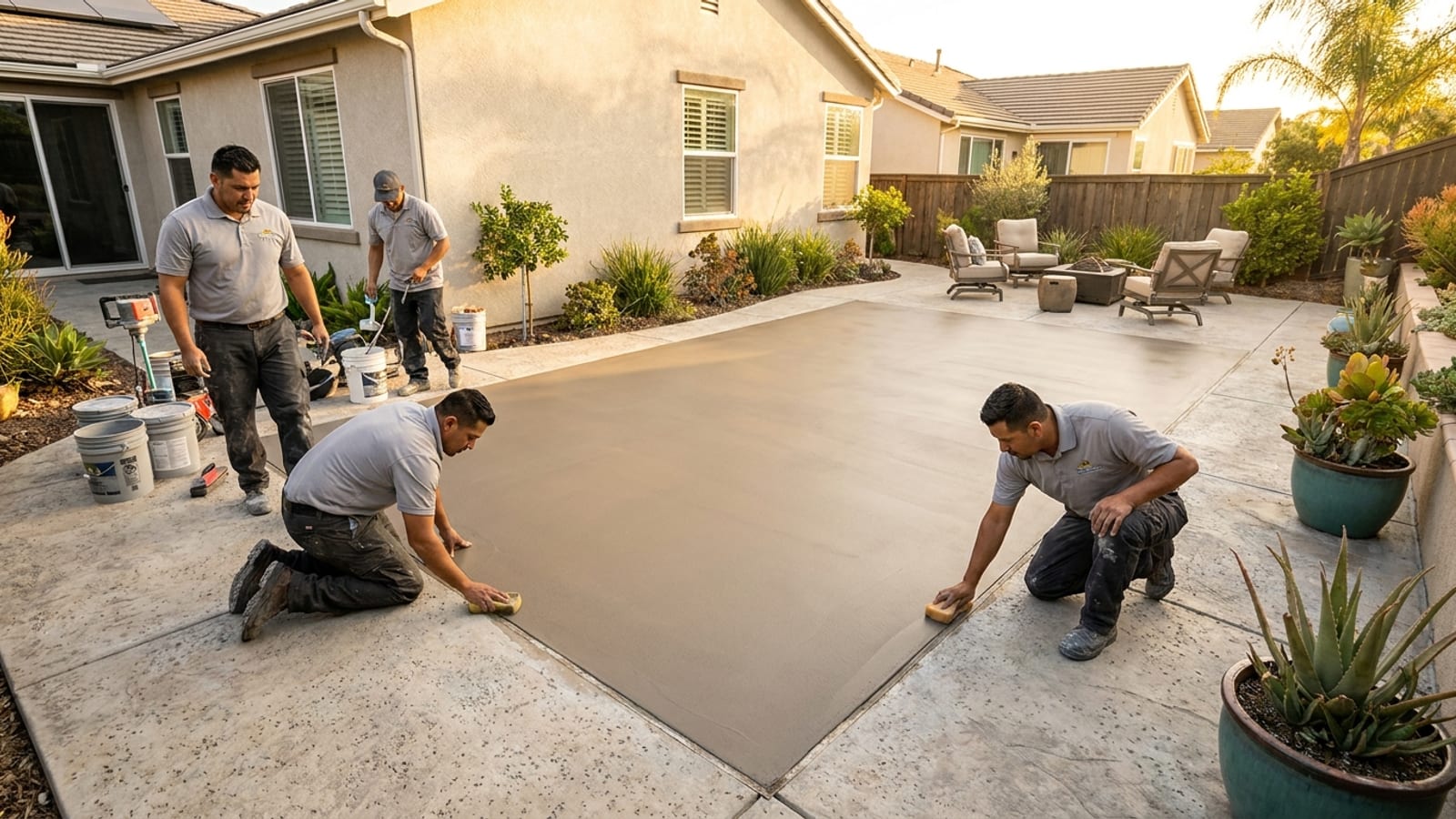
Concrete resurfacing in San Diego gets asked about a lot, usually after a homeowner looks at a faded, pitted, or cracked patio and wonders whether they can avoid tearing it out. The honest answer is: sometimes yes, sometimes no, and the difference matters. An overlay on the right slab saves real money and looks great for a decade or more. An overlay on the wrong slab peels, cracks, and costs you twice. This post lays out what resurfacing actually is, which overlay types make sense for which situations, what it costs, and when replacement is the smarter call.
What is concrete resurfacing and how does it work?
Resurfacing means applying a new layer of material over an existing concrete slab rather than tearing it out and pouring fresh. The overlay bonds to the old surface, fills pitting and minor defects, and gives you a clean face you can leave plain or finish decoratively.
The key word is bond. An overlay is only as good as its connection to the slab below. Surface prep (grinding, shot-blasting, or acid etching) is what makes that bond work. Skip prep and the overlay peels in one or two San Diego summers. Do it right and the overlay stays put.
Most overlays run 1/8 inch to 1/2 inch thick. Some decorative systems go slightly thicker. None of them add meaningful structural strength, that part of the job still belongs to the original slab.
What are the types of concrete overlays?
There are four main systems used for concrete resurfacing in San Diego. Each has a different look, thickness, and best use case.
| Overlay type | Best use | Rough cost per sq ft | Typical durability |
|---|---|---|---|
| Micro-topping | Interior floors, pool decks, smooth patios | $3 to $7 | 7 to 12 years with sealing |
| Spray-down / knockdown | Pool decks, patios, driveways | $3 to $6 | 8 to 12 years with sealing |
| Stamped overlay | Patios, entries, decorative driveways | $7 to $20 | 10 to 15 years with sealing |
| Self-leveling overlay | Garage floors, interior slabs | $3 to $8 | 10 to 15 years with sealing |
Micro-topping is a thin polymer-modified cement applied 1/16 to 1/8 inch thick. It produces a smooth, near joint-free surface that looks modern and minimal. Common on pool decks and interior floors. It does not hide large cracks or uneven sections, the slab needs to be close to flat already.
Spray-down or knockdown texture is the most common system on San Diego pool decks and back patios. A polymer-modified slurry is sprayed on and then knocked down with a trowel to create texture. It’s slip-resistant, handles UV well, and is forgiving of minor surface imperfections. A good spray-down job blends in at the edges and holds color reasonably well when sealed regularly.
Stamped overlay takes an overlay base and presses texture into it before it sets, mimicking stone, brick, slate, or wood grain. It looks significantly better than plain concrete and costs less than a stamped replacement pour. The surface needs to be flat and sound, stamped overlays do not hide heaving or uneven sections any better than other systems.
Self-leveling overlay is a pourable compound that finds its own level across a floor. It’s used on garage floors and interior slabs that have minor dips or surface damage. Once cured, you can leave it natural, apply a topcoat, or add a decorative finish over it.
For more on decorative finish options that pair well with these systems, see our post on colored concrete finishes in San Diego.
How much does concrete resurfacing cost in San Diego?
San Diego labor costs run above national averages, so expect to pay at the higher end of published ranges. Here’s what we see on actual jobs:
- Spray-down / knockdown on a patio or pool deck: $3 to $6 per square foot
- Micro-topping on a pool deck or interior floor: $4 to $8 per square foot
- Stamped overlay on a patio or driveway apron: $8 to $18 per square foot
- Self-leveling overlay on a garage floor: $4 to $8 per square foot, often plus a topcoat
A 500 square foot patio resurfaced with spray-down texture typically runs $1,500 to $3,000. That same footprint replaced with fresh concrete runs $4,000 to $8,000. The savings are real, but only if the existing slab is actually worth resurfacing.
Surface prep, bonding agent, and sealer are part of the job and should be included in any honest bid. A quote that does not mention prep should raise questions.
When is a concrete slab a good candidate for resurfacing?
The slab has to be structurally sound. That is the non-negotiable starting point. If the structure underneath is solid, resurfacing works well in these situations:
Surface scaling or pitting. San Diego’s sun and occasional freeze-thaw in inland areas (Ramona, Alpine, Julian) cause surface concrete to flake. If the damage is in the top 1/4 to 1/2 inch and the slab underneath is solid, an overlay bonds well and solves the problem.
Hairline or minor surface cracks. Cracks that have not shifted vertically and are under about 1/4 inch wide can be filled before overlay application. They may telegraph through a thin overlay over time, but a thicker stamped system can hide them.
Cosmetic staining or discoloration. Oil, rust, or weathered color that won’t clean up is a cosmetic issue, not a structural one. Resurfacing covers it.
Old broom finish that you want to upgrade. A functional but plain driveway apron or patio that you want to look like stamped stone is a good resurfacing candidate, as long as the structure is there.
See our post on concrete repair vs. replacement for a broader breakdown of how to assess slab condition before deciding.
When does the slab have to be replaced instead?
This is where homeowners sometimes want a different answer than the right one. An overlay cannot fix a failing slab. The situations that require full replacement are:
Deep structural cracks. Cracks that run the full depth of the slab, that have shifted vertically (one side is higher than the other), or that are moving seasonally are structural failures. An overlay bridges them cosmetically for a short time, then cracks in the same spots.
Heaving or settlement. If sections of the slab have lifted or sunk, the base underneath has failed. Resurfacing over uneven sections does not level them and does not fix the cause. Mudjacking can help with minor settlement, but significant heaving means the slab needs to come out.
Delamination or spalling deep into the slab. If the surface is not just flaking but actively crumbling, or if you can see rebar, the concrete has deteriorated past what bonding chemistry can reach. The overlay has nothing solid to attach to.
Failing base or drainage issues. A slab that is cracking because water is pooling underneath or the base has washed away will keep failing regardless of what you put on top. Fix the drainage and the base first, which usually means tearing out and starting fresh.
More than 25 to 30 percent of the surface is damaged. At that point, the cost of proper prep and a quality overlay often approaches replacement cost, and the replacement lasts longer.
Our concrete repair service page covers what a full condition assessment looks like before we recommend a path forward.
How San Diego sun affects overlay life
This is specific to our climate and worth knowing. UV exposure in San Diego is hard on the topcoats and sealers that protect overlays. An unsealed or under-sealed overlay fades, chalks, and wears faster than the same product in a less sunny market. Any overlay installed here should be sealed with a UV-stable sealer rated for outdoor use.
For patios and pool decks with full sun exposure, we recommend a penetrating or film-forming sealer reapplied every two to three years. Ignoring the sealer schedule cuts years off the overlay’s life. Our post on which concrete sealer to use breaks down which products hold up best in San Diego conditions.
Interior and shaded surfaces have it easier, a micro-topping on a shaded back patio or inside a garage holds up considerably longer between seal coats.
What prep actually involves
Proper prep is where overlays succeed or fail. It is not optional and it is not quick.
The surface has to be clean, open-pored, and free of any contamination. The pros we send grind or shot-blast the slab to open the pores so the bonding agent can penetrate. Any oil stains get treated with degreaser and sometimes grinding to bare concrete. Cracks get chased, cleaned, and filled. Low spots get feathered in.
A bonding primer goes down before the overlay. On polymer-modified overlays, some systems are applied damp; others need a dry surface. Getting the timing wrong ruins adhesion.
Contractors who skip grinding and just acid-wash are cutting corners. It looks the same to the homeowner at install, but the bond is weaker and the overlay will tell you about it within a year or two.
Honest expectation-setting on lifespan
A well-installed and properly maintained overlay on a sound slab in San Diego lasts 8 to 15 years depending on the product, traffic, and sun exposure. That is real service life. It is not a permanent fix, it is an extended life for an existing slab at a fraction of replacement cost.
A replacement slab with a decorative finish lasts 25 to 30 years and gives you full structural warranty. If the existing slab is 15 or more years old and showing multiple issues, replacing it now and getting 30 more years is often the better economic decision than resurfacing for 10.
We’ll tell you which path actually makes sense for your slab. We don’t push overlays when replacement is the right answer, and we don’t push replacement when resurfacing will do the job.
Get a straight answer on your slab
We do free onsite assessments across San Diego County. We look at the slab condition, check for structural movement, and give you a clear recommendation and a flat-rate quote for whichever path makes sense. Call (858) 925-5546 or use the contact form to schedule a visit.