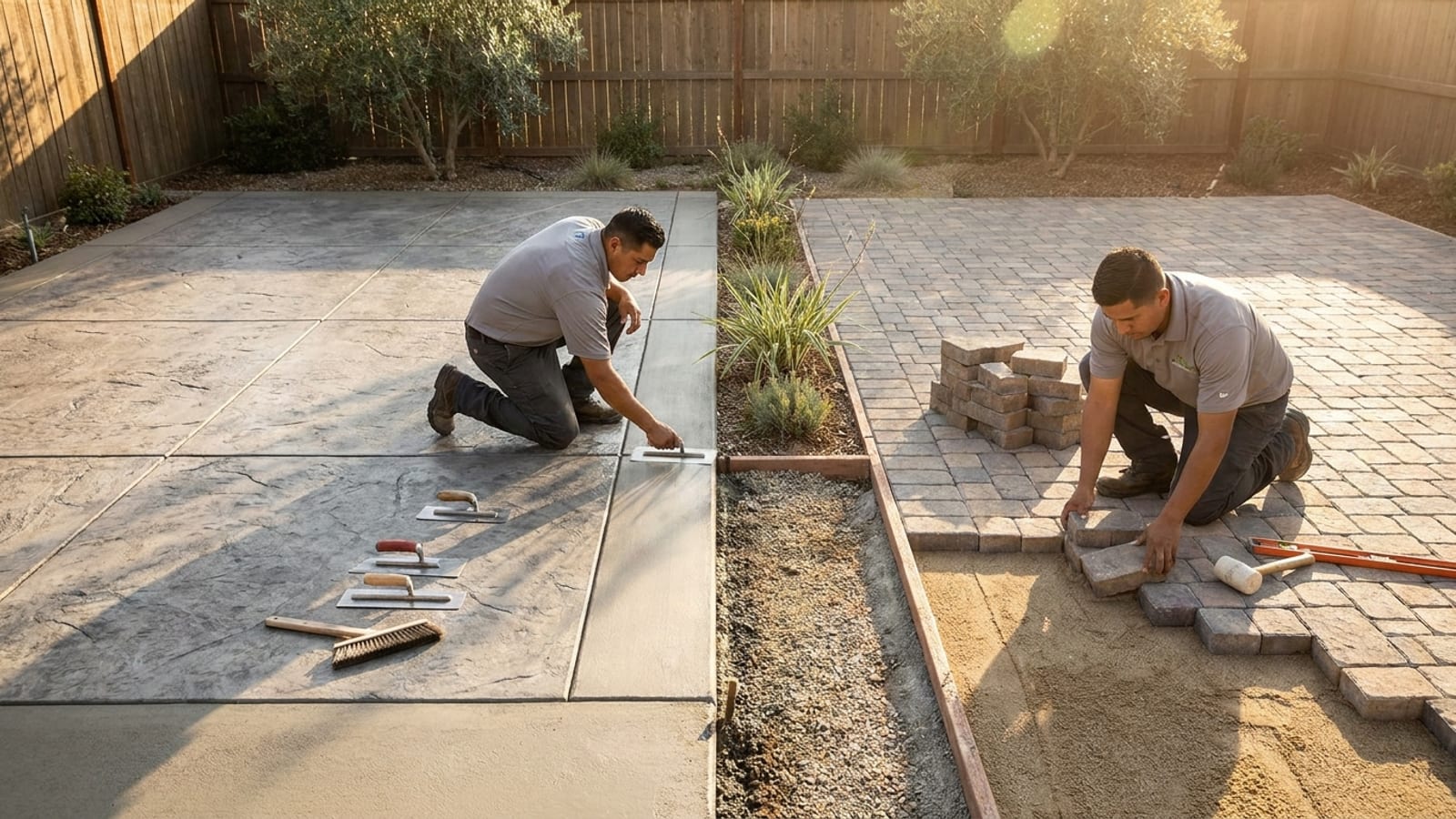
The stamped concrete vs pavers question comes up on almost every patio and driveway quote we do in San Diego. Both finishes look great in photos. Both can hold up for decades when they’re built correctly. The real differences are in upfront cost, what breaks and how much it costs to fix, and what the surface feels like to own for twenty years. This post covers all of it honestly, including the parts that contractors who sell only one product tend to leave out.
How do stamped concrete and pavers compare on upfront cost?
Stamped concrete is typically cheaper to install than pavers, but the gap narrows in the mid-range and closes almost entirely at the high end.
In San Diego County in 2026, installed costs run roughly like this:
| Surface | Low end | Mid-range | High end |
|---|---|---|---|
| Stamped concrete | $12/sq ft | $15 to 18/sq ft | $22 to 25+/sq ft |
| Concrete pavers | $10/sq ft | $15 to 20/sq ft | $25 to 35+/sq ft |
| Natural stone pavers | $20/sq ft | $28 to 35/sq ft | $45 to 50+/sq ft |
On a 400 square foot backyard patio, you’re looking at $4,800 to $10,000 for stamped concrete versus $4,000 to $14,000 for pavers, depending on paver material and pattern. For a two-car driveway at 560 square feet, the numbers are proportionally larger. See our stamped concrete cost guide for San Diego for a full driveway and patio breakdown by project type.
Pavers at the budget end (thin concrete pavers on compacted base) can actually undercut stamped concrete. Pavers at the mid and high end (thicker interlocking concrete units, travertine, or tumbled limestone) cost more than most stamped concrete work. So the “pavers are always more expensive” framing is a partial truth.
Which option looks better?
From ten feet away, a quality stamped concrete patio and a quality paver patio can look nearly identical. Up close, they feel different and behave differently.
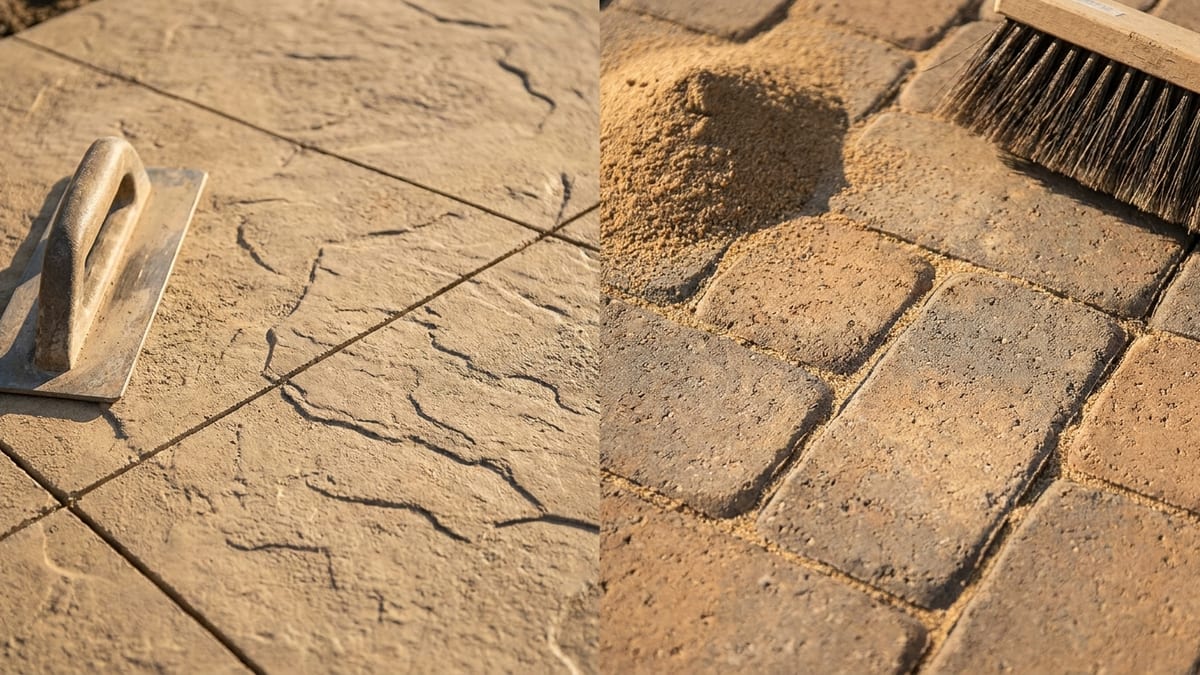
Stamped concrete is one continuous surface. The pattern is pressed into the wet concrete before it cures, and integral color runs through the whole slab. With the right pattern choice, you can convincingly replicate slate, flagstone, cobblestone, wood plank, or tile. The surface reads as unified and clean. There are no joints to catch dirt, trip a wheel, or shift over time.
Pavers are individual units, typically 2 to 3 inches thick, set over compacted base and sand. The joints between units are filled with polymeric sand. Because each unit is cast separately, color variation is natural and consistent. You can mix shapes and colors in ways that stamped concrete can’t replicate. The look often reads as more premium to buyers because they associate individual units with higher-end European or Mediterranean hardscaping.
Both options support a wide range of looks. The difference is that stamped concrete creates visual texture on a single surface, while pavers create real texture through actual joints and unit variation.
What does stamped concrete vs pavers cost to maintain?
This is where the lifetime math shifts. Stamped concrete costs more to maintain than pavers over time.
Stamped concrete maintenance. The sealer that gives stamped concrete its color depth and sheen needs to be reapplied every two to three years. A professional reseal on a 400 square foot patio runs $200 to $600 depending on surface prep needed. Over twenty years, that’s $2,000 to $6,000 in maintenance on top of the installation price. If you skip resealing, the color fades, the surface becomes porous, and cracks that form don’t have a protective layer slowing moisture penetration.
Paver maintenance. Polymeric sand between the joints needs to be topped off every three to five years as it degrades or washes out. On the same 400 square foot patio, that’s a DIY afternoon with a bag of polymeric sand and a compactor, or about $150 to $400 if you hire it out. Weeds can establish in paver joints if the polymeric sand breaks down. Annual weed control and periodic re-sanding are the realistic long-term tasks.
Pavers cost meaningfully less to maintain per decade. But they require attention to the joints. Ignore the sand long enough and you’ll get shifting units or weed infiltration that makes the surface look neglected.
How do repairs work on each surface?
Repair is where the two materials diverge most sharply, and it matters a lot in San Diego’s clay-heavy inland soils.
Stamped concrete repairs. Stamped concrete is one slab. When it cracks, you can fill the crack, but you cannot make it disappear. Color-matched crack repairs are visible up close. More significant surface repairs require grinding, patching, and recoloring a section, which never matches perfectly. A partial reseal after patching often highlights the repaired area rather than hiding it. Repair costs run $300 to $1,500 for moderate damage. If a section of slab fails badly enough to require replacement, you’re looking at cutting out and reporing that zone, which can run $2,000 to $6,000 and will always show some difference in color and pattern from the original.
Paver repairs. When a paver cracks, settles, or stains permanently, you pull up the affected units, re-level the sand base, and drop in replacements. If you saved matching pavers from the original job (which any good installer will recommend), the repair is nearly invisible. Even without saved pavers, new pavers weather quickly to match existing units. Repair cost for a section of settled pavers is typically $150 to $600 including labor. That is a real structural advantage.
In San Diego’s inland areas (Escondido, El Cajon, Santee, Vista, Ramona), expansive clay soils move seasonally. Some movement is unavoidable. That movement tends to produce isolated settling or lifting. Pavers handle isolated movement better because individual units shift independently rather than transmitting stress across an entire slab.
How long does each surface last?
Properly installed and maintained, both options last a long time in San Diego’s mild climate. Freeze-thaw cycles are not a significant concern here the way they are in Phoenix or Denver.
Stamped concrete sealed on schedule lasts 25 to 30 years before major resurfacing is needed. Pavers installed on a properly compacted base last 30 to 50 years, with individual unit replacement as needed along the way. The paver lifespan advantage is real, though the difference shrinks considerably in a climate as forgiving as coastal San Diego.
One factor worth noting: stamped concrete depends on the quality of the original pour and pattern work in a way that pavers don’t. A bad stamped job is harder to remediate. A bad paver job (improper base, wrong sand) can often be lifted, re-based, and reset without replacing the units.
What about slip resistance and heat?
Slip resistance. Stamped concrete with a matte anti-slip sealer performs reasonably well when dry. Wet sealed stamped concrete is noticeably slippery, which matters around pools or in areas that see San Diego’s occasional heavy rain. Pavers are naturally more slip-resistant because the joint texture and unit edge breaks up the surface. For poolside work specifically, we often recommend pavers or a broom-finish or exposed aggregate concrete over stamped.
Surface heat. Both materials absorb and radiate heat. Light-colored pavers run cooler underfoot than dark-stained stamped concrete in full afternoon sun. If barefoot comfort in summer is important, lighter paver colors or lighter stamped concrete base colors manage better. This is relevant in inland San Diego neighborhoods where summer afternoons hit 95 to 105 degrees.
How does drainage compare?
Stamped concrete is a solid slab. It sheds water rather than absorbing it, which means drainage design matters at install time. A poorly sloped stamped patio pools water against foundations or fence lines. Good contractors set a minimum 1/8 to 1/4 inch per foot of slope away from structures.
Pavers shed water through the joints as well as across the surface. Permeable paver systems with crushed aggregate bases can absorb significant rainfall directly into the ground, which reduces runoff and can satisfy drainage requirements in areas with limited drainage capacity. This is a real advantage in some San Diego hillside or canyon-adjacent lots where runoff management is a permit or HOA concern.
Does one option add more resale value?
Both surfaces add value relative to bare concrete or no hardscaping. Pavers tend to return slightly more at resale because buyers associate individual units with premium construction. Research across residential markets shows pavers returning 60 to 80 percent of installation cost at sale, versus 50 to 65 percent for stamped concrete.
In San Diego’s higher-end coastal submarkets (La Jolla, Del Mar, Rancho Santa Fe, Coronado), paver hardscaping reads as the expected baseline for mid-to-upper-tier homes. Stamped concrete is more competitive in inland markets (Chula Vista, El Cajon, Santee, Escondido) where buyer expectations center on durability and function over material prestige. See our concrete patio cost guide if you’re thinking through the full scope of a patio project before deciding on finish.
Choose stamped concrete if / choose pavers if
Choose stamped concrete if:
- Upfront budget is the primary constraint and you want a finished look
- Your project has curves, complex shapes, or tight access that makes paver installation difficult
- You want a smooth, uniform surface without visible joints
- The architecture of your home fits a smooth, textured-concrete aesthetic
Choose pavers if:
- You want repairs to be simple and nearly invisible when soil movement happens
- You’re near a pool or have kids and barefoot traffic that makes slip resistance a real concern
- You’re in La Jolla, Del Mar, or Rancho Santa Fe and resale presentation matters at a high price point
- You prefer lower long-term maintenance (no resealing schedule) and are willing to manage joints instead
- You want permeable drainage for a hillside or environmentally sensitive site
Neither answer is wrong for every project. What drives the recommendation on most of our jobs is soil condition, traffic type, and budget split between installation and long-term upkeep.
Get an honest quote on either surface
The pros we send install stamped concrete and pavers across San Diego County, and we’ll tell you which one makes more sense for your specific project based on your soil, your slope, your budget, and how you plan to use the space. No upsell agenda. Free onsite estimates within 48 hours.
Call (858) 925-5546 or use the contact form to schedule yours.