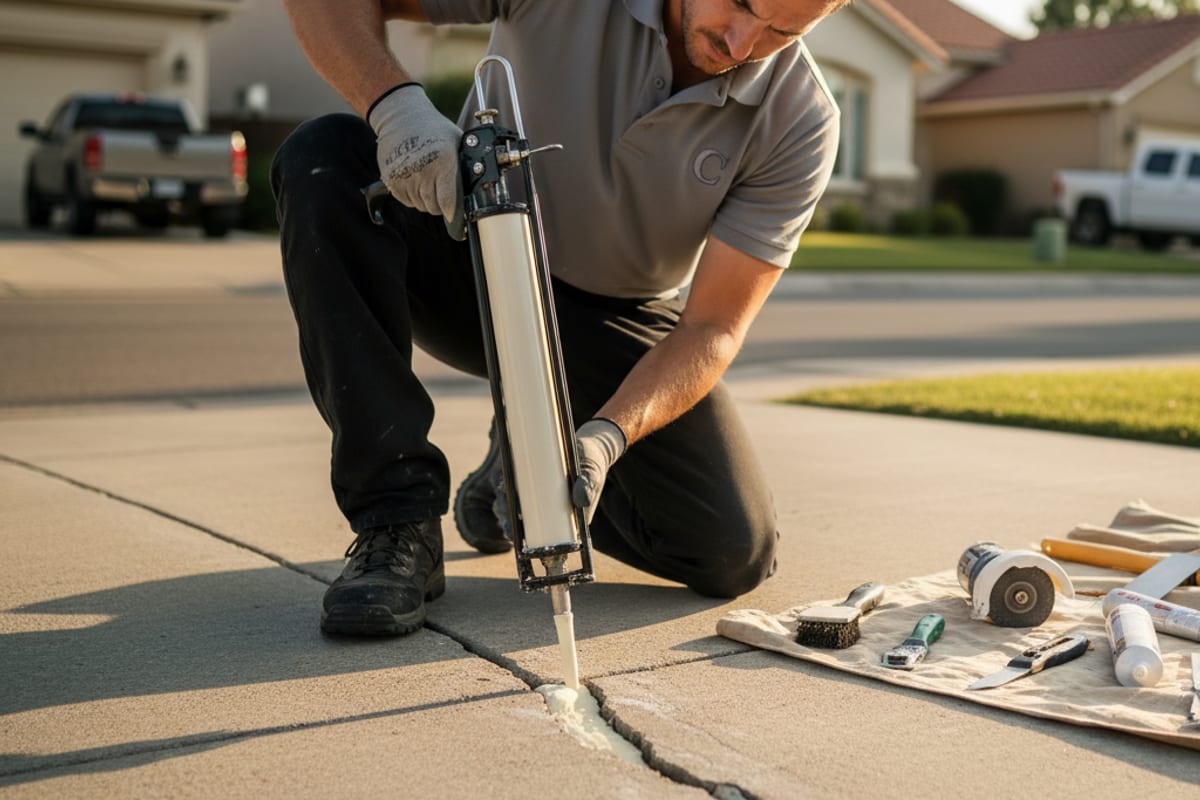
Concrete crack repair in San Diego runs from about $200 for a sealant fill to $3,000 for a polyurethane lift, with full tear-out starting near $5,000. The right number depends on why your slab cracked, not how the crack looks. Our clay soil, coastal salt, and bad drainage cause most of it. Here is how to read your crack and what each fix actually costs.
Why concrete cracks more in San Diego
The generic crack-repair guides skip the part that matters here. San Diego County sits on expansive clay soil. That soil swells when it gets wet and shrinks when it dries. Over a rainy winter and a dry summer, the ground under your slab moves up and down by inches. Concrete poured on soil that moves will crack. That is physics, not bad workmanship.
Three local forces drive most of the cracks we repair:
- Expansive clay heave and settlement. Inland areas like El Cajon, Santee, and Chula Vista have heavy clay. Slabs lift in winter and drop in summer. This causes stepped cracks and corner breaks.
- Coastal salt and spalling. Within about a half-mile of the coast, salt air gets into the concrete through hairline cracks, reaches the rebar, and rusts it. The rust expands and pushes the surface off. You see this in La Jolla, Coronado, and Ocean Beach.
- Drainage and drought cycles. Years of drought dry the clay out and shrink it. Then a heavy rain saturates it fast. That swing is brutal on slabs that are not sloped to drain.
So before we quote a repair, we figure out which of these caused your crack. Fix the crack without fixing the cause and you pay twice.
Read your crack first
Width and movement tell you almost everything.
- Hairline, under 1/16 inch. Cosmetic. Shows up as concrete cures. Seal it at your next reseal so coastal salt and water stay out.
- 1/8 to 1/4 inch, no height difference. A working crack. Fill it with flexible sealant so it stops growing and stops letting water reach the base.
- 1/4 inch or wider with one side higher. Settlement. The clay under one side dropped. This needs a lift, not a fill.
- Rust stains bleeding through near the coast. Spalling. The rebar is corroding and pushing the surface up from below.
Run your hand across the crack. If one side is higher, the slab has moved and a sealant alone will not hold. For a deeper diagnostic walk-through, see our guide on when to repair and when to replace concrete.
Concrete crack repair cost in San Diego
Here is what each repair method actually costs locally, and what it is for.
| Repair method | Typical cost | Best for | How long it holds |
|---|---|---|---|
| Flexible joint sealant | $200 to $800 | Working cracks under 1/4 inch, expansion joints | 10 to 15 years |
| Epoxy or polyurethane injection | $300 to $1,500 | Non-moving structural cracks, foundation and retaining walls | Lifetime if cause is fixed |
| Polyurethane lift (polyjacking) | $400 to $3,000 | Settled slabs, trip hazards, sunken AC pads | 10 to 30 years |
| Spalling patch and overlay | $600 to $2,500 | Coastal salt damage, exposed rebar | 5 to 15 years |
| Tear-out and replace | $5,000 to $25,000+ | Failed base, corroded rebar, multiple major cracks | 25 to 30 years |
National calculators quote crack filling at roughly $0.50 to $3 per linear foot for material alone, and slab leveling at $3 to $25 per square foot. Those numbers are real, but they leave out the local part. A coastal slab with rusting rebar costs more than the calculator says because you cannot just fill it. You have to cut out the bad concrete and treat the steel. An inland clay slab that keeps moving needs the drainage fixed first or the repair fails by next winter.
Most contractors here, us included, have a $100 to $175 trip minimum. A single small crack is rarely worth a standalone visit, so we usually bundle small repairs with a reseal.
When repair beats replacement
Replacement is the honest answer when the base has eroded, the rebar has failed across the slab, or multiple major cracks have grown over the past year. Short of that, repair almost always wins.
A $300 sealant on a 50-year-old failing driveway wastes money. Tell us, and we will price replacement instead. A $9,000 tear-out on a 5-year-old slab with one settlement crack near the house is overkill. Fix the drainage, lift the slab, done for around $1,500. The deciding question is simple: which fix costs the least and lasts long enough to be worth doing.
If your driveway is the problem, our breakdown of why driveways settle in San Diego explains the clay-soil cause behind most of these cracks.
Fix the cause, not just the crack
This is the step the DIY guides miss. A crack is a symptom. If you fill it but leave the cause, the slab cracks again somewhere else.
- Settlement cracks mean the soil under the slab moved. Lift the slab, then check whether drainage or a slow leak is feeding water under it.
- Foundation-edge cracks mean water is pooling at the joint. The slab needs to slope away from the house. Regrade or add drainage first.
- Coastal spalling means salt reached the rebar. Patching the surface buys time, but the steel keeps rusting unless you cut it out and treat it.
- Crazing or spider-web cracks are surface-only and cosmetic. A topical resurfacer hides them. No structural fix needed.
Painting over rust or cracks always comes back within a year or two. We see it on every coastal driveway a cheap contractor touched before us.
Permits and HOA rules
A surface crack repair needs no permit. Neither does a polyurethane lift. You only get into permit territory when the repair becomes a structural replacement, ties into the foundation, or changes drainage in a way that affects a neighbor or a slope.
If you are in an HOA, check your rules before any visible work on a front driveway or walkway. Some require you to match the original finish and color. We have matched plenty of HOA-spec finishes, so bring the requirement to the estimate and we will quote to it.
Frequently asked questions
How much does concrete crack repair cost in San Diego?
Most repairs run $200 to $1,500. A simple sealant fill is $200 to $800. Injection for a structural crack is $300 to $1,500. A polyurethane lift for a settled slab is $400 to $3,000. Full replacement starts around $5,000.
Can I just fill the crack myself?
For a hairline cosmetic crack, yes, a tube of self-leveling concrete sealant from a hardware store works fine. For anything wider than 1/4 inch, stepped, or near the coast with rust, a DIY fill hides the real problem. Those need a diagnosis before you spend money on them.
Why does my concrete keep cracking after I repair it?
Almost always because the cause was never fixed. San Diego clay soil moves with the seasons. If water keeps reaching the base, or the slab is not sloped to drain, a new crack opens near the old patch. Fix drainage and settlement first.
Are crack repairs permanent?
A structural injection on a stabilized crack can last the life of the slab. A flexible sealant on a working crack lasts 10 to 15 years. A polyurethane lift lasts 10 to 30 years if the underlying cause is also addressed. None of it lasts if the soil keeps moving unchecked.
Does coastal salt really cause cracks?
Yes. Salt air gets into concrete through small cracks, reaches the rebar, and rusts it. The rust expands and pushes the surface off, which is called spalling. It is the most common repair we do within a half-mile of the water.
How fast can a repair be done?
Most sealant and injection repairs are a few hours. A polyurethane lift is often same-day, and you can drive on it within 15 minutes. Replacement takes longer because of cure time, which we cover in our concrete cure time guide.
Get a real diagnosis
We give upfront quotes after walking the slab, not over the phone. We tell you the cheapest fix that holds, even when it is not the biggest bid. Onsite concrete repair estimates are free across San Diego County. Call (858) 925-5546 or use the contact form to set one up.