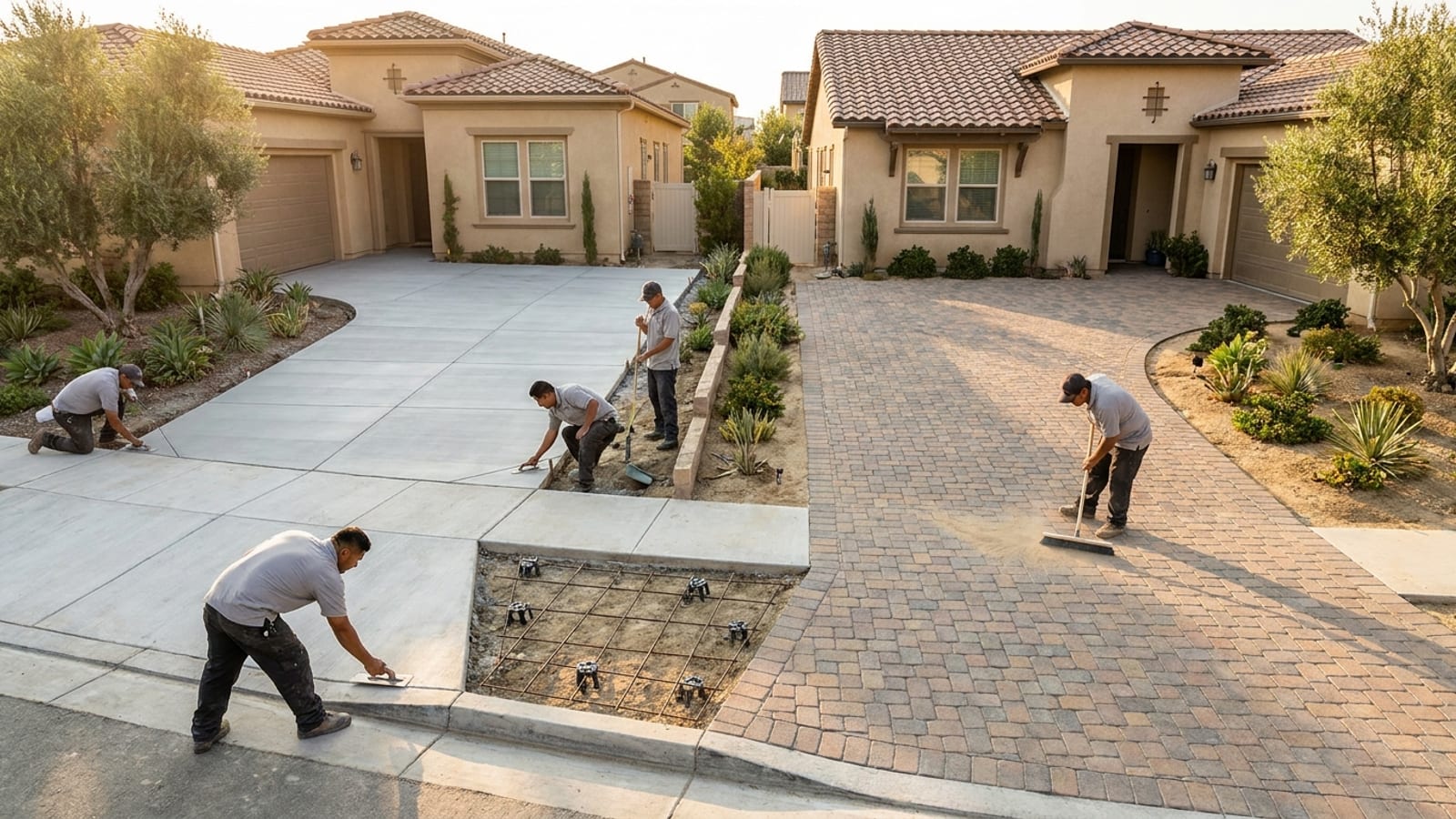
The concrete vs pavers driveway question comes up on almost every estimate we do for a driveway replacement in San Diego. Homeowners want a straight answer, and we give them one, but the straight answer depends on a few things specific to their property, their budget, and how long they plan to stay. This guide covers both materials honestly so you can make the call that actually fits your situation.
What does a concrete vs pavers driveway actually cost in San Diego?
This is where the comparison starts and ends for most people.
Poured concrete runs $8 to $15 per square foot for a standard broom finish in San Diego County in 2026. Decorative finishes like stamped concrete or exposed aggregate push that to $14 to $22 per square foot. See the full breakdown in our concrete driveway cost guide.
Concrete pavers run $20 to $35 per square foot installed in San Diego, with coastal neighborhoods like La Jolla and Encinitas landing at the higher end and inland communities like El Cajon and Santee at the lower end. Permeable pavers go higher still, $26 to $50 per square foot.
On a typical two-car driveway of 560 to 600 square feet, that gap is real money:
| Material | Cost per sq ft | 600 sq ft driveway |
|---|---|---|
| Concrete, broom finish | $8 to $15 | $4,800 to $9,000 |
| Stamped concrete | $14 to $22 | $8,400 to $13,200 |
| Concrete pavers | $20 to $35 | $12,000 to $21,000 |
| Permeable pavers | $26 to $50 | $15,600 to $30,000 |
The upfront cost difference between a concrete driveway and a paver driveway on the same footprint often runs $5,000 to $12,000. That gap narrows over a 25 to 30-year horizon when you factor in maintenance and repairs, but it doesn’t disappear.
How long does each driveway material last?
A properly poured concrete slab lasts 25 to 35 years in San Diego conditions. A poorly poured one (skimpy base prep, no rebar, no control joints) can start cracking in five to ten years. Execution matters more than the material.
Pavers typically last 30 to 50 years. The individual units are durable, and because they flex at every joint rather than moving as one monolithic piece, they distribute load and soil movement differently than poured concrete does. That flexibility is a genuine advantage on sites with active soils.
The honest caveat: a paver driveway that wasn’t installed on a proper compacted base will develop settling and heaving problems well inside its theoretical lifespan. Both materials reward a contractor who does the base work right.
How does each material handle repairs?
This is where the two options split most clearly.
Concrete cracks. It’s not a defect, it’s physics. Concrete expands and contracts with temperature, and it moves when the soil beneath it shifts. Saw-cut control joints placed correctly at pour time direct those cracks into the joints rather than across the middle of the slab. When a crack shows up in an unjointed section or when a section fails, your options are crack injection, grinding, or full section replacement. Matching a patch to aged concrete is hard. Full replacement of a 600 square foot slab runs $6,000 to $12,000 depending on demo and finish.
Pavers settle and lift. Individual pavers can crack, but the more common issue is heaving from roots or soil movement underneath, or low spots that collect water. The repair is surgical: pull the affected pavers, re-grade the base, reset them, re-sand the joints. A skilled crew can fix a 20 square foot settled section in a few hours. The material cost is low if you kept spare pavers from the original install. The labor cost is real, but it’s far less than ripping out and replacing a concrete section.
For long-term repairability, pavers win. Individual unit replacement costs a fraction of what concrete patching or section replacement does.
What about maintenance?
Concrete needs very little on a regular basis. Seal it every two to three years to protect against staining and surface wear, and blow it off or hose it down as needed. Oil stains are harder to remove from concrete than from pavers, degreasers work, but if the stain penetrated before you caught it, it may be permanent.
Pavers need periodic re-sanding of the joints with polymeric sand to lock out weeds and keep ants from nesting in the gaps. Plan on doing that every three to five years. Weeds in paver joints are the most common complaint we hear from paver driveway owners. Sealing pavers every two to three years helps with staining and slows the joint erosion.
Neither material is truly zero maintenance. Concrete is lower maintenance in the short run. Pavers require more ongoing attention to the joints.
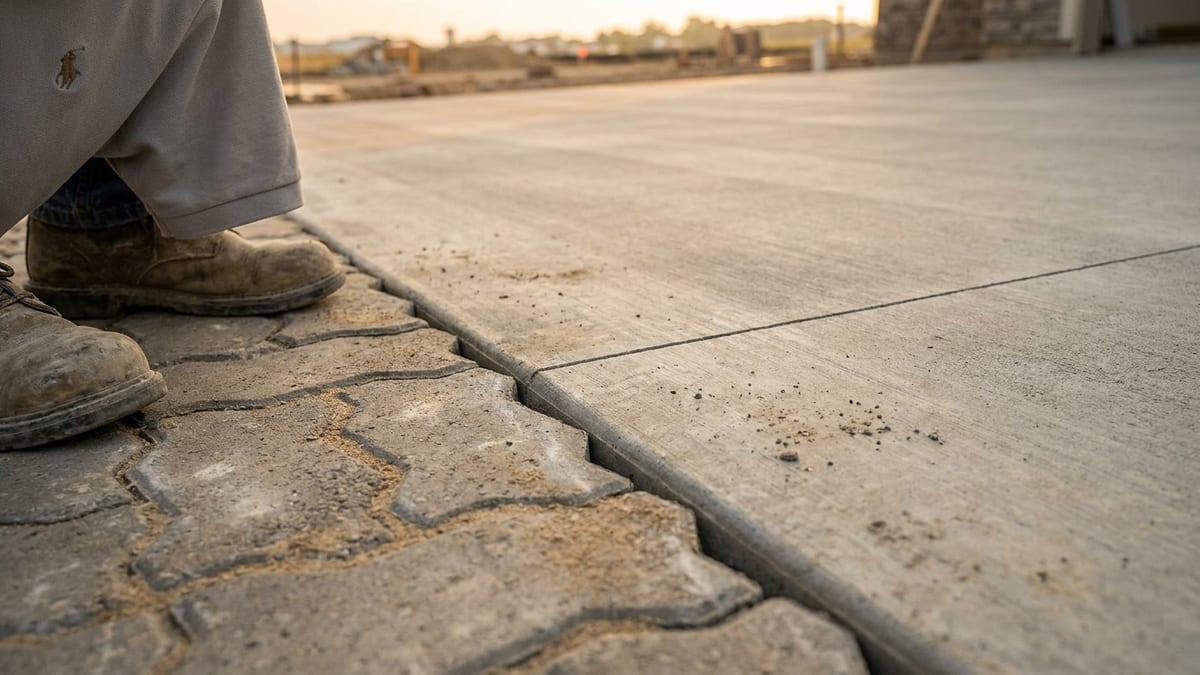 Pavers flex at every joint. A concrete slab moves as one piece. That difference drives most of the trade-offs.
How do San Diego’s clay soils affect the choice?
This matters more in San Diego than in most markets.
Inland San Diego (Escondido, Poway, El Cajon, Vista, Ramona) sits on expansive clay soils that swell when they absorb moisture and shrink as they dry out. That seasonal movement is the primary cause of cracked and heaved driveways in these communities.
For concrete on expansive clay, the answer is proper base prep: six to eight inches of compacted Class II road base, heavy rebar grid, and correctly spaced control joints. Done right, a concrete driveway handles clay movement well. Done cheap, it’s a cracked mess in ten years.
For pavers on expansive clay, the flexibility at every joint genuinely helps, sections can lift and be reset rather than cracking. But pavers still need a proper compacted base. Pavers laid directly over clay soil will settle unevenly.
Coastal San Diego (La Jolla, Pacific Beach, Coronado, Carlsbad) has sandier soils that compact well and cause less seasonal movement. Both materials perform well there.
Bottom line on soils: neither material wins categorically on expansive clay. Execution of the base is the variable that matters most.
Do pavers affect drainage?
Standard concrete is essentially impermeable. Rainwater and runoff sheet off the surface toward the street or wherever your grade directs it. That’s fine on a well-graded site, but it can contribute to runoff problems on flat or poorly drained lots.
Standard clay or concrete pavers are also largely impermeable, water runs off the surface, not through it. The joints allow minimal infiltration, but don’t count on it for drainage management.
Permeable pavers are a different category. They have wider joints filled with aggregate, and water drains through the paver system into a gravel bed below. They’re the right call when you’re dealing with a site that collects standing water, a drainage-challenged lot, or a municipality that charges stormwater fees based on impervious surface area. The cost premium is significant ($26 to $50 per square foot installed in San Diego) but on the right site, they solve a real problem.
Does either material affect resale?
In most San Diego neighborhoods, both concrete and pavers read as quality materials at resale. Buyers notice a tired, cracked, oil-stained concrete driveway. They notice a clean, recently sealed paver driveway. The material matters less than the condition.
In higher-end neighborhoods (Rancho Santa Fe, Del Mar, La Jolla, Coronado) paver driveways carry more visual weight. They signal investment and detail. If you’re selling a home over $2 million, a paver driveway fits the price point better than broom-finish concrete.
For stamped concrete, the math is closer. A well-done stamped concrete driveway can hold its own against pavers visually and costs significantly less. That’s worth considering if looks matter but budget is tight. See our stamped concrete cost breakdown for what that option runs.
What do HOAs say about this?
This one trips people up. Some HOAs in San Diego require specific driveway materials or finishes. Older tract neighborhoods sometimes mandate broom-finish concrete to maintain a uniform street appearance. Some newer communities specify pavers. A few prohibit gravel or asphalt.
Check your CC&Rs before you get quotes. If your HOA requires concrete, the question is settled. If they approve both, you’re making the decision based on budget and personal preference.
Concrete vs pavers driveway: which one is right for your situation?
Here’s how we break it down for homeowners after we’ve walked a job:
Choose concrete if:
- Budget is the primary constraint. The upfront savings are real and significant.
- You’re selling the property within five years and don’t want to over-invest.
- Your lot has good drainage and moderate soils.
- Your HOA requires it.
- You want a low-maintenance, hose-it-off surface.
- You want a decorative finish like stamped or exposed aggregate at a lower price point than pavers.
Choose pavers if:
- You’re planning to stay 15-plus years and want the longest possible lifespan.
- You have a history of cracking or settling with concrete on your property.
- You want easier long-term repair, pulling and resetting individual units rather than patching or replacing sections.
- You want a high-end visual for a home where that investment makes sense at resale.
- Drainage is a concern and permeable pavers are on the table.
Neither choice is wrong. Both are durable, both work in San Diego, and both beat cheap installation of the other. A $9,000 properly built concrete driveway will outperform a $14,000 poorly installed paver driveway every time.
Get a quote for either material
The pros we send install both concrete driveways and paver driveways across San Diego County. We’ll walk your site, look at your soils, measure the footprint, and give you a flat-rate quote for both options so you can compare actual numbers for your specific project. Estimates are free and we quote within 48 hours.
Call (858) 925-5546 or use the contact form to schedule your onsite estimate.