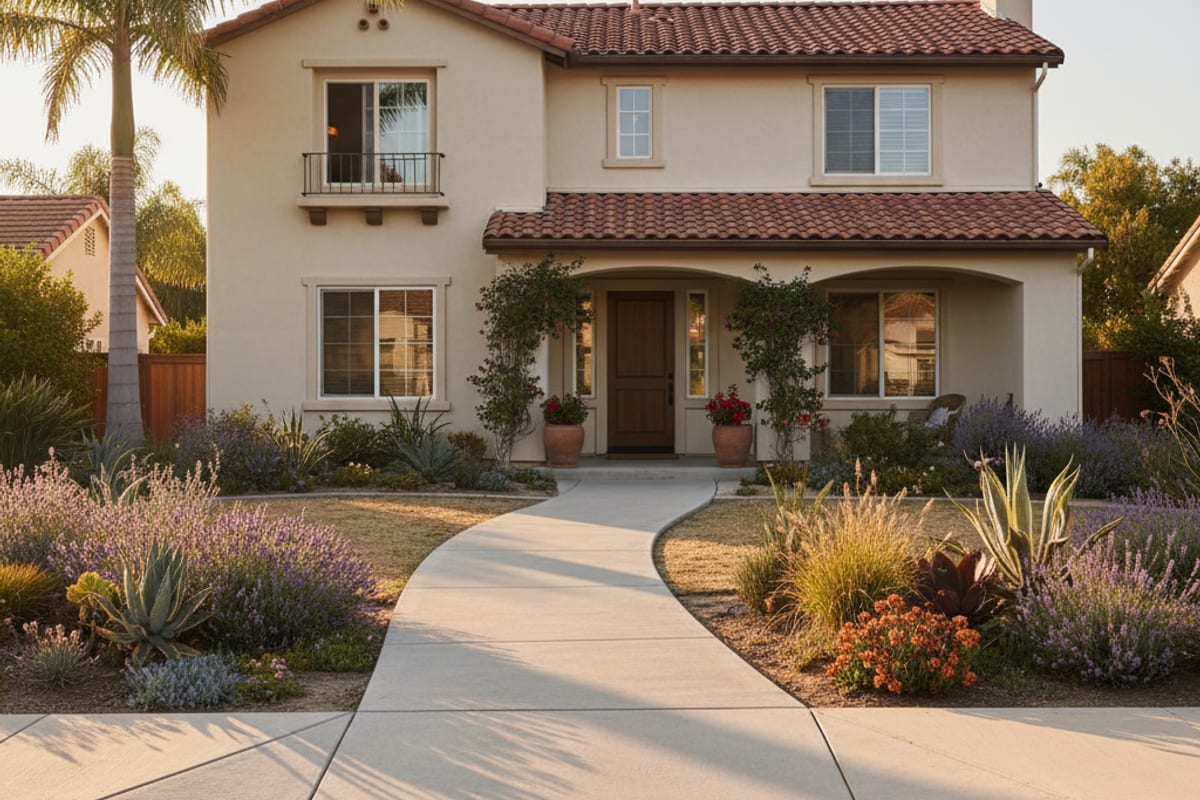
A concrete walkway in San Diego County runs $8 to $20 per square foot installed, or $30 to $80 per linear foot for a standard 4-foot-wide path. A typical 50-foot front walkway lands between $1,600 and $4,000. Finish, thickness, base prep, demolition, and your soil drive the spread. Inland clay soils push the high end. This is how the math actually works.
What does a concrete walkway cost per square foot in San Diego?
Most walkways here fall in this range by finish:
- Broom finish, standard reinforcement: $8 to $13 per square foot
- Colored or integral-tint concrete: $10 to $15 per square foot
- Exposed aggregate: $11 to $17 per square foot
- Stamped concrete: $13 to $20 per square foot
National cost guides like HomeGuide and Angi quote broom-finish paths at $6 to $12 per square foot and stamped at $10 to $21. Those numbers are real, but they assume average soil and easy access. San Diego adds two things most guides skip: expansive clay and tight side-yard access. Both nudge the real bid up.
A common front walkway is 4 feet wide by 40 to 50 feet long, about 160 to 200 square feet. Broom finish on that footprint runs $1,500 to $2,600. Stamped on the same path runs $2,800 to $4,000.
Cost by walkway size and finish
| Walkway | Square feet | Broom finish | Stamped |
|---|---|---|---|
| Short entry path | 80 sq ft | $700 to $1,100 | $1,100 to $1,600 |
| Standard front walk | 180 sq ft | $1,500 to $2,400 | $2,500 to $3,600 |
| Side-yard run | 250 sq ft | $2,100 to $3,300 | $3,400 to $5,000 |
| Wrap-around path | 400 sq ft | $3,300 to $5,200 | $5,500 to $8,000 |
These assume 4-inch slabs with rebar or fiber mesh, compacted base, and saw-cut control joints. A bid far below this range is usually skipping base prep or reinforcement.
What’s included in a real walkway bid
A real bid covers the path from demo to final finish:
- Demolition and haul-off. Tearing out an old walkway runs $1.50 to $4 per square foot.
- Base prep. Compacted Class II road base, plate-compacted. About $1 to $2 per square foot.
- Forms. Lumber set to grade with the right slope for drainage.
- Reinforcement. Rebar grid or fiber mesh. On a narrow 3-foot path, mesh is acceptable. Wider walks get rebar.
- Concrete. 3,000 to 4,000 PSI mix.
- Finishing. Bullfloat, edge, and broom or specialty finish.
- Saw-cut control joints. Within 24 hours. This is how cracks land in the joint, not across the path.
The most common cut on a cheap walkway bid is base prep. The second is control joints. Both shorten the life of the slab on our soils.
Why San Diego soil moves the price
This is where local matters more than any national average.
Expansive clay soil. Inland San Diego, including Escondido, Poway, El Cajon, Santee, and Vista, sits on clay that swells when wet and shrinks when dry. A walkway poured straight on untreated clay heaves in winter and settles in summer. We over-compact the base, add a thicker Class II layer, and tie in rebar so the slab moves as one piece. That adds $1 to $3 per square foot versus coastal sandy soils. Skipping it is the number-one reason a walkway cracks and lifts inside a few years. We cover the mechanics in why your driveway is settling, and the same physics applies to a path.
Drainage and drought. San Diego goes months dry, then gets heavy rain in short bursts. A flat walkway holds water against the slab edge and feeds clay heave. Every walkway needs a slight cross-slope, away from the house and toward a drainage path. The pros we send set that slope at form time. It costs nothing extra and prevents the most common failure.
Seismic movement. This is earthquake country. Control joints and proper reinforcement let a walkway flex without spider-cracking when the ground shifts. A path poured as one rigid slab with no joints is the one that cracks first.
Coastal salt. In Coronado, Imperial Beach, Ocean Beach, and Point Loma, salt air accelerates surface wear and rebar corrosion. Walkways near the coast benefit from a sealer and adequate rebar cover. Plan to seal every two to three years. See which sealer to use for the breakdown.
Permits, Title 24, and HOA rules
Most private walkways on your own property, behind the front setback, do not need a permit in San Diego County. Two situations change that:
- Work in the public right-of-way. A walkway that connects to a city sidewalk, or any pour in the strip between sidewalk and curb, needs an encroachment permit. Add $300 to $1,000 for permit and inspection time.
- ADA or accessible paths on rentals and ADUs. If the walkway serves an ADU or a unit subject to accessibility rules, slope and width specs apply. We build to spec when it’s required.
Title 24 is California’s energy code. It rarely touches a plain walkway, but it matters when a path is tied into an ADU build. If your walkway is part of an ADU foundation project, the scope and inspections expand.
HOA rules are common in San Diego’s planned communities. Many require a specific finish or color for front walkways. Check your CC&Rs before choosing stamped or colored concrete, since some HOAs only allow broom finish out front.
When stamped or aggregate is worth it
The jump from broom finish to stamped is roughly 40 to 60 percent. On a $2,000 broom walkway, that’s $800 to $1,200 more. Three times it pays off:
- Front-of-house curb appeal. A walkway is the first thing a guest or buyer walks on. Stamped or aggregate reads as quality. Plain broom reads as builder-grade.
- It matches the home. Spanish, Mediterranean, and Craftsman homes pair well with stone or slate stamp patterns. See stamped patterns that work in San Diego.
- You’re staying long-term. A sealed stamped walkway stays sharp for 20-plus years.
Where it doesn’t pay back: a tight budget, an HOA broom-only rule, or a path nobody sees. A well-built broom walkway with real base prep and rebar outlasts a poorly built stamped one. Build it right first, upgrade the finish second.
What you should never see in a walkway bid
- Under 4 inches thick. Bare minimum for a walkway is 4 inches.
- No base prep mentioned. “The pros we send pour over the dirt” means it’ll heave on clay.
- No control joints. Saw-cut joints control where it cracks.
- No slope for drainage. A flat path holds water and fails faster here.
- No PSI spec. A bid without a strength number lets the cheapest mix show up.
Frequently asked questions
How much does a 50-foot concrete walkway cost in San Diego? A standard 4-foot-wide, 50-foot path is about 200 square feet. Broom finish runs $1,600 to $2,600. Stamped runs $2,800 to $4,000, depending on soil and access.
Is a concrete walkway cheaper than pavers in San Diego? Usually yes for the install. Poured concrete runs $8 to $20 per square foot. Pavers often run $15 to $30 installed. Concrete also has fewer joints for weeds and shifting, which matters on expansive clay.
Do I need a permit for a walkway in San Diego? Most private walkways on your property don’t need one. You do need an encroachment permit for work in the public right-of-way or anything touching the city sidewalk. Add $300 to $1,000 when it applies.
How thick should a concrete walkway be? Four inches is the residential minimum on a footpath. Where the walkway crosses a driveway or carries occasional vehicle weight, we step it up to 5 or 6 inches with heavier rebar.
Why do San Diego walkways crack and lift? Almost always expansive clay soil plus skipped base prep or missing control joints. The clay swells and shrinks with the seasons, and a slab without proper base and joints can’t handle the movement.
How long does a concrete walkway last? A properly built and sealed walkway lasts 25 to 30 years here. The cheap bid that skips base prep often fails within five to ten.
Get a real number for your walkway
Onsite estimates across San Diego County are free. We measure the path, check access, read the soil and drainage, and quote a flat rate. No surprise add-ons. See our walkway service for scope, or call (858) 925-5546 for a free estimate.