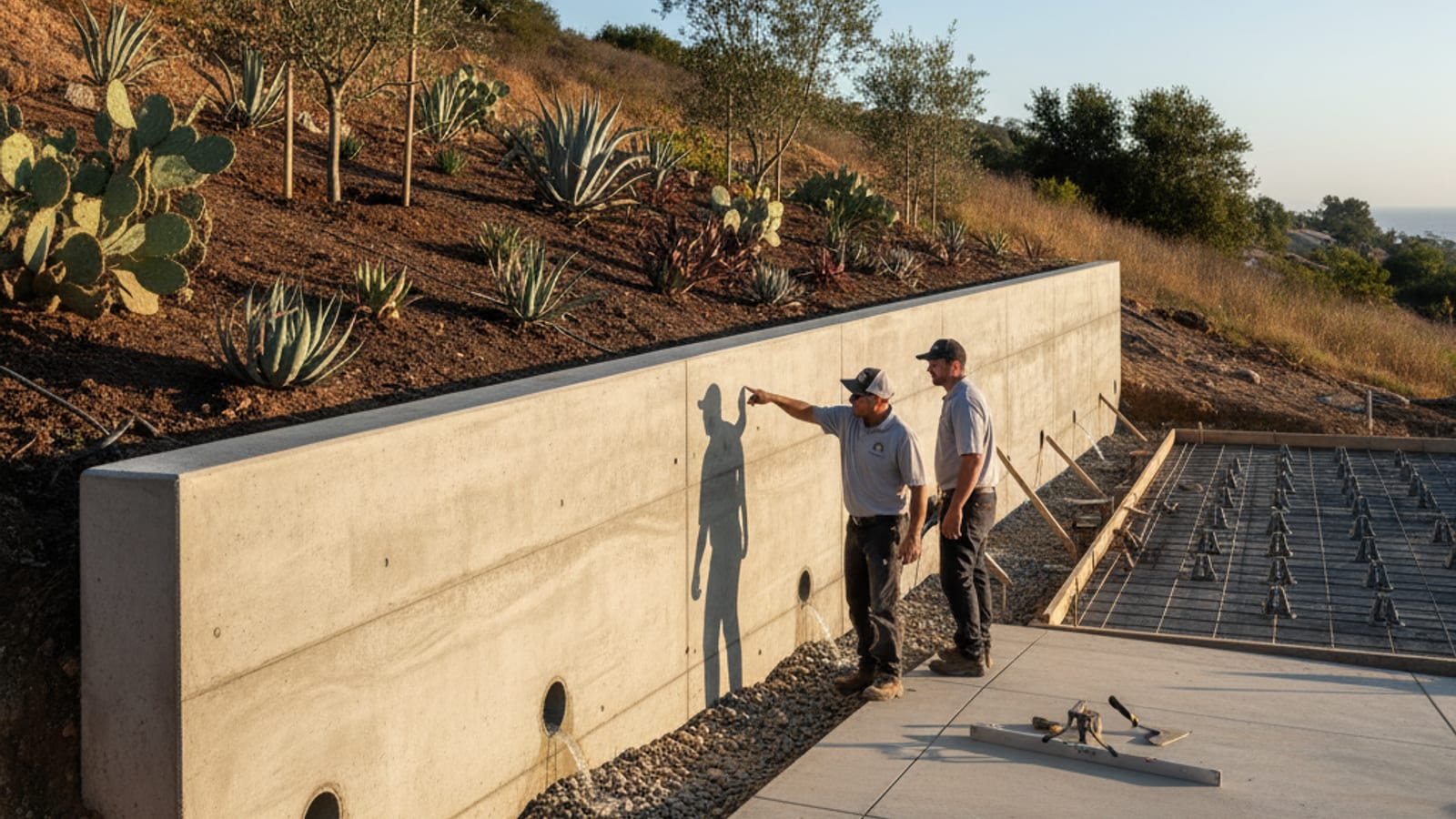
A retaining wall in San Diego County runs $25 to $60 per square foot of wall face in 2026, or roughly $60 to $300 per linear foot depending on height. A typical 50-foot, 3-foot-tall block wall lands around $5,000 to $12,000. Poured concrete and stone push higher. What moves the number most here isn’t the wall itself. It’s the clay soil behind it, the drainage it needs, and whether the height triggers a permit and an engineer.
This is how the cost actually breaks down on residential retaining walls across San Diego in 2026.
Retaining wall cost per square foot by material
National cost guides quote a wide range because they average every market and every soil. Here’s where San Diego jobs typically land, installed, with footing and backfill:
| Wall type | Cost per sq ft of face | Cost per linear foot (3 ft tall) |
|---|---|---|
| Segmental block (interlocking) | $25 to $40 | $75 to $160 |
| CMU block (cinder block, stucco-faced) | $30 to $45 | $90 to $180 |
| Poured concrete | $35 to $60 | $110 to $300 |
| Boulder / rock | $30 to $55 | $90 to $220 |
| Stone veneer over CMU | $45 to $80 | $135 to $320 |
A 50-foot run, 3 feet tall, is about 150 square feet of face. That puts a clean segmental block wall around $5,000 to $9,000 and a poured concrete wall around $7,000 to $14,000 on a straightforward lot.
Note the per-square-foot number is wall face, not footprint. A 6-foot wall has twice the face of a 3-foot wall, so it costs at least twice as much before you add the engineering and deeper footing that taller walls require.
Why height doesn’t scale in a straight line
A 6-foot wall does not cost twice a 3-foot wall. It usually costs three to four times as much. Here’s why.
Past about 4 feet, the soil pressure on the back of the wall climbs fast. The wall needs a deeper, wider footing, heavier rebar, and often a structural engineer’s design. In San Diego that engineering runs $100 to $220 per hour or a flat $800 to $2,500 for a stamped wall design. Above 4 feet, most jurisdictions also require a building permit and inspections, which adds $300 to $1,200 in fees and time.
So the jump from a 3.5-foot garden wall to a 5-foot structural wall isn’t a small upgrade. It’s a different category of project. If your slope lets you split one tall wall into two shorter terraced walls, you can sometimes stay under the permit threshold on each and save real money. Sometimes. The setback between terraces has to be wide enough that the upper wall isn’t surcharging the lower one.
What San Diego clay soil does to the price
This is the part the national guides skip entirely, and it’s the single biggest reason a San Diego wall costs more than the same wall in a sandy market.
Much of inland San Diego County sits on expansive clay. Escondido, Poway, El Cajon, Santee, Vista, San Marcos, and Rancho Bernardo are full of it. Clay swells when it’s wet and shrinks when it dries. That seasonal heave and settlement pushes sideways on a retaining wall harder than stable soil does. A wall built for sandy coastal soil will lean, crack, or tip on a clay lot within a few years.
Building it right on clay adds cost in three places:
- A wider, deeper footing. Clay needs more bearing area and more depth to resist the lateral push. That’s more concrete and more excavation.
- More steel. Heavier rebar grids and, on taller walls, geogrid layers tied back into the hillside.
- Soil testing on bigger jobs. A geotechnical report runs $1,000 to $3,000 but tells the engineer exactly what the clay will do. On a tall wall protecting a house or a neighbor’s yard, that report isn’t optional.
Add it up and clay-soil prep adds roughly 15 to 30 percent over the same wall on coastal sand. Skipping it is how you end up paying twice.
Drainage is half the job, and the first thing cheap bids cut
San Diego’s rain is the opposite of steady. We go months bone dry, then get hit with a few heavy storms that dump everything at once. That pattern is brutal on retaining walls. Dry clay cracks, the cracks fill with storm water, the water has nowhere to go, and the pressure behind the wall, called hydrostatic pressure, shoves it over.
A wall that drains properly handles this. A wall that doesn’t will fail no matter how much steel is in it. Proper drainage means:
- Gravel backfill behind the full height of the wall
- A perforated drain pipe at the base, sloped to daylight or a drain
- Weep holes or a French drain so water exits instead of building up
- Filter fabric so the gravel doesn’t silt up over time
Budget $10 to $30 per linear foot for the drainage system. A bid that doesn’t line-item drainage is a bid that’s planning to skip it. That’s the number one corner cut on retaining walls in this county, and it’s the number one reason they fail.
Seismic and coastal factors most bids ignore
Two more San Diego realities that affect cost and design:
Seismic. We’re earthquake country. Taller engineered walls get designed for seismic load, which means more steel and a footing tied to resist shaking. It’s built into a real engineer’s design and into a real bid.
Coastal salt. Walls in La Jolla, Coronado, Encinitas, Carlsbad, and the rest of the coast deal with salt air that corrodes rebar over time. Coastal walls should use epoxy-coated rebar or higher concrete cover over the steel. That’s a small material upcharge that buys decades of life. A wall built with bare rebar a mile from the ocean is a wall that rusts from the inside out.
What’s actually in a real retaining wall bid
A real bid is line-itemed so you can see what you’re paying for:
- Excavation and footing. Dig, form, and pour the footing to engineered depth.
- Wall material. Block, CMU, or poured concrete with the spec’d rebar.
- Reinforcement. Rebar size and spacing, plus geogrid if the design calls for it.
- Drainage system. Gravel, pipe, weep holes or French drain, filter fabric.
- Backfill and compaction. In lifts, compacted, not just dumped.
- Permits and engineering. Pulled and included when the height requires them.
- Cleanup and haul-off. Spoils removed, site left clean.
If a number looks too good, one of these is missing. It’s almost always drainage or footing depth, and those are the two that decide whether the wall lasts 30 years or 3.
Permits, height thresholds, and HOAs
In most San Diego jurisdictions, walls 4 feet or less in total height (footing bottom to wall top) usually don’t need a permit, with conditions. Above 4 feet, or any height with a slope or structure pushing on the wall from above (called a surcharge), a permit and engineered drawings are typically required. The rules vary by city. We cover the specific thresholds, surcharge rules, and which jurisdictions are stricter in our guide on when a retaining wall needs a permit in San Diego.
If you’re in an HOA, expect material and color review before you build. That can rule out raw block and steer you toward stucco-faced CMU or stone veneer, which changes the budget.
How retaining wall cost compares to other concrete work
If you’re budgeting a full backyard or hillside project, a retaining wall often comes paired with a patio or driveway. For context on those, see our breakdowns on concrete patio cost in San Diego and concrete driveway cost in San Diego. The same soil and drainage realities apply across all of them.
Frequently asked questions
How much does a retaining wall cost in San Diego per linear foot? Most residential walls run $60 to $300 per linear foot in 2026, driven mostly by height. A 3-foot block wall sits near the bottom of that range. A 6-foot poured concrete wall with engineering and drainage sits near the top.
Why are San Diego retaining walls more expensive than the national average? Expansive clay soil and our dry-then-deluge rain pattern both demand heavier footings, more steel, and serious drainage. That adds roughly 15 to 30 percent over the same wall built on stable coastal sand.
Do I need a permit for a retaining wall in San Diego? Usually not under 4 feet total height with no surcharge, though rules vary by city. Above 4 feet, or any height with a slope or structure pushing on the wall, you typically need a permit and an engineer’s design.
What’s the cheapest retaining wall material? Segmental block and timber are the lowest upfront. Timber only lasts 10 to 20 years, though, and rots faster in damp soil. Block and poured concrete cost more upfront and outlast timber by decades, so they’re usually the better value over the life of the wall.
Can I save money by building two short walls instead of one tall one? Sometimes. Terracing can keep each wall under the permit threshold and reduce engineering. It only works if the terraces are spaced far enough apart that the upper wall isn’t pushing on the lower one. An onsite look tells you fast.
Does drainage really matter that much? Yes. Poor drainage is the leading cause of retaining wall failure in San Diego. Water building up behind a wall during a storm creates pressure that no amount of steel fully resists. Drainage is not the place to save money.
Get a real number for your wall
Retaining wall pricing depends on your soil, your slope, your height, and your drainage. Nobody can quote it honestly from a photo. We walk the site, check the soil and grade, flag any permit or engineering triggers, and quote flat-rate across San Diego County. See our concrete retaining walls service for what we build, or call (858) 925-5546 for a free onsite estimate.