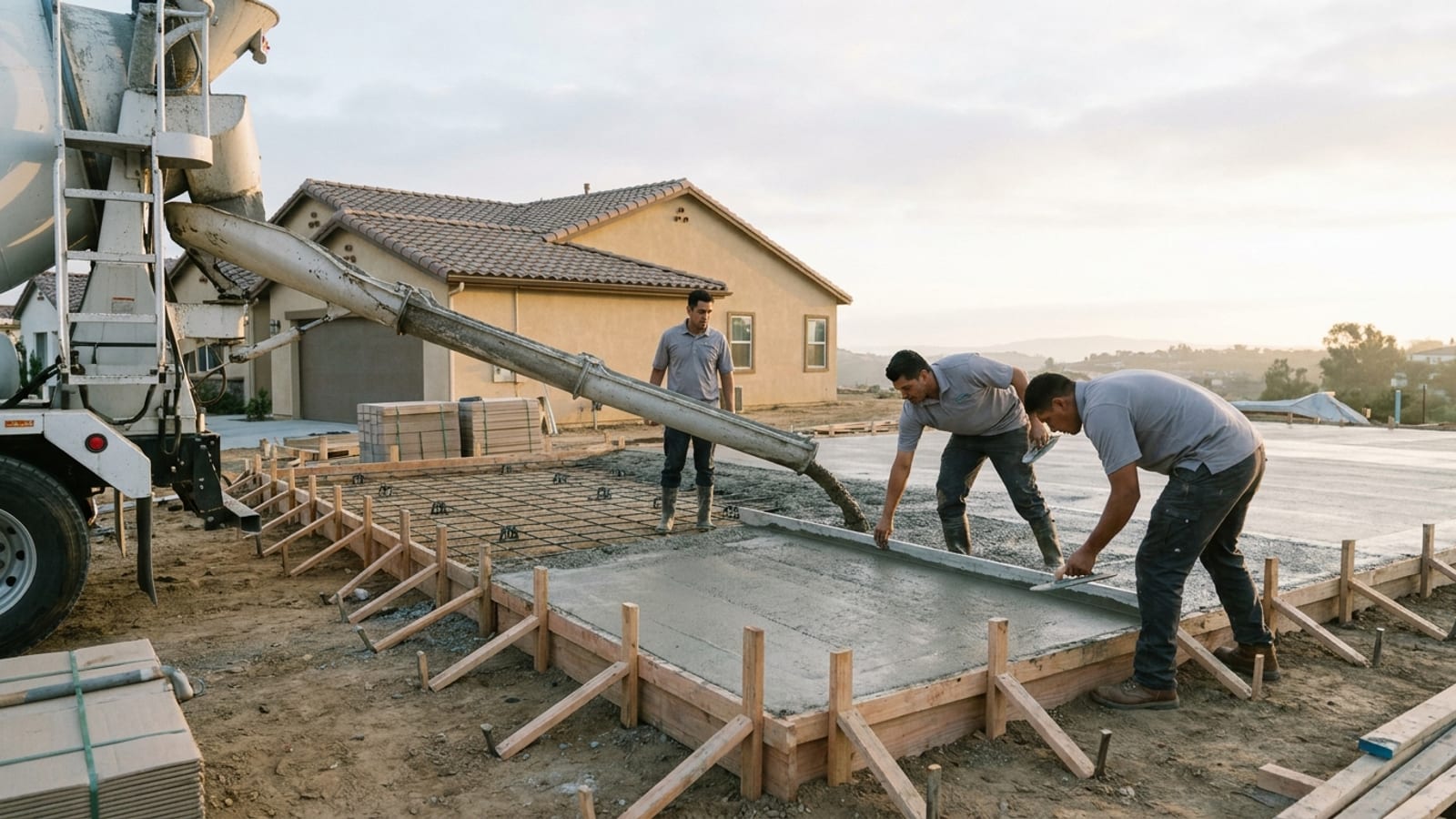
The honest answer to when is the best time to pour concrete in San Diego is almost any time. Our county doesn’t freeze. We rarely see the extended heat events that make summer pours genuinely dangerous in Phoenix or Las Vegas. We don’t get weeks of rain that would shut down an exterior slab. Compared to most of the country, San Diego pours concrete year-round, and experienced crews do it every month without issue.
That said, conditions do matter. Temperature and humidity affect how concrete hydrates, how fast it sets, and how strong it gets. Getting those factors right is the difference between a slab that lasts 30 years and one that surfaces-cracks in the first two. Here’s how we think about timing across San Diego County.
What’s the best time to pour concrete in San Diego?
The sweet spot for concrete is between 50 and 85 degrees Fahrenheit with moderate humidity and low wind. In those conditions, the chemical reaction that binds the concrete mix together happens at a predictable, controlled rate. The water in the mix stays where it’s supposed to stay, hydrating the cement rather than evaporating off the surface.
San Diego’s coastal communities sit in that window for most of the year. An average June morning in Carlsbad or Chula Vista is around 62 to 68 degrees. October afternoons in Encinitas rarely push past 78. Winter days along the coast hover in the upper 50s to mid-60s. That’s nearly ideal concrete weather without any special measures.
The months where conditions get more complicated are July through September, when inland San Diego pushes into the 90s, and the occasional stretch in December through February when marine-layer mornings can put coastal neighborhoods in the mid-50s with 90 percent humidity. Both situations are workable. They just need a different approach.
How the marine layer affects a pour
San Diego’s marine layer is a low coastal fog that rolls in off the Pacific, usually overnight and into the morning. For concrete, it’s actually a friend more than a problem. The fog keeps temperatures down, slows surface evaporation, and gives the slab time to set without the top drying out faster than the bottom.
The risk comes with high humidity combined with cool temperatures. If it’s 55 degrees and 95 percent humidity, the slab can hold moisture on the surface for hours, which delays finishing and can extend the pour window longer than expected. Crews who aren’t watching the bleed water will start finishing too early, trapping moisture under the surface and creating a weakened upper layer.
We account for this by reading the slab rather than the clock. When bleed water is still visible on the surface, finishing hasn’t started. That’s true whether it’s a sunny October afternoon or a gray June morning with marine layer sitting overhead.
Wind is the other factor. A Santa Ana wind event, which typically rolls through San Diego in the fall and occasionally winter, can pull moisture out of fresh concrete faster than you’d see in a Phoenix summer. Low humidity combined with warm dry wind is one of the fastest ways to get plastic shrinkage cracks on a slab surface. On those days, we apply evaporation retarder before finishing and get curing compound down the moment the finishing is done.
Why summer pours in San Diego need an early start
When temperatures climb above 90 degrees, concrete sets faster than normal. The ready-mix truck is working against the clock from the moment the drum stops turning. Workability drops. The window for proper finishing shrinks. And if the concrete surface dries out faster than the core cures, you get surface scaling and micro-cracking that don’t show up until the first winter.
The fix for summer in San Diego is simple: we start pours at dawn. Most summer pours in inland areas kick off between 5:30 and 6:30 a.m. The air is still cool, the sun isn’t at full angle, and the slab has its most critical first hours in the best possible conditions. By the time the heat builds in the afternoon, the concrete has already taken its initial set and is well into the curing phase.
For larger slabs in peak summer, we also ask the ready-mix plant to reduce the mix temperature by cooling the aggregate or using cold water in the batch. Admixtures called retarders can slow the set time, giving the crew more time to place and finish without fighting the clock.
Curing in summer means getting the surface covered fast. We use curing compound, wet burlap, or curing blankets depending on the project. The goal is keeping the concrete from losing moisture to the heat. A slab that stays moist for the first seven days reaches most of its design strength. A slab that dries out in the first 48 hours is permanently weaker, and there’s no fixing it after the fact. For more detail on what’s happening inside the concrete during those first days, see our post on concrete cure time explained.
Microclimates across San Diego County
San Diego is not one climate. The coast, the inland valleys, and the desert communities have meaningfully different conditions, and timing a pour right means knowing which zone you’re working in.
| Area | Typical summer high | Typical winter low | Key consideration | How we adjust |
|---|---|---|---|---|
| Coastal (Carlsbad, Encinitas, OB) | 72 to 80°F | 48 to 58°F | Marine layer, moderate humidity | Early starts in summer, watch bleed water in winter |
| Inland valleys (Escondido, Poway, El Cajon) | 88 to 100°F | 40 to 52°F | Real summer heat, occasional winter frost | Dawn pours Jun to Sep, retarders on hot days |
| East County (Santee, Lakeside, Alpine) | 90 to 105°F | 35 to 50°F | Hottest inland conditions, frost possible | Dawn pours and temp-controlled mix in summer, protect slab overnight in winter |
| Desert (Borrego Springs, Ramona, Boulevard) | 100 to 115°F | 28 to 40°F | Extreme heat and occasional hard freeze | Avoid peak summer midday entirely, curing blankets in winter |
Coastal San Diego is the most forgiving. Inland Escondido and Poway run about 15 to 20 degrees warmer in summer than the coast, which puts mid-July afternoons genuinely into hot-weather concreting territory. East County and the mountain communities add the additional variable of real freezing temperatures in winter. Concrete should not be poured when temperatures are expected to drop below 40 degrees overnight, because freezing water in fresh concrete disrupts the curing process and causes permanent internal damage.
Borrego Springs and the desert communities east of the mountains are the only parts of San Diego County where we’d recommend avoiding peak summer daytime pours outright. A 108-degree afternoon in Borrego with 5 percent humidity is not a concrete day, full stop.
Does San Diego’s rainy season change anything?
San Diego’s rainy season runs roughly November through March, with the wettest stretch typically in January and February. Average annual rainfall is around 10 to 12 inches in coastal areas, heavier in the mountains. That’s not a lot compared to most of the country.
The main scheduling concern with rain isn’t that a wet climate makes concrete impossible. It’s that rain falling on fresh concrete is genuinely damaging. Water landing on a surface that’s being finished or hasn’t yet set will dilute the cement paste at the surface, washing away aggregate and weakening the top layer. A finished slab that gets rained on before initial set can look pitted and worn within a year.
We watch weather forecasts closely during the rainy season. If there’s more than a 20 percent chance of rain during a pour window, we reschedule. Tarps work for small pours or if rain arrives unexpectedly, but chasing weather with tarps on a large driveway or patio is not a good plan.
Outside the actual rain events, winter is genuinely good concrete weather in coastal San Diego. The temperatures are mild, the sun isn’t baking the surface, and the marine layer provides some humidity buffer. January pours at a coastal Carlsbad home, on a clear day, are easy work.
Curing technique matters more than the month
Here’s the thing most people don’t think about when they’re trying to pick the “perfect” time to pour: curing is where the concrete actually becomes strong. The pour itself is maybe two to four hours. Curing is 28 days. What you do to control moisture and temperature during that period determines the final strength of the slab.
A slab poured on a warm, dry October afternoon with proper curing practices will outperform a slab poured on a perfect March morning that gets left to air-dry without any moisture protection. Concrete gains about 70 percent of its design strength in the first seven days, but only if it stays moist. Letting it dry out early permanently stunts that process.
Good curing in San Diego means: curing compound applied immediately after finishing, followed by wet burlap or curing blankets for at least three days on smaller slabs and up to seven days on structural work. For driveways, we don’t let anyone drive on the slab for a minimum of seven days and ideally 28 days before heavy vehicle loads. If your slab is already showing movement or cracking, that’s a different conversation, see our post on why your driveway is settling.
The month on the calendar matters less than whether the crew is watching conditions and responding to what the concrete is telling them. That’s what separates a 30-year slab from one that needs repair in five.
When we recommend scheduling your project
If you have flexibility, the easiest scheduling windows across most of San Diego County are:
March through May. Temperatures are mild, rain risk is dropping, the marine layer hasn’t built to summer thickness. This is the low-friction window for nearly every part of the county.
September through November. Summer heat is fading. Santa Ana winds are possible but manageable. Rainy season hasn’t fully arrived. Good conditions for inland and coastal work alike.
If those windows aren’t available, don’t worry. We’re pouring concrete in June in Carlsbad and in January in Chula Vista, and both slabs come out right when the crew is working with the conditions rather than ignoring them.
Get a quote for your project
San Diego’s climate gives us more usable concrete days than almost anywhere else in the country. The question isn’t usually whether a pour is possible, it’s whether the crew is managing the conditions that specific day correctly.
The pros we send pour driveways, patios, walkways, and slabs across San Diego County year-round. Onsite estimates are free. Call us at (858) 925-5546 or fill out the contact form and we’ll get out to measure your project, check access, and give you a flat-rate price within 48 hours. Looking to start with a concrete driveway specifically? That page covers everything we do for residential driveway work across the county.