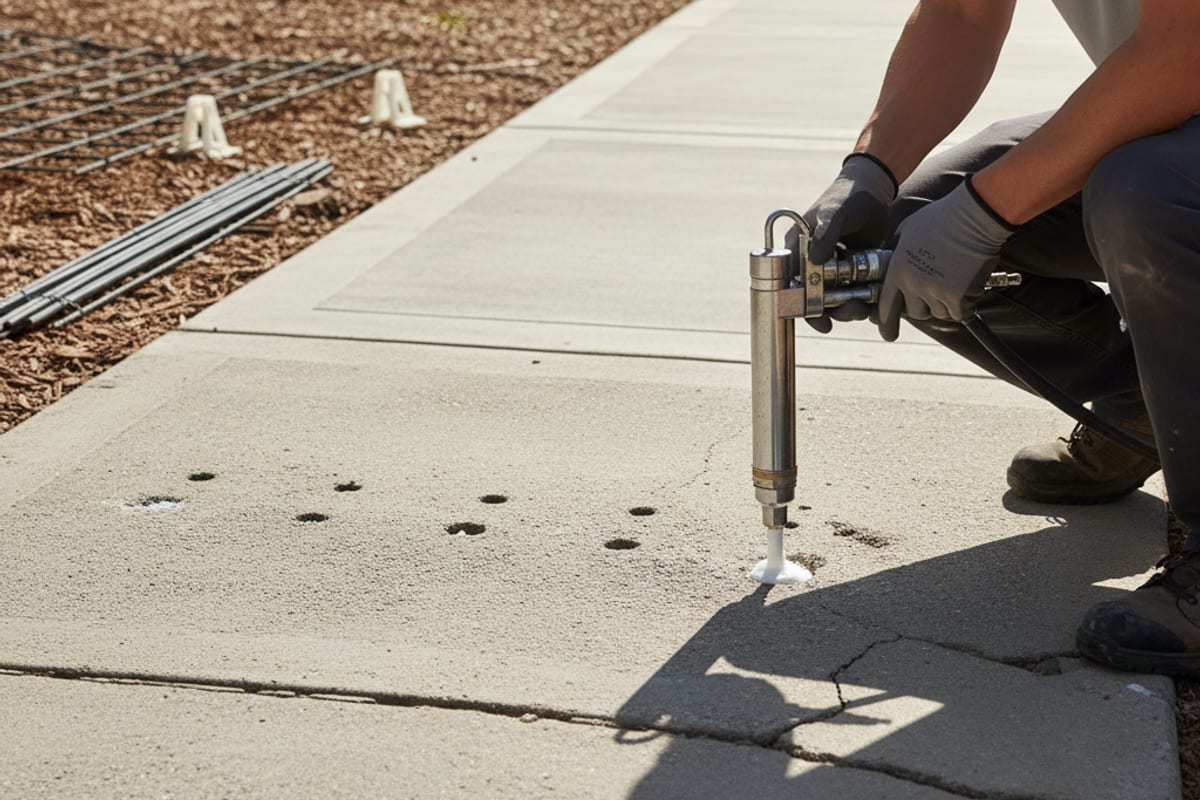
Concrete leveling in San Diego runs about $0.50 to $4 per square foot for mudjacking and $5 to $25 per square foot for polyurethane foam. A sunken walkway or AC pad usually lands between $500 and $1,500. A settled driveway runs $1,500 to $4,000. That is roughly a quarter to a third of replacement cost, and it is done in a day. Here is what changes the price in San Diego, and how to know which method fits your slab.
What concrete leveling actually does
Leveling lifts a slab that has sunk back up to grade. It does not pour new concrete. Small holes get drilled through the slab, material gets pumped underneath, and the pressure raises the concrete back into place. The holes get patched and you walk on it within hours.
It works when the slab itself is sound and the problem is underneath it. The soil settled, water washed out the base, or the ground shifted. If your concrete is cracked into pieces or crumbling, leveling will not save it. For that call, read our guide on when to repair and when to replace concrete.
Mudjacking vs foam in San Diego
Two methods dominate, and the right one depends on your soil and what is sitting on the slab.
Mudjacking pumps a slurry of cement, sand, and water under the slab. It has been around for decades. The slurry is heavy, the injection holes are larger (about an inch and a half), and it cures over a day or two. It costs less up front.
Polyurethane foam injects a two-part foam that expands and hardens in minutes. The holes are smaller (about the size of a dime), it is far lighter, and you drive on it the same day. It costs more per square foot but lasts longer in shifting ground.
Here is the trade-off that matters in San Diego specifically:
| Factor | Mudjacking | Polyurethane foam |
|---|---|---|
| Cost per sq ft | $0.50 to $4 | $5 to $25 |
| Weight added under slab | Heavy (adds load) | Light (almost none) |
| Hole size | ~1.5 inch | ~0.6 inch (dime) |
| Cure / use time | 1 to 2 days | Same day |
| Lifespan on stable soil | 5 to 10 years | 10 to 30 years |
| Best for clay soil | Risky | Better |
The weight difference is the San Diego point. Mudjacking adds hundreds of pounds of wet slurry on top of soil that already could not hold the slab. Over expansive clay that swells and shrinks, that extra load can drive the slab right back down. Foam adds almost no weight, so it does not re-load failing soil. On clay, foam is usually the smarter spend even though it costs more.
Why San Diego soil makes leveling tricky
Most of inland San Diego County sits on expansive clay. La Mesa, El Cajon, Santee, Scripps Ranch, parts of Chula Vista, and much of the back-country soil swells when it gets wet and shrinks when it dries out. That cycle is the number one reason slabs settle here.
In a wet winter the clay expands and can heave a slab up. Through a dry summer it shrinks and pulls support out from under the same slab. The concrete cracks and tilts trying to follow ground that will not hold still. This is why we wrote a full breakdown of why driveways settle in San Diego. Leveling fixes the slab. It does not fix the clay.
That distinction drives the honest part of any leveling quote. If we lift your slab but leave a downspout dumping water against it, the clay under that corner will swell again and the slab will drop again. A leveling job that ignores the water is a job you pay for twice.
Drainage is half the fix
San Diego runs dry most of the year, then gets hammered in a few winter storms. Slabs that look fine for years move during those storm weeks because that is the only time the clay gets enough water to swell hard.
Before we level anything we look at where water goes. Downspouts emptying next to the slab, irrigation overspray, a patio sloped back toward the house, a driveway with no edge drainage. Fix those and the lift holds. Skip them and you are renting a flat slab for a season.
Coastal slabs have a second problem
Within a half-mile of the coast, in Coronado, Imperial Beach, Ocean Beach, and the Point Loma stretch, salt air is a factor on top of soil. Salt works into the concrete through cracks, reaches the rebar, and rust expands and spalls the slab from below. If a coastal slab is both settled and spalling, leveling alone is a half-measure. We tell you that on the walk-through instead of after.
What you will actually pay
Real numbers for common San Diego jobs. These assume a sound slab with normal access.
| Project | Foam estimate | Mudjacking estimate |
|---|---|---|
| Sunken walkway section | $500 to $1,200 | $400 to $900 |
| AC condenser pad | $300 to $700 | $250 to $600 |
| Garage floor (one corner) | $800 to $2,000 | $600 to $1,500 |
| Patio (200 sq ft) | $1,000 to $3,500 | $700 to $2,500 |
| Driveway (600 sq ft) | $2,000 to $6,000 | $1,500 to $4,500 |
Replacement on that same driveway runs $5,000 to $15,000 and takes a week with cure time. That is the math that makes leveling worth a look first. See our concrete driveway cost guide for full replacement pricing.
What pushes a leveling quote up: very deep settling (more material to pump), poor access for the rig, clay so unstable it needs soil stabilization first, and drainage corrections bundled into the job. We quote those as line items so you see what each piece costs.
Do you need a permit to level concrete in San Diego?
Usually no. Lifting an existing slab back to its original grade is repair, not new construction, and the City and County treat it that way. You are not adding structure or changing the footprint.
A permit can come into play when leveling is tied to other work. Replacing the slab instead of lifting it, doing drainage or grading changes near a slope, or working inside a coastal or floodplain overlay can all trigger review. Foundation-related lifting near a structure is another case worth checking. If you are in an HOA, expect to notify them before any visible work even when the City does not require a permit. We flag the permit question on the estimate so it is not a surprise later.
When leveling is the wrong call
We turn down leveling jobs that should not be leveled. It is cheaper for you to hear it now.
- The slab is broken into pieces. Leveling lifts a slab as one piece. If it is already in three sections, lifting just spreads the gaps.
- Rebar has failed from coastal salt. A spalling, rust-stained slab is structurally gone. Lifting it buys months, not years.
- The settling is over a foot. Deep voids that large usually mean a base failure or erosion problem that needs to be dug out and rebuilt.
- The cause is active and unfixable on a budget. A slab over a leaking line or an eroding slope will keep moving no matter how well we level it.
In those cases we point you to repair or replacement and explain why. An honest no saves you the cost of a fix that fails by next winter.
Frequently asked questions
How long does concrete leveling last in San Diego? Foam holds 10 to 30 years and mudjacking 5 to 10, but only if the drainage that caused the settling gets fixed too. Over untreated expansive clay with bad drainage, any lift is on borrowed time.
Is foam or mudjacking better for clay soil? Foam, in most cases here. It adds almost no weight, so it does not re-load the clay that already failed under the slab. Mudjacking adds heavy slurry that can drive the slab back down over swelling and shrinking clay.
How much does it cost to level a sunken driveway? Most San Diego driveways run $1,500 to $4,500 for mudjacking and $2,000 to $6,000 for foam, against $5,000 to $15,000 to replace. Deep settling, poor access, and drainage corrections move the number up.
Can you level a slab the same day? With polyurethane foam, yes. It cures in minutes and you drive on it the same day. Mudjacking needs one to two days to cure before full load.
Will leveling stop my concrete from cracking again? Only if the underlying cause is addressed. Leveling lifts the slab. Fixing the drainage and soil that caused the settling is what keeps it level. We treat both as part of the job.
Do I need a permit to level my concrete? Usually not, since lifting an existing slab is repair. Permits can apply when leveling ties into drainage, grading near a slope, replacement, or coastal overlay work. We flag it on the estimate.
Get a real leveling quote
We give upfront quotes across San Diego County. We walk the slab, find what made it settle, and tell you whether leveling is the right fix or whether your money is better spent elsewhere. If we cannot fix the cause, we say so. See our concrete leveling service for coverage and details, or call (858) 925-5546 for a free onsite estimate.