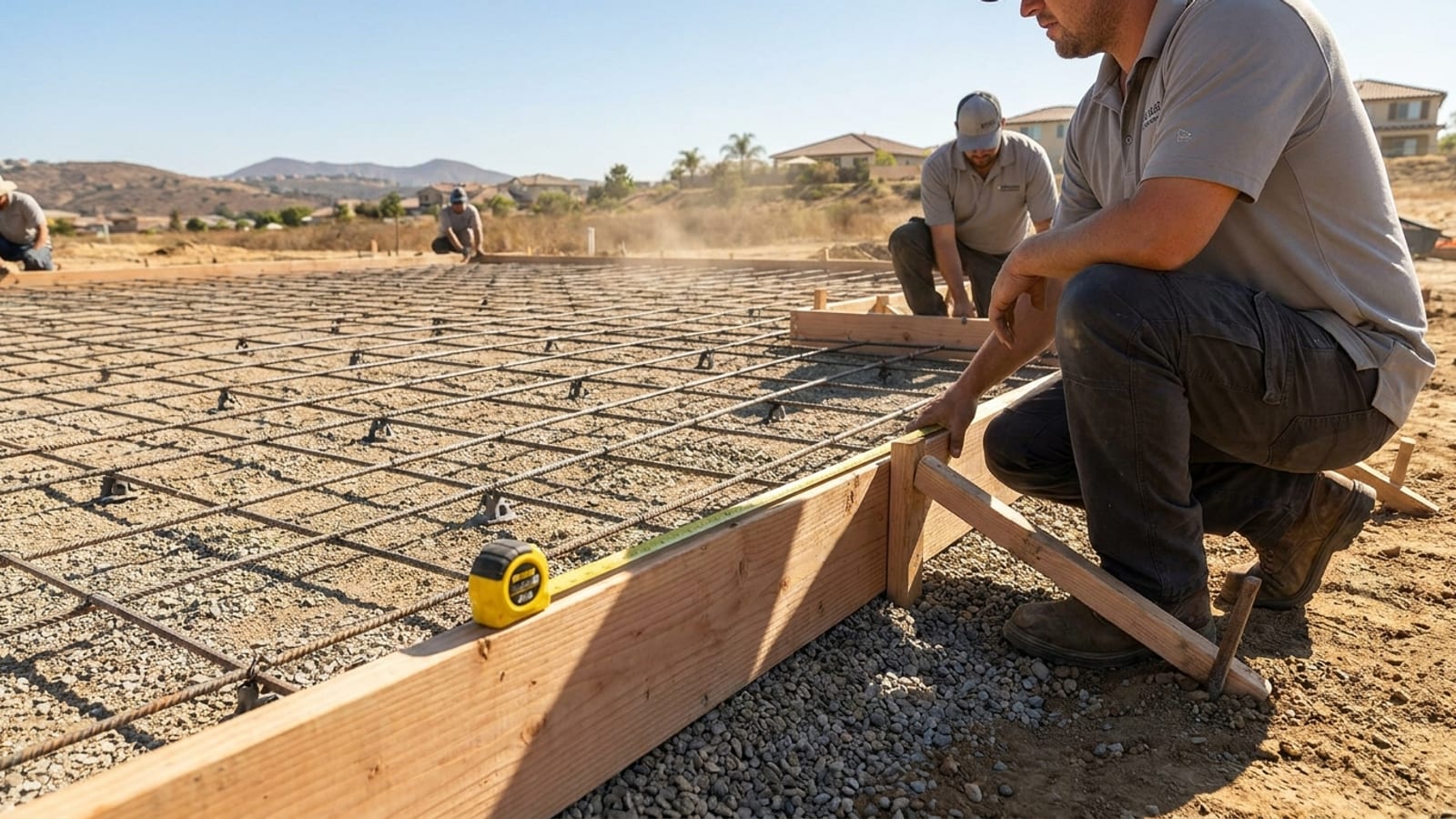
The most common call we get goes something like this: “I got three bids and they’re all different thicknesses. Who’s right?” It’s a fair question, and the answer depends on what you’re building, what’s going underneath it, and what’s going to drive or park on it. Knowing how thick should a concrete driveway be, or any slab for that matter, is the starting point for a pour that lasts.
Here’s what the numbers actually mean, organized by project type.
How thick should a concrete driveway be for a standard car?
Four inches is the residential standard for passenger vehicle driveways. That spec shows up in ACI guidelines and in the practice of every legitimate contractor in San Diego County. Four inches of 3,000 to 3,500 PSI concrete on a compacted base handles sedans, SUVs, and pickup trucks without issue.
Where homeowners get into trouble is thinking 4 inches means 4 inches everywhere. If your driveway has soft spots in the base, areas where the soil wasn’t compacted, or sections that weren’t graded for drainage, the slab under those areas is effectively thinner than the spec because the support beneath it failed first. Thickness on paper only works when the base underneath it is solid.
For the full picture on reinforcement inside that 4-inch driveway, see our post on whether you need rebar in a driveway.
What about patios and walkways?
Patios run at 4 inches as well. It’s the same spec as a driveway because 4 inches of properly cured concrete handles foot traffic, patio furniture, and occasional vehicle access without flexing under load.
Walkways are where you have a bit more flexibility. A 3.5 to 4-inch walkway is standard. Some contractors pour residential sidewalks at 3 inches, and for a light-traffic path in a backyard, that’s technically fine. But we default to 4 inches across the board because the material cost difference between 3 and 4 inches is minimal, and the structural margin you gain is not.
The spec that matters more on a patio or walkway isn’t thickness alone. It’s the control joint pattern. A 4-inch patio without saw-cut joints within 24 hours will crack unpredictably. A 3.5-inch patio with properly spaced joints and good drainage grading can outlast its poorly jointed 5-inch neighbor.
How thick should concrete be for an RV or boat pad?
This is where people routinely underspec. A standard RV or boat trailer sits on jack stands and hitch points that concentrate thousands of pounds onto a small contact area. That point load stress is very different from the distributed load of a car rolling across a slab.
For RV and boat pads, 5 to 6 inches is the working minimum, and the pros we send typically pour at 6 inches for Class A motorhomes and heavier boat trailers. The PSI goes up too, from 3,000 on a standard driveway to 4,000 for an RV-rated pad.
Rebar density also increases. Where a standard driveway gets #4 bar on 18-inch centers, an RV pad gets #4 bar on 12 to 16-inch centers to handle the higher point loads.
If you’re planning an RV pad as part of a larger driveway project, we cover the full layout considerations in our RV slab and parking pad guide for San Diego.
What thickness does a garage slab or shop floor need?
A residential garage slab is typically 4 inches, the same as a driveway, and that handles standard passenger vehicles and normal storage loads. If you’re parking a work truck, running a vehicle lift, or operating heavy equipment in the space, move to 5 to 6 inches with a heavier rebar grid.
Shops with car lifts are a specific case worth flagging. The anchor bolts for a two-post lift transfer significant point loads into the slab at bolt locations. A 4-inch garage slab may not have enough material depth to anchor those bolts properly. The pros we send pour lift-ready garage slabs at 5 inches minimum, and we thicken the slab locally at anchor points when the design calls for it.
Thickness specs by project type
Here’s a quick reference for standard San Diego residential work:
| Project type | Thickness | Rebar | Concrete PSI |
|---|---|---|---|
| Walkway / path | 4 in | Optional, #3 on 18 in centers | 3,000 |
| Patio | 4 in | Optional, #3 on 18 in centers | 3,000 |
| Residential driveway (cars) | 4 in | #4 on 18 in centers | 3,000 to 3,500 |
| Driveway with trucks / heavy pickups | 5 in | #4 on 12 to 18 in centers | 3,500 |
| RV pad / boat trailer pad | 5 to 6 in | #4 on 12 to 16 in centers | 4,000 |
| Residential garage (standard) | 4 in | #4 on 18 in centers | 3,500 |
| Garage with lift or heavy equipment | 5 to 6 in | #4 on 12 in centers | 4,000 |
| Strip footing / stem wall | Per engineer | Per engineer | 3,000 to 3,500 |
These are starting specs, not guarantees. Soil conditions, drainage, and load specifics can push any of these up.
Why thicker is not always the answer
There’s a counterintuitive truth here that homeowners sometimes miss: going from 4 to 6 inches on a residential driveway that doesn’t need it doesn’t double its strength in any practical sense. A properly reinforced 4-inch slab on a compacted base outperforms a 6-inch slab poured over soft, uncompacted soil every time.
What actually determines slab performance is a combination of three things: thickness, base prep, and concrete quality. If any one of those fails, the other two can’t compensate.
A 4-inch slab on 4 to 6 inches of compacted Class II road base, poured at 3,500 PSI with #4 rebar on chairs at the correct depth, with properly spaced control joints saw-cut within 24 hours, will last 25 to 30 years under normal residential use. Add 2 inches of thickness without fixing the base, and you’ve added cost without adding durability.
How San Diego soil affects what you actually need
Inland San Diego sits on expansive clay soils. Escondido, Vista, El Cajon, Poway, Santee, and similar inland zip codes see significant seasonal soil movement as clay absorbs winter moisture and dries out through summer. That swell-and-shrink cycle is one of the primary causes of residential slab failure in the county.
On expansive clay, we increase base depth before we increase slab thickness. Getting 4 to 6 inches of compacted Class II base under the slab matters more than adding an inch to the slab itself. We sometimes also add a thicker edge beam around the perimeter to resist the upward push that clay movement creates at slab edges.
Coastal San Diego, Oceanside, Carlsbad, Encinitas, and the beach communities sit on sandy soils that drain well and don’t expand significantly. Base prep is still important, but the clay movement factor isn’t in play the same way.
This is why a bid from a contractor who hasn’t walked your site and checked your soil type is a bid built on assumptions.
What happens when the slab is too thin
A slab that’s too thin for its load fails in a predictable pattern. The surface holds, but the slab flexes under load at the point where it’s weakest, usually a control joint or a crack. Once flexing starts, the joint or crack works open. Water infiltrates. The base softens under the joint. Now you have an unsupported slab edge that chips, spalls, and continues to open every time weight crosses it.
Three-inch driveways fail this way within five to eight years in most conditions. The pros we send replace them regularly. The homeowner saved a few hundred dollars on material and paid for a full tear-out and replacement a decade earlier than they should have needed to.
What to look for in a bid
A spec-complete bid tells you exactly what you’re getting before you sign. The line items that matter most:
- Slab thickness in inches, called out specifically
- Rebar size and spacing (#4 on 18-inch centers, for example, not just “steel reinforced”)
- Concrete PSI (3,000, 3,500, or 4,000)
- Base prep depth and material (Class II road base, compacted per lift)
- Control joint pattern and method (saw-cut within 24 hours vs. hand-tooled vs. nothing)
If a bid says “4-inch reinforced concrete driveway” and nothing else, you don’t know the rebar spec, the PSI, or the base prep. Any of those gaps can be where a contractor cuts cost after you’ve signed.
For a full breakdown of what goes into a driveway bid, see our concrete driveway cost guide for San Diego.
Our standard residential driveway spec is a 4-inch concrete driveway on 4 to 6 inches of compacted Class II base, 3,500 PSI concrete, #4 rebar on 18-inch centers on chairs at 2 inches, control joints saw-cut within 24 hours, and a final sealer pass at 28 days. We put that on paper before we ask for a deposit.
Get the right spec for your project
If you’re not sure what your slab needs, that’s what the site visit is for. We walk the project, check the soil, look at drainage, ask about what’s parking on it, and quote you a spec that fits the actual conditions. Estimates are free across San Diego County.
Call (858) 925-5546 or use the contact form and we’ll schedule a time that works.