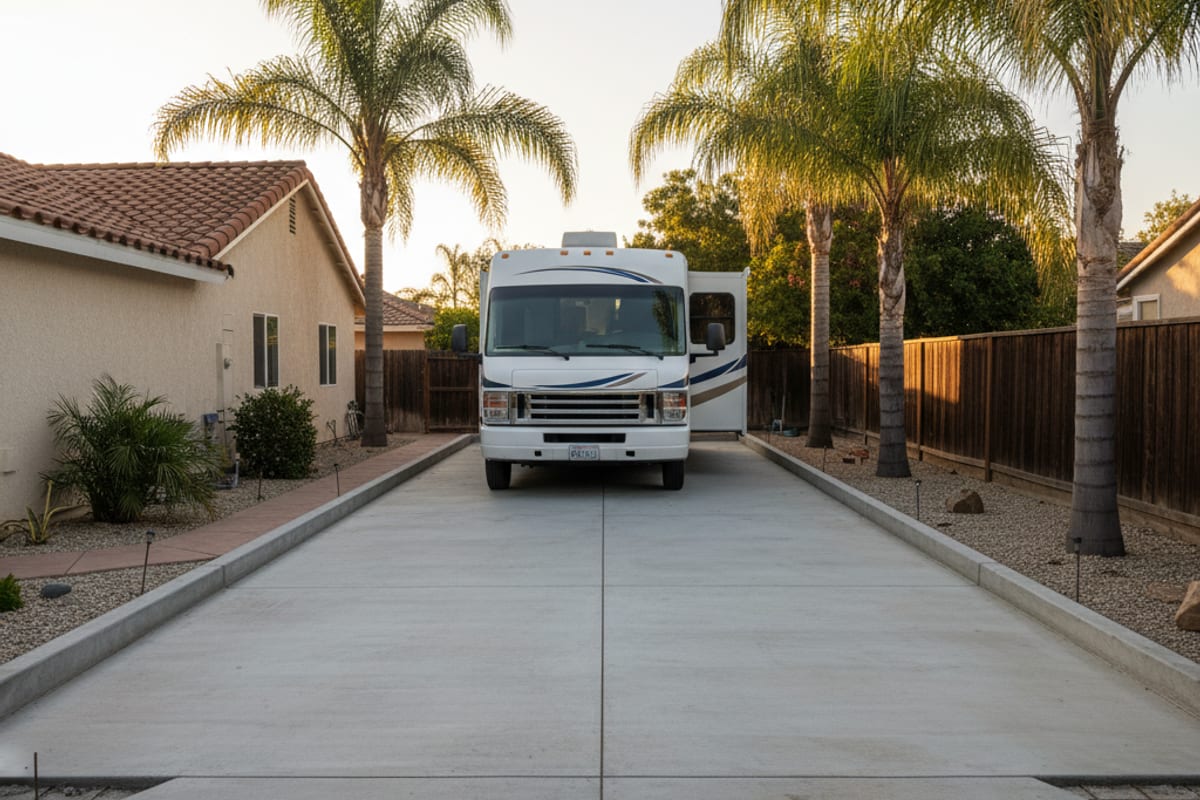
An RV concrete slab in San Diego County runs $8 to $14 per square foot, or about $4,000 to $8,500 for a typical 12-by-40 pad in 2026. The price climbs above national averages here for one reason: most of inland San Diego sits on expansive clay that swells and shrinks with the seasons. An RV pad built like a patio cracks under that movement plus the weight of a loaded coach. This guide covers thickness, rebar, drainage, and permits for our soil.
What does an RV concrete slab cost in San Diego?
National cost guides put a basic concrete pad at $6 to $12 per square foot. Those numbers assume a 4-inch slab on stable soil. An RV pad is neither. It needs more thickness, heavier steel, and deeper base prep, so the real San Diego range sits higher.
Here is how it breaks down by pad size and build:
| Pad size | Use | Thickness | Typical 2026 cost |
|---|---|---|---|
| 10 x 30 (300 sq ft) | Travel trailer | 5 inch | $2,800 to $4,500 |
| 12 x 40 (480 sq ft) | Class A / fifth wheel | 6 inch | $4,500 to $8,000 |
| 14 x 45 (630 sq ft) | Big rig + slide-out room | 6 inch | $6,000 to $10,500 |
| 12 x 60 (720 sq ft) | Coach + tow vehicle | 6 inch | $7,000 to $12,500 |
These are flat-rate, finished numbers: base prep, rebar, concrete, forming, finishing, and saw-cut control joints. They do not include demolition of an existing slab (add $1.50 to $4 per square foot) or a permit if one is required.
For comparison, a standard residential driveway pour runs less per foot because it carries lighter loads. If you are pricing a full driveway too, see our concrete driveway cost guide for San Diego.
How thick should an RV pad be?
Thickness is the single biggest factor in whether your pad survives. A 4-inch slab is fine for a sedan. It is not fine for a 20,000-pound motorhome parked on hydraulic jacks.
- 5 inches is the minimum for a travel trailer or smaller Class C.
- 6 inches is what the pros we send pour for any Class A, fifth wheel, or big rig. The point loads at the jack contact zones are brutal on thin concrete.
- 6 inches with a thickened edge is the safe call when the soil is heavy clay and the coach gets parked loaded for months at a time.
The jump from 4 to 6 inches adds roughly $2 to $4 per square foot. On a 480-square-foot pad, that is $960 to $1,920. It is the cheapest insurance you will buy on this project. A cracked pad costs five times that to tear out and replace.
Why San Diego clay soil changes the build
Most cost calculators ignore soil entirely. In San Diego County that is a mistake. Large parts of the inland valleys sit on expansive clay, the kind that swells when it gets wet and shrinks when it dries.
Escondido, Poway, El Cajon, Santee, Ramona, and much of Vista all have expansive soil zones. When that clay moves, a rigid slab without enough steel and base cracks right down the middle. RV pads are especially exposed because the coach concentrates weight on a few small contact points.
Here is how we build for it:
- Over-excavate and recompact. We dig past the loose topsoil, then build the base back up in compacted lifts of Class II road base. Deeper base on clay than on coastal sand.
- Heavier rebar grid. A #4 rebar grid on 12-inch centers in the parking zone, not the 18-inch spacing you can get away with on a walkway.
- Thickened edges. A deepened perimeter beam stiffens the slab so seasonal heave bends it less.
- Control joints, saw-cut within 24 hours. Joints tell the slab where to crack. On clay, they earn their keep.
Coastal lots in Coronado, Carlsbad, and Encinitas often sit on sandier soil that packs tighter and moves less. The base prep is lighter there, but the salt air adds a different problem, which is corrosion. We keep at least 2 inches of cover over the rebar near the coast so chloride does not reach the steel.
Drainage matters as much as the slab
San Diego gets most of its rain in a few winter storms, then stays dry for months. That swing is exactly what cracks clay-supported concrete. Water pools, the clay swells, then it dries out and shrinks. A pad that does not shed water sits on soil that is always moving.
Every RV pad the pros we send pour gets a slope of at least 1 to 2 percent away from the home and toward a drainage point. For a 40-foot pad that is a 5 to 10 inch fall end to end, enough to move water without making the coach feel tilted. On low or flat lots we add a perimeter swale or a channel drain so storm runoff has somewhere to go instead of soaking the subgrade.
If your existing concrete is sinking or pooling water, that is usually a base and drainage failure, not a concrete failure. We cover the why in why your driveway is settling.
Do you need a permit for an RV pad in San Diego?
Often, yes. The rules vary by jurisdiction, so confirm before you pour:
- A flat-on-grade slab in your existing yard usually does not need a building permit, but many cities cap how much of a lot can be paved. Adding impervious surface can trigger a stormwater or grading review.
- A new driveway approach into the public right-of-way needs an encroachment permit from the city or county.
- Setbacks matter. Most jurisdictions require RV and vehicle parking to sit a set distance from property lines. An HOA may have tighter rules than the city.
- Covered or enclosed pads that add a roof or carport cross into building-permit territory and Title 24 energy review.
The pros we send pull permits when the job needs them and build that cost into the bid. We do not pour first and ask questions later. For the broader picture on when concrete work needs a permit here, see retaining wall permit requirements in San Diego.
What a real RV pad bid includes
A real bid lists every step so you can compare apples to apples:
- Demolition and haul-off of any existing slab
- Excavation and compacted Class II base, depth specified
- Slab thickness and PSI of the concrete mix
- Rebar size and grid spacing
- Thickened edge or perimeter beam where the soil calls for it
- Forming, pour, and finish type
- Slope and drainage plan
- Saw-cut control joint layout
- Permit handling if required
- One flat-rate price with deposit and final payment terms
A bid that just says “12x40 concrete pad, $4,000” is hiding something. The most common cuts are base prep and rebar, and both fail under an RV inside a few years. If you want the full rundown on reinforcement, read do I need rebar in my driveway.
You can also see the scope of our RV slab work on the service page.
RV concrete slab FAQ
How thick does a concrete slab need to be for an RV? Five inches is the minimum for a travel trailer. The pros we send pour 6 inches for any Class A, fifth wheel, or big rig because of the concentrated jack and tire loads.
Can I just park my RV on my existing driveway? You can, but a standard 4-inch driveway was not built for it. Loaded jack stands and long-term parking crack thin slabs, usually at the contact points within a year or two.
How long before I can park the RV on a new pad? Concrete reaches most of its strength by 7 days, but we recommend waiting the full 28-day cure before loading it with a heavy coach. More on that in concrete cure time explained.
Does an RV pad need rebar or is wire mesh enough? Rebar. Wire mesh is acceptable on light walkways, not under RV loads on expansive clay. We run a #4 grid on 12-inch centers in the parking zone.
Why is an RV slab more expensive in San Diego than the national average? Expansive clay soil. Inland pads need deeper base, heavier steel, and thickened edges to handle seasonal soil movement, which adds a few dollars per square foot over national pricing.
Do I need a permit to pour an RV pad? Sometimes. A flat slab in your yard often does not, but lot coverage limits, new driveway approaches, and setbacks can require one. We check and pull what is needed before the pros we send pour.
Get a real number for your RV pad
Onsite estimates across San Diego County are free. We walk the site, check the soil and drainage, measure for your coach, and quote a flat-rate price within 48 hours. No day-of surprises. Call (858) 925-5546 or use the contact form to set up a free estimate.