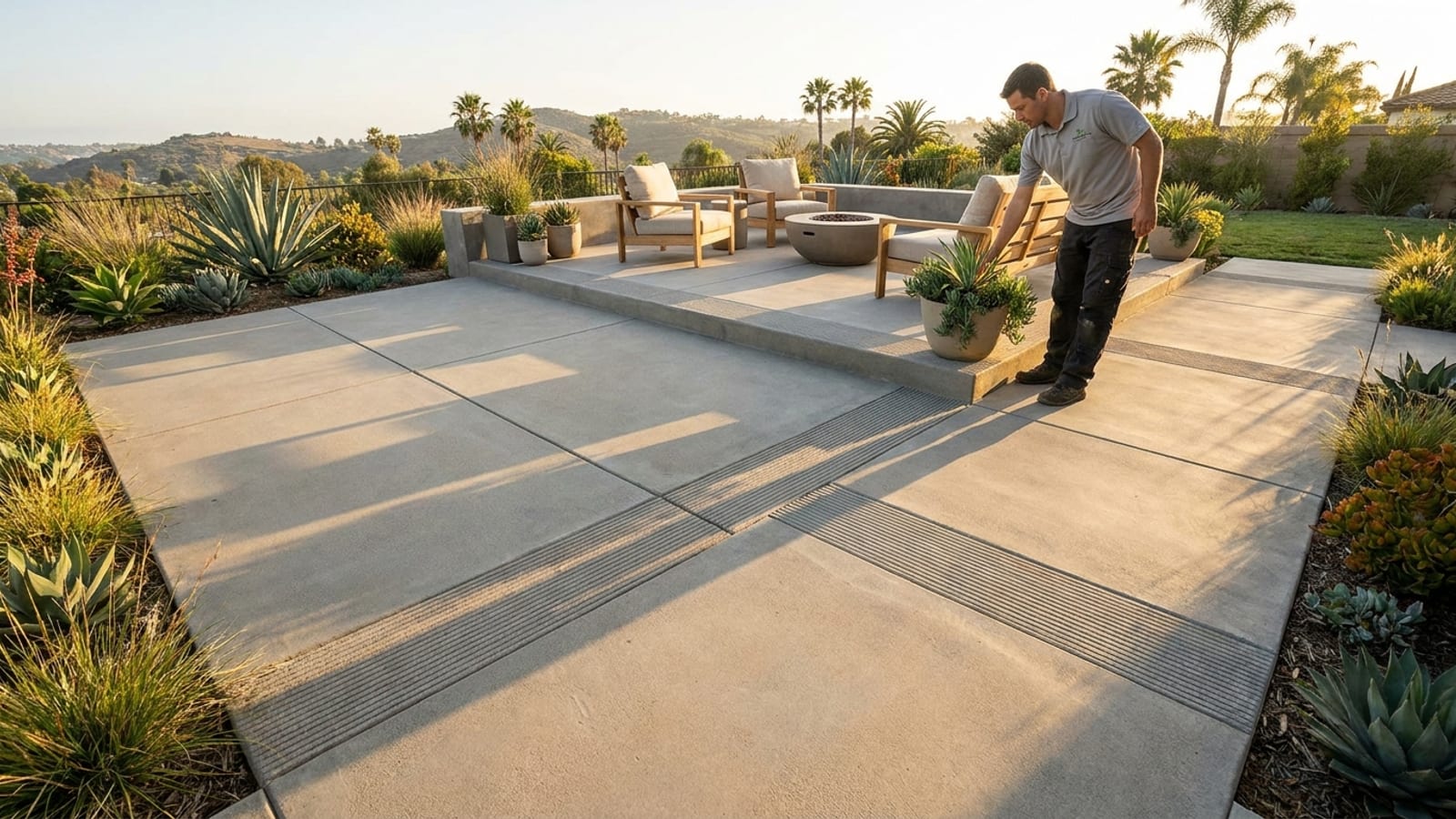
San Diego backyards spend more time in use than almost anywhere else in the country. Year-round sun, mild nights, and indoor-outdoor living that actually works means your patio does real work, weekend barbecues in February, kids playing through November, dinner outside six months straight. The finish and layout you choose will either hold up to that or start showing wear in two or three years. These 11 concrete patio ideas san diego homeowners have been asking us about cover everything from the simplest low-cost finish to multi-level outdoor rooms with fire pits and seat walls. The pros we send pour all of them, and we’ll tell you straight which ones hold up best in this climate.
Quick reference: concrete patio ideas at a glance
| Idea | Vibe | Rough cost adder vs. plain broom |
|---|---|---|
| Broom finish | Practical, clean, classic | Baseline |
| Stamped slate or wood-plank | High-end look, natural material feel | +$6 to $12/sq ft |
| Exposed aggregate | Textured, natural, low-maintenance | +$2 to $5/sq ft |
| Integral color | Warm depth, fades gradually | +$1 to $3/sq ft |
| Acid stain | Mottled, variegated, one-of-a-kind | +$2 to $4/sq ft |
| Sawcut grid or banding | Modern geometry, no extra pour | +$0.50 to $1.50/sq ft |
| Decorative border | Frames the slab, color contrast | +$3 to $6/sq ft (border zone) |
| Multi-level patio | Defined zones, dramatic look | +$8 to $15/sq ft overall |
| Fire pit or seat wall integration | Gathering focal point | $2,500 to $6,000 added |
| Pool deck tie-in | Cohesive outdoor room | Varies by pool shape |
| Smooth trowel with turf joints | Contemporary, low-profile | +$1 to $2/sq ft |
For a broader look at what you’ll spend total, see our concrete patio cost guide.
1. Broom finish: the workhorse that still looks sharp
Broom finish is the most common concrete patio finish in San Diego for a reason. After the concrete is floated smooth, a stiff-bristled broom pulls parallel grooves across the surface. You get texture that grips without being rough, and it holds up to bare feet, sandals, patio chairs, and wet swimsuits for decades.
On its own, broom finish reads utilitarian. Pair it with a warm integral color and sawcut control joints that form a deliberate grid, and the same basic finish looks intentional and clean. This is the starting point most of our customers choose when they want a long-lasting patio without a high design budget.
Cost: $8 to $14 per square foot installed, depending on size and access.
San Diego note: the fine texture channels light rain runoff without being slick. It also stays cooler than a smooth-troweled surface in full afternoon sun.
2. Stamped concrete: slate, stone, and wood-plank patterns
Stamped concrete is where concrete patio ideas san diego homeowners get the most visual impact for the money. A rubber stamp pattern is pressed into the fresh concrete before it sets, creating texture and depth that reads like natural stone or wood. The most popular patterns the pros we send pour in San Diego:
- Ashlar slate, large irregular stone blocks with tight joints. Works with Spanish, Mediterranean, and contemporary homes.
- Running bond stone, rectangular units in a brick-like pattern. More formal, good for Craftsman and traditional architecture.
- Random flagstone, irregular shapes with varied sizes, closest to real flagstone. Great for curving patios and poolside areas.
- Wood plank, long parallel boards with realistic grain texture. Gaining traction in coastal and modern farmhouse builds.
Stamps get combined with integral color (mixed into the pour) and a release agent (dusted on the surface before stamping) to create two-tone depth. The result looks genuinely like stone or wood from 20 feet away.
Cost: $14 to $26 per square foot depending on pattern complexity and color count. More detail on patterns at stamped concrete patterns in San Diego.
San Diego note: stamped concrete needs to be sealed every two to three years. UV exposure in Southern California fades unsealed color faster than in cloudy climates. We recommend a penetrating sealer plus a UV-resistant topcoat on every stamped job.
3. Exposed aggregate: texture and character without the maintenance
Exposed aggregate finishes involve washing or brushing the surface layer of cement paste off the fresh slab, leaving the rounded stones (aggregate) visible and partially proud of the surface. The result is a naturally textured finish with real grip and a lot of visual warmth.
The look changes based on the aggregate mix. Standard San Diego ready-mix includes granite and quartz pea gravel in tans, grays, and rusts. Upgraded mixes add river rock, colored quartz, or crushed recycled glass for more pop.
Exposed aggregate is one of the more forgiving finishes when it comes to showing wear and dirt. The texture hides minor scuffs, and the varied color of the stones means small stains don’t stand out.
Cost: $12 to $20 per square foot installed.
San Diego note: exposed aggregate is a strong choice for poolside and walkway areas. The texture provides slip resistance without being uncomfortable underfoot, and the stone colors tend to complement drought-tolerant landscaping naturally.
4. Integral color: warm depth from the pour itself
Integral color is mixed directly into the concrete before it’s poured. The pigment runs through the full depth of the slab, so chips and scratches don’t reveal a gray core the way surface-applied stains do.
Popular tones for San Diego concrete patios include warm terracottas, sandy tans, soft sages, and neutral greiges. These read better in the strong Southern California light than pure grays, which can look cold and flat on overcast days and washed-out in full sun.
Integral color alone runs $1 to $3 per square foot added to the base price. When combined with a broom finish and sawcut joints, it transforms a plain slab into something that reads as a designed finish. For more on the color options and how they hold up, see our guide to colored concrete finishes in San Diego.
San Diego note: colors do lighten over time as concrete cures and weathers. We always apply a UV-stable acrylic or penetrating sealer at the end of the job to slow that process. Plan on resealing every two to three years.
5. Acid stain: mottled, variegated, and one-of-a-kind
Acid staining is a chemical reaction, not a coating. A diluted acid solution reacts with the minerals in the concrete surface, producing mottled, marbled tones that vary across the slab. No two acid-stained patios look exactly alike.
Colors stay in the brown, tan, amber, and rust family because the reaction depends on the concrete’s mineral content. You can’t get a true blue or green from acid stain. Water-based concrete stains (sometimes called dye stains) offer a broader color palette without the chemical reaction, but the look is more uniform and less dramatic.
Acid stain works best on smooth-troweled slabs without broom texture, which would create uneven color absorption. It reads high-end in contemporary and Spanish architectural settings.
Cost: $10 to $18 per square foot, including prep, staining, and sealing.
San Diego note: acid-stained surfaces need a quality sealer and consistent maintenance. The coastal salt air in neighborhoods like Ocean Beach, La Jolla, and Coronado can accelerate wear on unsealed surfaces.
6. Sawcut grid and banding: free geometry from the saw
Control joints are saw-cut into concrete within 24 hours of the pour to control where cracks form. Standard control joints are cut in a simple grid. But the same cuts can be used decoratively to create intentional geometry: wide-band grids, asymmetric layouts, diagonal lines, or a centered medallion frame.
Sawcut banding adds visual structure to a plain broom-finish or colored slab without any additional pour or material cost. It turns practical cracking-control cuts into a design feature.
For a modern look, many of our San Diego customers are asking for a three-band border cut inside the perimeter of the slab, then a grid at 4-by-4 or 6-by-6 foot spacing in the field. Simple, clean, and architectural.
Cost: minimal add-on, roughly $0.50 to $1.50 per square foot, depending on cut complexity and number of passes.
7. Decorative borders and bands: two-color contrast
A contrasting border poured or sawcut at the perimeter of the patio is one of the most effective ways to make a concrete patio look custom. The border is typically a different color (sometimes a different finish) than the field. A stamped limestone field with a broom-finish charcoal border is a common example. So is a smooth troweled warm-tan field with an exposed aggregate border.
Borders require either a two-stage pour (field first, border second, or the reverse) or a deep sawcut with a color-filled joint. Both work. The two-stage pour gives you a real material separation and the cleanest result.
Cost: the border zone runs $3 to $6 per square foot more than the field finish, depending on complexity.
8. Multi-level patios: define zones, add drama
When a yard has grade change, or when you want to create distinct zones (dining area, lounge area, BBQ station), a multi-level concrete patio is the answer. Stepped concrete slabs at different elevations connected by formed concrete steps or low retaining walls create an outdoor room with real hierarchy.
This is one of the more involved concrete patio ideas in San Diego because it requires careful formwork, grade planning, and sometimes permit review if the height change exceeds 30 inches. But the result reads like landscape architecture, not just a poured slab.
Cost: multi-level work typically runs $20 to $35 per square foot overall when you factor in the forming, step-building, and finish work. Highly variable depending on the grade change and complexity.
San Diego note: clay soils in inland areas like El Cajon, Santee, and La Mesa shift seasonally. Multi-level patios in those areas need thicker slabs, deeper footings for any walls, and careful drainage planning to prevent uplift or settling.
9. Fire pit and seat wall integration
A concrete patio with a poured-in-place fire pit and seat wall is one of the most requested upgrades we build. The fire pit can be round or square, gas-fed or wood-burning. The seat wall is typically 18 inches tall and 12 to 14 inches wide, capped with the same concrete finish or a natural stone veneer.
The key is designing the patio and the seat wall as one poured system, not adding the seat wall as an afterthought. When they’re poured together, you get clean transitions, matching joints, and structural integration that a stacked-block wall can’t replicate.
Cost: a fire pit and two-sided seat wall integrated into a new patio typically adds $2,500 to $6,000 to the project, depending on size, gas versus wood, and cap material.
San Diego note: gas fire pits require a gas line stub from the house. If you don’t have a line, a licensed plumber runs it before the pros we send pour. Budget $800 to $2,000 for the gas line depending on distance from the meter.
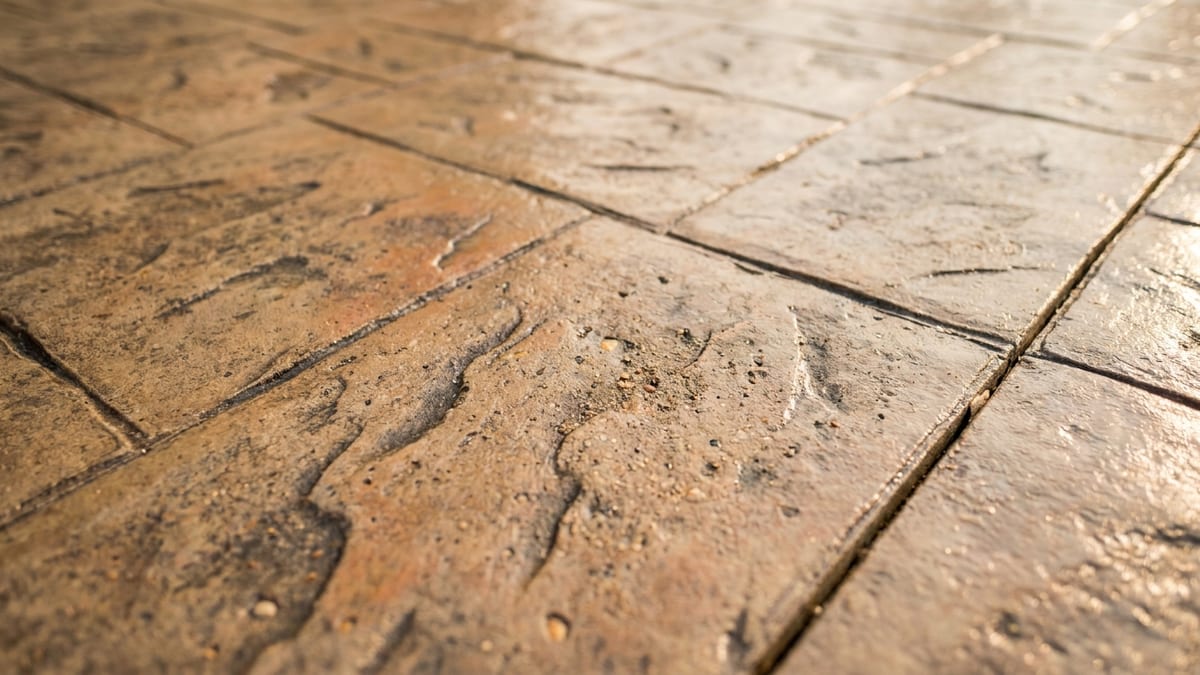 Stamped slate with integral color reads high-end without the price of natural stone.
10. Pool deck tie-in: one cohesive outdoor room
If you have a pool, or are building one, the patio and pool deck should feel like one outdoor room, not two separate projects. Matching concrete finishes across the deck and the patio creates continuity. The most common approach: broom finish or exposed aggregate on both surfaces in the same color family, with the joints running in the same direction.
One practical detail: pool decks need a slight slope (1/8 inch per foot minimum) to drain water away from the pool edge and house. The patio adjacent to the deck also needs to slope to a drain point, not toward the pool or the structure. The pros we send set grades before the pour and verify with a level, grade problems that show up after the concrete sets are expensive to fix.
Curved pool edges call for curved or freeform slab edges on the adjacent patio. Forming and finishing curved concrete takes more labor than straight forms, which is reflected in the per-square-foot cost.
Cost: pool deck pours run $12 to $20 per square foot for broom or exposed aggregate finish. Matching an existing patio’s color and finish adds a color-matching step and sometimes a sample pour.
11. Smooth trowel with turf joints: clean and contemporary
A steel-troweled surface is the smoothest finish concrete can achieve. It’s flat, dense, and nearly non-porous compared to broom finish. Paired with synthetic turf strips set into the joints of a large patio (poured in sections separated by turf-filled gaps), you get a look that’s contemporary, low-maintenance, and surprisingly popular in San Diego’s coastal and hillside neighborhoods.
The turf strips read like grass joints in a large-format paver pattern. The concrete sections are typically 3 feet by 3 feet or 4 feet by 4 feet. Each section is poured and troweled independently, then the gaps are filled with adhered artificial turf after the concrete cures.
This finish works best in shaded patios. Smooth-troweled concrete in full afternoon sun gets hot underfoot in summer and can be slick when wet. If your patio is mostly south- or west-facing, broom texture or exposed aggregate is a better fit.
Cost: $14 to $22 per square foot depending on the turf specification and the pour-section complexity.
Choosing the right finish for your San Diego yard
The best concrete patio for your yard depends on three things: how much sun it gets, how you plan to use it, and what the house looks like from the patio side. A stamped patio that reads beautifully in a shaded Encinitas canyon can look bleached out on a south-facing Chula Vista yard by midsummer. A smooth-troweled slab that photographs well gets slippery and hot on a west-facing exposure with afternoon glare.
For concrete patios in San Diego County, the pros we send pour all eleven of the finishes listed here. Free onsite estimates, flat-rate bids, and zero surprise add-ons. Call us at (858) 925-5546 or use the contact form to schedule a visit. We’ll walk the yard, talk through your goals, and put a real number on it within 48 hours.